
COMPARISON
BCAA vs. EAA: Comparing Muscle Protein Synthesis, Recovery, and Practical Use
Three amino acids versus all nine: what composition tells us, what human studies measure, and when a supplement may add little.
By Planet Wellness Report · Oct 6, 2026 · 7 min read
Editorial review and publication: Felipe Lopes, Publisher & Editor. This is an editorial review, not a medical review.

Side by side
Quick comparison
INGREDIENT
- Branched-Chain Amino Acids (BCAAs)
Branched-chain amino acids (BCAAs) are three essential amino acids — leucine, isoleucine, and valine — commonly discussed in relation to muscle protein metabolism, exercise, and recovery.
- Essential Amino Acids (EAAs)
Essential amino acids (EAAs) are amino acids the body cannot produce in sufficient amounts and must obtain from the diet, including the three branched-chain amino acids.
BCAA vs. EAA is often framed as a contest between two muscle-building supplements. The starting point is simpler: branched-chain amino acids (BCAAs) are three members of the essential amino acid (EAA) family. A full EAA formula supplies all nine. That difference matters for the building materials available to muscle, but it does not settle every question about soreness, performance, or whether you need either supplement.
BCAA vs. EAA: the quick answer
If your purpose is to supply all essential amino acids in one isolated supplement, a verified all-nine-EAA formula fits that purpose; a BCAA-only formula does not. BCAA supplements have some evidence for reducing post-exercise soreness, but that is different from proving greater muscle growth or better performance. Neither category is automatically useful when your diet already supplies enough appropriate protein.
The evidence discussed here does not provide a dependable head-to-head ranking for every adult, dose, or training program. Compare the outcome you care about, the actual formula, and your existing nutrition before choosing a product.
What BCAA and EAA supplements actually contain
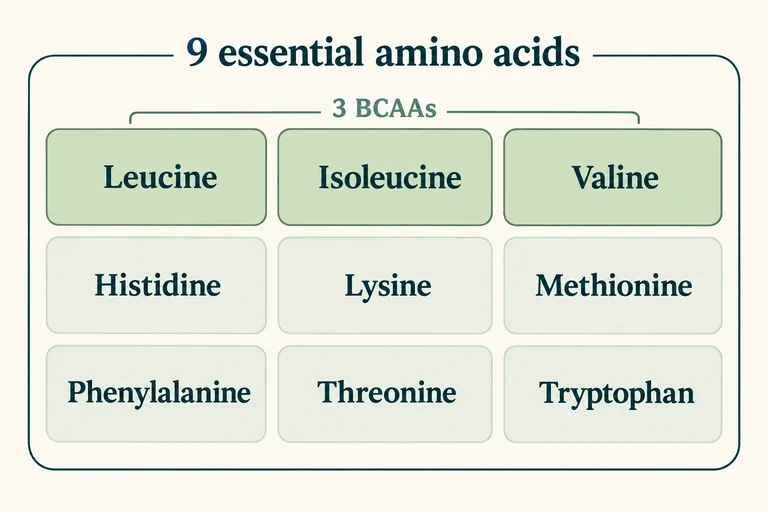
A BCAA-only mixture contains leucine, isoleucine, and valine. Leucine participates in signaling that helps regulate muscle protein synthesis, while all three contribute to body proteins. Increasing leucine's share of a formula does not add the six missing essential amino acids.
A full EAA mixture contains those three plus histidine, lysine, methionine, phenylalanine, threonine, and tryptophan. Essential means the body needs an adequate dietary supply. For the broader biology, see our guide to essential amino acids.
A complete essential-amino-acid profile is not the same thing as a complete meal, and the presence of all nine names does not establish adequate amounts or a tested formulation. Protein foods provide amino acids along with a wider nutritional context. Our comparison of protein and essential amino acids explains that separate choice.
Compare four different questions
Amino acid completeness
BCAA: three essential amino acids, with the other six absent from a BCAA-only supplement. EAA: all nine when the label confirms a full mixture. This is a compositional distinction, not a measured effect on strength. The body can draw on other amino acids already available from diet and protein turnover, but the BCAA drink itself does not supply them.
Muscle protein synthesis
BCAA: an acute response above placebo has been measured in a small experiment. EAA: supplies the complete essential-amino-acid substrate and has evidence for stimulating synthesis. Muscle protein synthesis (MPS) measures production of new muscle proteins over a study interval. It is not a direct measurement of months of muscle gain, and it does not account by itself for protein breakdown.
Recovery
BCAA: several pooled analyses suggest less delayed-onset muscle soreness under some exercise protocols. EAA: evidence for MPS should not be repurposed as proof of superior soreness relief. Recovery can mean how sore you feel, blood markers, restored force, or readiness for another session. These outcomes need separate evidence.
Practical use
BCAA: a narrower amino acid supplement, with uncertain added value over adequate protein. EAA: a way to consume all nine in a small-volume format, with usefulness depending on the nutritional gap it addresses. Neither replaces a balanced diet or training plan. Convenience, taste, and tolerance are practical considerations, not evidence of greater efficacy.
What human evidence says about muscle protein synthesis
In Jackman and colleagues' 2017 placebo-controlled crossover experiment, ten resistance-trained young men consumed 5.6 grams of BCAA or placebo after resistance exercise. Myofibrillar MPS was higher with BCAA over the four-hour measurement period. That makes an absolute claim that BCAAs can never stimulate synthesis inaccurate.
The experiment did not include an EAA or whey comparison group and did not measure long-term muscle gain. It therefore cannot tell us how that BCAA dose compares directly with a complete EAA formula, or establish a dosing recommendation. Wolfe's physiological review explains the constraint: sustained production of new proteins requires all essential amino acids to be available, not just a leucine signal.
The 2023 International Society of Sports Nutrition EAA position stand summarizes evidence for EAA-stimulated MPS in several settings. It is a professional synthesis of the literature, not a meta-analysis directly ranking BCAA and EAA products. The combination of complete substrate and acute research supports using a full EAA mixture when the goal is to deliver all nine, while leaving questions about additional long-term benefit dependent on diet, training, population, and formulation.
Faster absorption is also not a shortcut to a better outcome. A double-blind randomized trial comparing free amino acids with an equivalent amount of intact protein in young adults found more rapid absorption without a difference in MPS rates. That was not a BCAA-versus-EAA trial, but it helps explain why an absorption claim should not be read as proof of more muscle.
Does less soreness mean better recovery?
A 2024 systematic review and meta-analysis by Salem and colleagues included 18 studies with 331 participants. BCAA supplementation reduced delayed-onset soreness at several follow-up times and lowered creatine kinase, a blood marker, at some times. It did not significantly change lactate dehydrogenase, another marker. The literature search ended in September 2022, so the publication date should not be confused with the newest trial included.
Protocols differed in exercise, dose, duration, and training status, and most studies enrolled only men. Soreness ratings and blood markers do not establish faster restoration of strength or readiness for repeated training. These comparisons also do not demonstrate that BCAA is better than EAA for recovery.
A newer systematic review by Julea and Saleh searched through August 15, 2025 and included 22 randomized trials with 511 participants. It found some support for reduced soreness, while findings for strength, endurance, and body composition remained inconsistent. The authors did not perform a meta-analysis because several studies had unclear or high risk of bias. That reinforces an outcome-specific interpretation rather than a broad performance claim.
Long-term results and different populations
An acute muscle response is one piece of the picture. A large meta-analysis of protein supplementation alongside resistance training found modest additional improvements in muscle and strength outcomes on average. It tested dietary protein strategies, not a universal ranking of isolated BCAA versus EAA products. For many readers, checking total protein intake is more actionable than changing amino acid ratios; see how much protein adults need per day.
A January 2026 meta-analysis illustrates why population matters. Nine randomized trials involving 496 older adults with sarcopenia examined resistance training with various amino acid-based supplements. Some strength and function measures improved, but evidence certainty was low to very low, and muscle-mass measures did not show significant improvement. The analysis combined different interventions, including EAA, BCAA, leucine, and derivatives, sometimes with other nutrients. It neither establishes an EAA-versus-BCAA winner nor predicts results in healthy recreational lifters.
Who might prefer each option—or neither?
When a BCAA product is the narrower choice
Someone specifically interested in the limited soreness literature may consider BCAA after reviewing the study limitations and their existing protein intake. That is a narrower rationale than claiming muscle-building superiority. A BCAA-only formula is a poor match for the goal of supplying the full essential-amino-acid profile, and a favorable recovery headline does not establish that every commercial blend will reproduce the result.
When a full EAA mixture may be practical
Someone who wants all nine essential amino acids in a small-volume supplement may prefer a verified full EAA formula. This can be a practical format preference when eating a protein-containing meal is inconvenient; it does not prove that EAA is superior to food or adequate protein. Persistent difficulty eating enough deserves a broader nutritional assessment rather than reliance on a supplement alone.
When neither may add much
If you already consume sufficient varied protein and can eat around your training, neither isolated mixture has an automatic role. Protein foods already supply BCAAs and the other EAAs. Explore foods high in essential amino acids for dietary options, and our guide to protein timing and muscle recovery for the separate timing question.
Read the label before using the evidence
Check which amino acids are listed, their amounts per serving, and whether a proprietary blend obscures the quantities. A product called an amino formula may not contain all nine EAAs. BCAA ratios describe relative amounts of three ingredients; they do not prove that a higher leucine ratio improves outcomes. An EAA formula already includes BCAAs, so combining both categories can duplicate ingredients.
There is no single evidence-based dose or timing schedule established here for all readers. Study doses describe specific experiments, not interchangeable instructions for commercial products. Compare verified labels and total cost for the serving actually used rather than assuming a price-per-gram calculation compares equal interventions.
The NIH Office of Dietary Supplements emphasizes the limits of exercise-supplement evidence and the importance of product quality. Independent testing can help assess ingredient identity or contamination, but does not prove effectiveness. Consider the whole formula, including added stimulants or other active ingredients. If you have a medical condition, take medication, are pregnant or breastfeeding, or are considering use for a child, discuss the actual product with a qualified clinician; healthy-adult exercise studies do not establish suitability in those situations.
The practical takeaway on BCAA vs. EAA
A full EAA mixture supplies all nine essential amino acids; BCAA-only supplements supply three. That makes EAA a better match for the specific compositional goal of supplying all nine, without proving greater benefit for every outcome. BCAA has some soreness evidence, but neither an acute MPS response nor less soreness guarantees long-term muscle gain. Choose according to a real nutritional need, the measured outcome, and a verified formula—and recognize when adequate dietary protein makes either supplement unnecessary.
Was this article helpful?
Your anonymous response helps improve our editorial coverage.
Loading feedback options…
Share
Share this article
Selected references
Recommended products
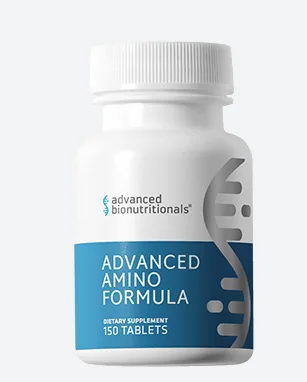 Advanced Amino Formula
A dietary supplement from Advanced Bionutritionals combining eight essential amino acids to support protein intake, muscle health, physical performance, and recovery.
View product details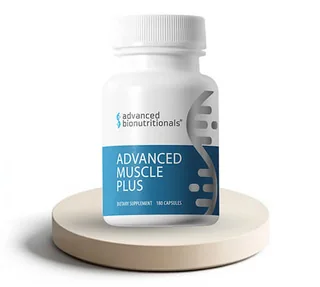 Advanced Muscle Plus
A formula containing DL185 dileucine, calcium HMB monohydrate (myHMB), vitamin D, and calcium, marketed for muscle health and recovery. Ingredient research and manufacturer claims are distinct from finished-product evidence.
View product details
More from Planet Wellness Report
Continue Reading
Nutrition
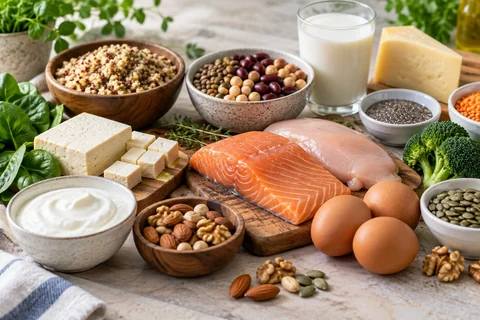
Essential Amino Acids: What They Are, Why They Matter, and Food Sources
Essential amino acids must come from the diet, but that does not mean everyone needs a supplement. Learn how EAAs relate to protein, BCAAs, food quality, muscle protein synthesis, and exercise recovery.
12 min read
Nutrition
Advanced Amino Formula Review: Ingredients, Evidence, and Value
Advanced Amino Formula reviewed: five-tablet serving, eight-amino-acid blend, undisclosed leucine dose, missing histidine, research context, and purchase value.
8 min read

Nutrition
Leucine and Muscle Protein Synthesis: What the Research Actually Shows
Leucine helps regulate muscle protein synthesis. Learn what human trials show about thresholds, protein context, exercise, age, and long-term outcomes.
6 min read
Evidence
Sources
- Robert R. Wolfe. Branched-Chain Amino Acids and Muscle Protein Synthesis in Humans: Myth or Reality? — Journal of the International Society of Sports Nutrition (Aug 22, 2017) · DOI
- Sarah R. Jackman; Oliver C. Witard; Andrew Philp; Gareth A. Wallis; Keith Baar; Kevin D. Tipton. Branched-Chain Amino Acid Ingestion Stimulates Muscle Myofibrillar Protein Synthesis following Resistance Exercise in Humans — Frontiers in Physiology (Jun 7, 2017) · DOI
- Arny A. Ferrando; Robert R. Wolfe; Katie R. Hirsch; David D. Church et al.. International Society of Sports Nutrition Position Stand: Effects of essential amino acid supplementation on exercise and performance — Journal of the International Society of Sports Nutrition (Oct 6, 2023) · DOI
- Atef Salem et al.. Attenuating Muscle Damage Biomarkers and Muscle Soreness After an Exercise-Induced Muscle Damage with Branched-Chain Amino Acid (BCAA) Supplementation: A Systematic Review and Meta-analysis with Meta-regression — Sports Medicine - Open (Apr 16, 2024) · DOI
- Maxim Julea; Sohag N. Saleh. The Effect of Oral Pure Branched-Chain Amino Acid Supplementation on Exercise Performance and Body Composition: A Systematic Review — Cureus (Nov 3, 2025) · DOI
- Chengfu Xie; Ruixiang Yan; Ran Tao. Combined resistance training and amino acid-based supplementation for sarcopenia in older adults: a systematic review and meta-analysis — BMC Musculoskeletal Disorders (Jan 15, 2026) · DOI
- Michelle E. G. Weijzen; Rob J. J. van Gassel; Imre W. K. Kouw; Jorn Trommelen; Stefan H. M. Gorissen; Janneau van Kranenburg; Joy P. B. Goessens; Marcel C. G. van de Poll; Lex B. Verdijk; Luc J. C. van Loon. Ingestion of Free Amino Acids Compared with an Equivalent Amount of Intact Protein Results in More Rapid Amino Acid Absorption and Greater Postprandial Plasma Amino Acid Availability Without Affecting Muscle Protein Synthesis Rates in Young Adults in a Double-Blind Randomized Trial — The Journal of Nutrition (Jan 11, 2022) · DOI
- Robert W. Morton; Kevin T. Murphy; Sean R. McKellar; Brad J. Schoenfeld; Menno Henselmans; Eric Helms; Alan A. Aragon; Michaela C. Devries; Laura Banfield; James W. Krieger; Stuart M. Phillips. A Systematic Review, Meta-analysis and Meta-regression of the Effect of Protein Supplementation on Resistance Training-Induced Gains in Muscle Mass and Strength in Healthy Adults — British Journal of Sports Medicine (Mar 1, 2018) · DOI
- Dietary Supplements for Exercise and Athletic Performance: Fact Sheet for Health Professionals — NIH Office of Dietary Supplements