
ARTICLE
Protein for Muscle Health and Recovery: How Much Does Timing Really Matter?
Why daily protein and resistance training come first—and how meal distribution, workout timing, and optional pre-sleep protein can fit into a practical recovery routine.
By Planet Wellness Report · Sep 21, 2026 · 12 min read
Editorial review and publication: Felipe Lopes, Publisher & Editor. This is an editorial review, not a medical review.

Protein Timing: The Short Answer
Protein timing can matter, but it is rarely the first thing to optimize. For most healthy adults who exercise, consistently eating enough protein across the day and following an appropriate resistance-training program matter more than consuming protein within a narrow number of minutes after a workout.
That does not make timing irrelevant. A protein-containing meal near a training session can provide amino acids for muscle remodeling, and distributing protein among regular meals may create several opportunities to stimulate muscle protein synthesis. The practical value of any timing strategy depends on the entire day: total protein, when the previous meal was eaten, energy intake, training, sleep, and recovery.
The useful approach is therefore flexible rather than clock-driven. Meet overall nutritional needs, include protein in regular meals, and place a meal reasonably close to training when convenient. Supplements and pre-sleep protein are optional tools, not requirements.
Total Daily Protein Comes First
Why Timing Cannot Fix an Inadequate Diet
Resistance training provides the primary stimulus that asks muscle to adapt. Dietary protein supplies amino acids used in the remodeling process. If total intake is consistently too low for a person’s needs, perfectly timing a small serving after exercise is unlikely to compensate for the larger shortfall.
A meta-analysis of resistance-training studies found that protein supplementation can modestly support gains in muscle mass and strength, particularly when it helps increase an otherwise lower intake. The same research also suggests that benefits do not continue increasing without limit as total protein rises. More is not automatically better once needs are adequately met.
This is one reason food-first planning remains useful. Regular meals containing protein can cover much of the day’s intake while also providing energy and other nutrients. A powder or another concentrated source may offer convenience, but the supplement itself does not make timing more important than the overall dietary pattern.
What Research Ranges Mean—and What They Do Not
Sports-nutrition consensus literature commonly discusses daily protein ranges around 1.4 to 2.0 grams per kilogram of body weight for healthy exercising adults. These are broad research and consensus ranges, not personal prescriptions. They should not be applied automatically to every person, medical situation, training goal, or life stage.
Body size, training volume, energy intake, age, food preferences, health status, and the amount someone already eats all affect what is appropriate. Readers with kidney disease, metabolic disorders, pregnancy, or a medically prescribed diet should seek guidance from an appropriate healthcare professional before substantially increasing protein or using concentrated supplements.
Does Protein Timing Actually Matter?
Exercise Makes Muscle More Responsive to Protein
Resistance exercise and protein ingestion both stimulate muscle protein synthesis, the process through which the body builds new muscle proteins. After training, muscle remains more responsive to amino acid availability for an extended period. Protein quality and amino acid composition can influence the acute response, but a short-term laboratory measurement is not the same as long-term muscle growth.
Long-term adaptation reflects repeated training sessions and repeated eating patterns over weeks and months. Total intake, progressive training, sufficient energy, and consistency create the environment in which timing may provide an additional practical advantage.
The “Anabolic Window” Is Wider Than 30 Minutes
The classic anabolic-window claim suggested that protein had to be consumed within roughly 30 minutes after exercise or the opportunity for muscle growth would quickly close. Evidence does not support such a rigid universal deadline. The post-exercise period is relevant, but it is better understood as a broad and context-dependent opportunity.
A meta-analysis of protein-timing trials initially found a small apparent hypertrophy advantage from consuming protein near training. After researchers accounted for total protein intake and other variables, the timing advantage was no longer significant, and total intake was the strongest predictor of the observed effect. This does not prove that timing never matters. It shows why timing should not be separated from how much protein the participants consumed overall.
The practical window also depends on the previous meal, the size and composition of that meal, the length of the training session, and the remainder of the day’s diet. Replacing the 30-minute myth with a different exact universal deadline would repeat the same mistake.
Do You Need Protein Immediately After a Workout?
Your Previous Meal Changes the Answer
If you ate a substantial protein-containing meal reasonably close to training, digestion and amino acid absorption may still be underway during and after the session. In that situation, there is usually less reason to treat the moment the workout ends as an emergency.
A ten-week randomized trial in 21 resistance-trained men compared protein consumed immediately before training with the same amount consumed immediately afterward. Strength, muscle thickness, and body-composition changes were similar between groups. The study was small and cannot establish that pre- and post-workout intake are identical in every context, but it supports viewing nutrition on both sides of training as a continuum.
When Post-workout Protein Is More Useful
Post-workout protein becomes more practically relevant when several hours have passed since the last meaningful protein-containing meal, when training was lengthy, or when the next regular meal would otherwise be delayed. Eating after training can then help prevent an unnecessarily long gap and contribute toward the day’s total.
This meal does not need to be a supplement. A regular meal containing an appropriate protein food can serve the same practical purpose. A shake may be convenient when appetite, travel, work, or food preparation makes a meal difficult, but convenience should not be mistaken for physiological necessity.
What About Protein Before Exercise?
Pre-workout Protein Still Counts
Protein eaten before exercise does not stop contributing when the workout begins. Digestion and absorption continue, so amino acids from the pre-workout meal may remain available during and after training. That can reduce the urgency of consuming another serving the moment the session ends.
Pre-workout protein is not mandatory, either. Some people train comfortably after a meal, while others prefer a longer gap because eating close to exercise causes fullness or digestive discomfort. The relevant question is how the training session fits between the surrounding meals—not whether everyone follows the same pre-workout ritual.
Does Protein Distribution Across the Day Matter?
Repeated Protein Meals May Support Muscle Protein Synthesis
Muscle protein synthesis rises temporarily after an effective combination of food and exercise. Including protein in several meals may create repeated opportunities to support that process, rather than concentrating nearly all of the day’s protein in one sitting.
This concept is physiologically plausible and can be practical. A breakfast, lunch, and dinner that each contain a meaningful protein source may make it easier to reach an appropriate daily total than relying on one very large evening meal.
The Long-term Evidence Is Less Certain
Evidence does not show that protein must be divided into perfectly equal portions. A systematic review found that a more even distribution was associated with greater muscle mass in some studies, but results were inconsistent. Evidence was insufficient to draw firm conclusions about muscle strength or protein turnover.
The literature includes both observational and intervention studies, different age groups, and varying definitions of an even distribution. These limitations make it difficult to isolate distribution from total intake, diet quality, physical activity, and other lifestyle factors.
You Do Not Need a Perfect Schedule
A reasonable practical goal is to include protein in regular meals when convenient. That does not mean eating every three hours, setting alarms, or worrying when one meal is smaller than another. A consistent pattern over time matters more than making every day mathematically identical.
How Much Protein per Meal?
Why Exact Numbers Depend on Context
Research often tests standardized protein servings to study the acute muscle protein synthesis response, but those experimental amounts should not be turned into a universal meal prescription. Body size, age, training status, the muscles exercised, protein quality, meal composition, and total daily intake can all influence the response.
Higher-quality proteins generally provide the essential amino acids needed for muscle protein synthesis. Leucine contributes to signaling associated with that response, but it is only one part of the process. A leucine value or an isolated acute response cannot determine the best meal or predict long-term hypertrophy on its own.
Instead of searching for one perfect number, think about whether regular meals contain a recognizable protein source and whether those meals collectively meet the day’s needs. That approach is more adaptable to different foods, schedules, appetites, and cultural eating patterns.
Is Protein Before Bed Useful?
Overnight Muscle Protein Synthesis
Protein consumed before sleep can be digested and absorbed during the night. Studies—many using casein—have found that pre-sleep intake can increase overnight amino acid availability and measures of protein synthesis, including in some settings involving evening resistance exercise.
These findings show that the digestive system continues working during sleep and that nighttime is not a nutritionally closed period. They do not show that everyone needs a shake before bed or that a bedtime serving produces greater long-term gains than consuming the same protein elsewhere in the day.
Acute Findings Versus Long-term Adaptation
A systematic review found relatively consistent evidence that pre-sleep protein can support an acute overnight protein-synthetic response. The long-term evidence was more limited. Studies were few, participants were predominantly male, and some chronic comparisons did not provide the same total daily protein to each group.
That distinction matters because adding protein before bed may improve results simply by increasing total daily intake. A study would need to match total intake carefully to determine whether bedtime itself provides an advantage over another time of day.
Optional Strategy, Not a Requirement
Pre-sleep protein may fit someone who trains in the evening, has a long gap between dinner and breakfast, or needs another convenient opportunity to meet an appropriate daily intake. A regular evening meal or snack containing protein may already serve that role.
There is little reason to add food solely to satisfy a timing rule when daily protein and energy needs are already comfortably met. Appetite, sleep comfort, digestion, and the overall diet should guide the decision.
Protein Timing and Recovery
Protein Supports Remodeling but Does Not Eliminate Soreness
Protein supplies material used in muscle remodeling after exercise, but recovery includes more than muscle protein synthesis. A recent systematic review and meta-analysis found that peri-exercise protein supplementation may help preserve certain measures of strength following damaging resistance exercise. It did not consistently reduce muscle soreness.
This helps separate outcomes that are often grouped together. Soreness is not a direct measure of muscle growth. Strength recovery, subjective readiness, tissue remodeling, and performance can also follow different timelines. A rise in acute muscle protein synthesis does not guarantee that a person will feel less sore or perform better the next day.
Recovery Is More Than Protein
Adequate energy intake, sleep, hydration, appropriate carbohydrate availability, training load, and enough time between demanding sessions all contribute to recovery. Protein cannot erase the effects of chronically poor sleep, inadequate energy, dehydration, or a program that does not allow sufficient recovery.
A more recent network meta-analysis ranked certain post-exercise and nighttime supplementation strategies favorably for some muscle and strength outcomes. However, network rankings rely partly on indirect comparisons, and the included trials differed in participants, baseline diets, protein types, total intake, and training programs. No timing or protein type produced a clear physical-performance advantage across the analyzed outcomes.
A Practical Protein-timing Framework
Meet Daily Needs Before Optimizing the Clock
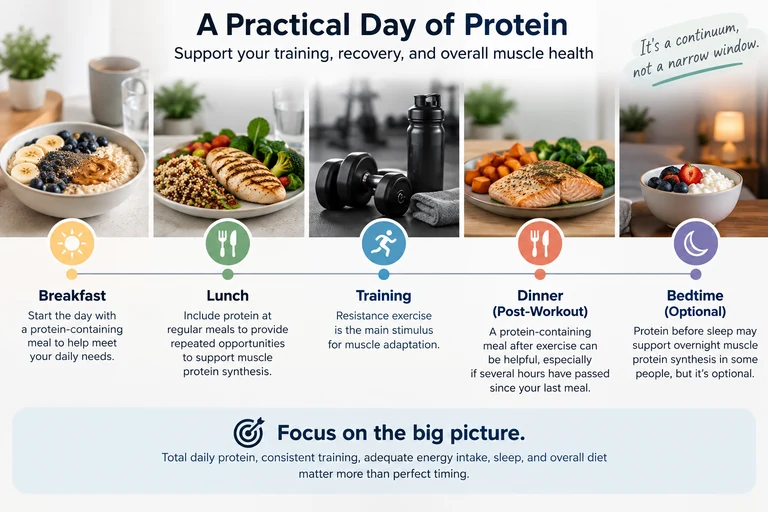
Start with the overall diet. Regularly meeting an appropriate daily protein intake gives timing strategies something to optimize. If intake is inconsistent or meals routinely lack protein, improving that pattern is generally more useful than focusing on a narrow workout window.
Include Protein in Regular Meals
Distributing protein among several ordinary meals is a practical way to support total intake and provide repeated opportunities for muscle protein synthesis. The meals do not have to be identical, and the intervals do not have to follow a fixed schedule.
Place a Protein-containing Meal Near Training When Convenient
A meal before or after training—or both, depending on the schedule—can place protein within the broader exercise-recovery period. If a substantial meal was eaten before training, the post-workout meal may be less urgent. If the previous meal was many hours earlier, eating afterward becomes more useful.
Use Supplements Only When They Solve a Practical Problem
Protein powders and other concentrated products can help when portability, appetite, preparation time, or a busy schedule makes food difficult. They are tools for convenience, not evidence that a specialized timing routine is required. A regular protein-containing meal remains a valid option.
Do Not Panic About a Missed Window
One delayed meal does not erase a workout, and one perfectly timed serving does not create long-term adaptation by itself. Training and nutrition work through repetition. A flexible routine that can be followed consistently is more valuable than a theoretically precise plan that creates unnecessary stress.
The Bottom Line
Protein timing matters most within the context of the whole day. Adequate total protein and consistent resistance training are foundational. Distribution across regular meals may be useful, and protein near training can be practical, but the evidence does not support a universal 30-minute deadline or a requirement to eat at perfectly even intervals.
Protein consumed before a workout still counts. Post-workout intake becomes more relevant when the previous protein-containing meal was distant. Pre-sleep protein can raise overnight amino acid availability in some settings, but it remains optional and should fit within total intake rather than simply adding unnecessary food.
The most useful timing plan is one that supports—not replaces—the larger recovery picture: sufficient food, regular protein-containing meals, progressive training, appropriate hydration, adequate sleep, and enough time between hard sessions.
Was this article helpful?
Your anonymous response helps improve our editorial coverage.
Loading feedback options…
Share
Share this article
Selected references
Recommended products
 Advanced Amino Formula
A dietary supplement from Advanced Bionutritionals combining eight essential amino acids to support protein intake, muscle health, physical performance, and recovery.
View product details Advanced Muscle Plus
A formula containing DL185 dileucine, calcium HMB monohydrate (myHMB), vitamin D, and calcium, marketed for muscle health and recovery. Ingredient research and manufacturer claims are distinct from finished-product evidence.
View product details
More from Planet Wellness Report
Continue Reading

Nutrition
BCAA vs. EAA: Comparing Muscle Protein Synthesis, Recovery, and Practical Use
BCAAs are part of the EAA family. Compare amino acid completeness, muscle protein synthesis, soreness, and practical use without assuming a universal winner.
7 min read

Nutrition
Protein vs. Essential Amino Acids: What’s the Difference?
Protein and essential amino acids overlap, but they are not nutritionally identical. Learn how foods, protein powders, and EAA supplements differ—and why faster absorption does not automatically mean better results.
11 min read
Nutrition
Essential Amino Acids: What They Are, Why They Matter, and Food Sources
Essential amino acids must come from the diet, but that does not mean everyone needs a supplement. Learn how EAAs relate to protein, BCAAs, food quality, muscle protein synthesis, and exercise recovery.
12 min read
Evidence
Sources
- Robert W. Morton; Kevin T. Murphy; Sean R. McKellar; Brad J. Schoenfeld; Menno Henselmans; Eric Helms; Alan A. Aragon; Michaela C. Devries; Laura Banfield; James W. Krieger; Stuart M. Phillips. A Systematic Review, Meta-analysis and Meta-regression of the Effect of Protein Supplementation on Resistance Training-Induced Gains in Muscle Mass and Strength in Healthy Adults — British Journal of Sports Medicine (Mar 1, 2018) · DOI
- Ralf Jäger et al.; International Society of Sports Nutrition. International Society of Sports Nutrition Position Stand: Protein and Exercise — Journal of the International Society of Sports Nutrition (Jun 20, 2017) · DOI
- Kiera Wilkinson; Christopher P. Koscien; Alistair J. Monteyne; Benjamin T. Wall; Francis B. Stephens. Association of Postprandial Postexercise Muscle Protein Synthesis Rates With Dietary Leucine: A Systematic Review — Physiological Reports (Aug 1, 2023) · DOI
- Brad Jon Schoenfeld; Alan Albert Aragon; James W. Krieger. The Effect of Protein Timing on Muscle Strength and Hypertrophy: A Meta-analysis — Journal of the International Society of Sports Nutrition (Dec 3, 2013) · DOI
- Alan Albert Aragon; Brad Jon Schoenfeld. Nutrient Timing Revisited: Is There a Post-exercise Anabolic Window? — Journal of the International Society of Sports Nutrition (Jan 29, 2013) · DOI
- Simon E. Jespersen; Jakob Agergaard. Evenness of Dietary Protein Distribution Is Associated With Higher Muscle Mass but Not Muscle Strength or Protein Turnover in Healthy Adults: A Systematic Review — European Journal of Nutrition (Feb 6, 2021) · DOI
- Brad Jon Schoenfeld; Alan A. Aragon; Colin Wilborn; Steven L. Urbina; Sara E. Hayward; James Krieger. Pre- Versus Post-exercise Protein Intake Has Similar Effects on Muscular Adaptations — PeerJ (Jan 3, 2017) · DOI
- Caio E. G. Reis; Laís M. R. Loureiro; Hamilton Roschel; Teresa H. M. da Costa. Effects of Pre-sleep Protein Consumption on Muscle-related Outcomes: A Systematic Review — Journal of Science and Medicine in Sport (Aug 7, 2020) · DOI
- Alice G. Pearson; Karen Hind; Lindsay S. Macnaughton. The Impact of Dietary Protein Supplementation on Recovery From Resistance Exercise-induced Muscle Damage: A Systematic Review With Meta-analysis — European Journal of Clinical Nutrition (Dec 13, 2022) · DOI
- Huan-Huan Zhou; Yuxiao Liao; Xiaolei Zhou; Zhao Peng; Shiyin Xu; Shaojun Shi; Liegang Liu; Liping Hao; Wei Yang. Effects of Timing and Types of Protein Supplementation on Improving Muscle Mass, Strength, and Physical Performance in Adults Undergoing Resistance Training: A Network Meta-analysis — International Journal of Sport Nutrition and Exercise Metabolism (Dec 1, 2023) · DOI