
ARTICLE
Protein Quality Explained: DIAAS, PDCAAS, Amino Acids, and What the Scores Really Mean
How amino-acid patterns and digestibility inform a score—and why that score is only part of a food decision.
By Planet Wellness Report · Oct 14, 2026 · 8 min read
Editorial review and publication: Felipe Lopes, Publisher & Editor. This is an editorial review, not a medical review.
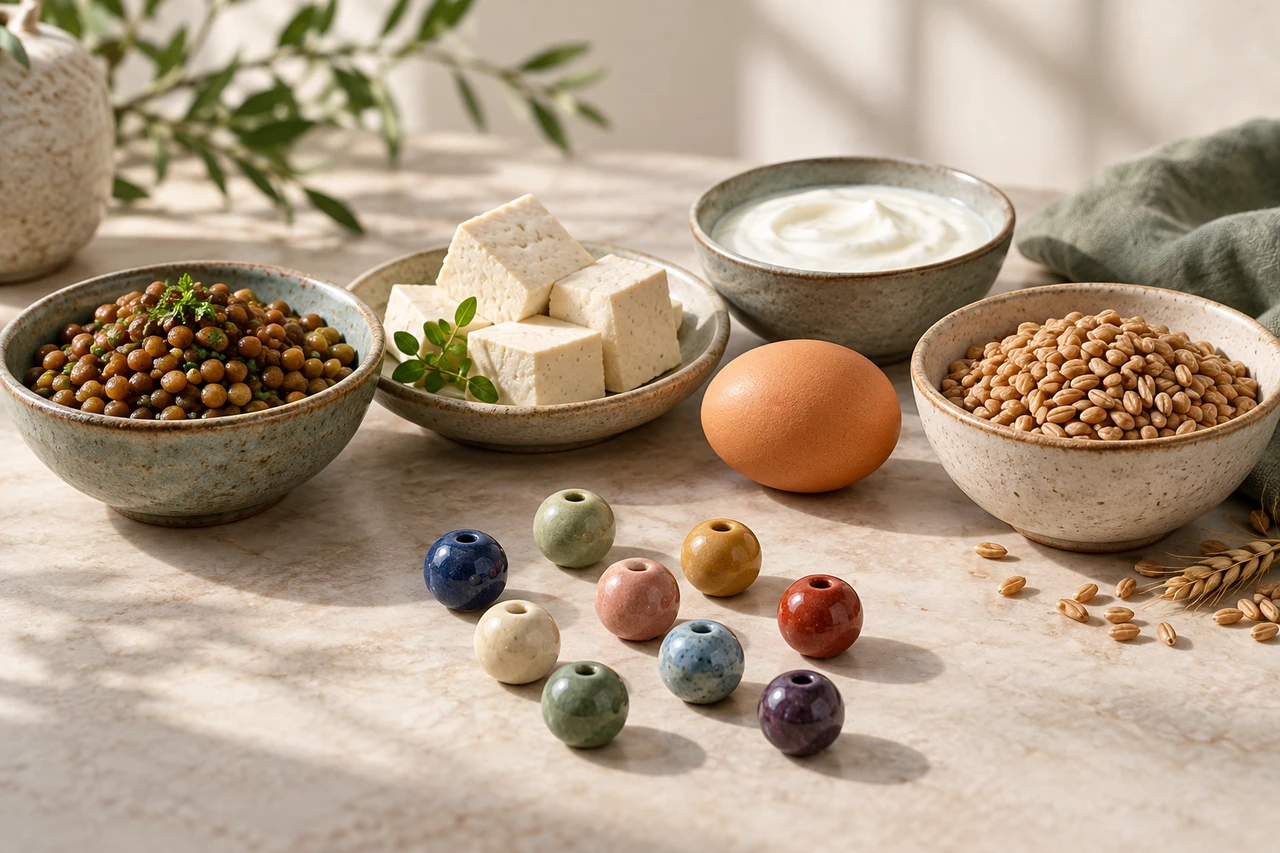
Protein quality describes how well a protein supplies the indispensable amino acids the body needs, after allowing for digestion. DIAAS and PDCAAS summarize that question. They do not summarize everything that makes a food nutritious, and they are not direct predictions of muscle gain.
A label can tell you how many grams of protein a serving contains without showing its amino-acid pattern or how much of each amino acid becomes available. Understanding the scoring methods helps you interpret those missing details without turning a technical measurement into a verdict on an entire diet.
What protein quality actually measures
Indispensable amino acids, also called essential amino acids, must come from the diet because the body cannot make enough of them. Protein quality assessment compares their proportions in a food with a reference amino-acid pattern: an estimate of the amounts needed per gram of reference protein for a specified age group. The pattern is a benchmark, not the composition of one ideal food.
The limiting amino acid is the one with the lowest ratio to that benchmark. It may be present in the food, just relatively scarce. Calling a food incomplete can obscure this distinction. For the basic definitions and food context, see our guide to essential amino acids.
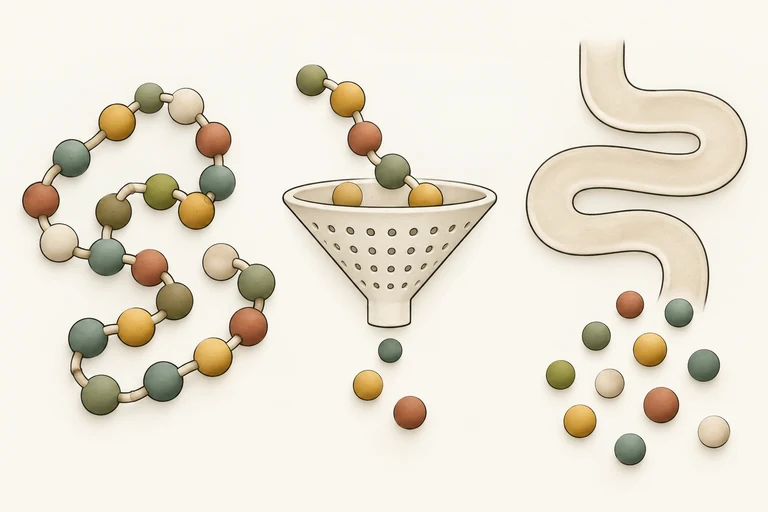
Digestibility adds another dimension. The amount eaten is not identical to the amount digested and absorbed. A protein can have a favorable chemical composition but deliver less of an amino acid if digestion or processing reduces its availability. Conversely, a highly digestible protein can still have an amino-acid pattern that limits its score.
PDCAAS: composition corrected by overall protein digestibility
PDCAAS stands for Protein Digestibility-Corrected Amino Acid Score. First, the amount of each indispensable amino acid per gram of food protein is compared with the reference pattern. The lowest ratio is then multiplied by a correction for overall protein digestibility. In the conventional method, that correction uses true fecal protein digestibility, with an allowance for endogenous losses rather than treating all nitrogen in feces as undigested food.
Fecal measurement evaluates what remains after passage through the digestive tract. Microbial activity in the large intestine can change nitrogen losses, so this endpoint does not directly reveal the absorption of each amino acid in the small intestine. Applying one protein-level digestibility factor to the limiting amino acid is another simplification: amino acids within a food need not have identical digestibility.
Conventionally reported PDCAAS values are capped at 1.0, also written as 100%. The cap reflects the framework of meeting the reference requirement: an excess above that benchmark is not credited as extra quality in the final reported score. It can therefore hide differences between proteins that exceed the benchmark and obscure their potential to complement other foods.
DIAAS: digestibility assessed amino acid by amino acid
DIAAS means Digestible Indispensable Amino Acid Score. It estimates the digestible amount of each indispensable amino acid per gram of food protein and compares that amount with the relevant reference requirement. The lowest ratio, multiplied by 100, is the score.
Its digestibility endpoint is the ileum, the final part of the small intestine, before material enters the large intestine. This better matches the site at which dietary amino acids are absorbed. Rather than applying the same overall factor to every amino acid, DIAAS uses amino-acid-specific ileal digestibility. The FAO proposed the approach to address important limitations of PDCAAS.
For individual proteins, DIAAS is not routinely truncated at 100. A value above 100 means that even the lowest digestible indispensable amino-acid ratio exceeds the chosen reference pattern. It does not mean more than 100% of the protein was digested, nor that the food provides more than 100% of a person’s daily protein needs.
Why the numbers are not interchangeable
The methods differ in both the digestibility endpoint and the correction being made. Reference patterns can also differ, and PDCAAS truncation removes information that an untruncated DIAAS retains. Multiplying a PDCAAS value by 100 changes its notation; it does not convert it into DIAAS. A meaningful comparison identifies the method, age reference, food preparation and analytical dataset.
The 2013 FAO report discussed excellent/high quality around DIAAS 100 or more and good/source quality around 75–99 in a proposed claims framework. It also said the cutoffs for claims needed further consideration. These are technical classification proposals, not universal legal labeling rules or a declaration that a food below a cutoff should be avoided.
There are practical limits to the evidence. Direct human ileal measurements are difficult; much digestibility work uses animal models. Laboratories also differ in protein determination and preparation methods. Recent methodology reviews emphasize that reference patterns, measurement choices and available digestibility data affect the resulting score. A value quoted without those details gives a false impression of precision.
Whole foods, isolates and cooking are different contexts
Soybeans and soy protein isolate are related sources, but they are not interchangeable test materials. The same is true of peas versus pea isolate, milk versus a separated milk protein, or a grain versus an extracted concentrate. Removing fiber and other components, changing protein structure or concentrating protein can alter the measured result.
The food matrix is the physical structure in which nutrients are packaged. Cooking can make some proteins easier to digest and reduce some compounds that interfere with digestion. More intense processing can also reduce availability of particular amino acids, including through reactions involving lysine. There is no rule that all processing improves quality or that every raw food scores worse.
For that reason, this article does not assemble a league table of numbers for eggs, meat, soy, wheat and rice from unrelated experiments. A score belongs to a tested preparation and method. It should not be assigned indiscriminately to every product or recipe sharing the food’s name.
Mixed diets change the meaning of a limiting amino acid
Foods can complement one another because their amino-acid patterns differ. Many cereal proteins are relatively low in lysine, while legumes often provide more lysine but may be relatively limited in sulfur-containing amino acids. The balance depends on the specific foods and the amounts of protein each contributes. Rice and beans are one practical combination, not a mandatory formula.
A mixture’s quality cannot be calculated by averaging two headline scores. Its digestible amino-acid contributions must be combined in proportion to their protein contributions, then compared with the reference pattern. The limiting amino acid of the mixture can differ from the limiting amino acid of either ingredient.
For healthy adults eating enough energy and a varied diet, complementary proteins do not always need to be deliberately paired in the same meal. Variety across the diet can meet amino-acid needs. That does not mean meal composition is irrelevant when appetite is low, intake is restricted or muscle-focused feeding is being considered. Our guide to foods high in essential amino acids covers food choices in more detail.
A higher DIAAS does not automatically mean a healthier food
Neither score directly measures fiber, micronutrients, saturated fat, sodium, sustainability, affordability or cultural suitability. Nor does either directly measure chronic disease risk or overall diet quality. These factors require their own assessment. A food can have a lower protein-quality score and still make a valuable contribution to a balanced dietary pattern.
Keep the evidence levels separate. Method validation asks whether the measurement is suitable. Digestibility studies assess amino-acid availability. Acute muscle protein synthesis studies assess a response over hours or days. Training trials assess outcomes such as muscle size and strength over weeks or months. Success at one level is not proof of success at the next.
A higher DIAAS, by itself, does not demonstrate greater hypertrophy. See plant protein vs. animal protein for muscle for how composition, short-term responses and training outcomes fit together.
How should you actually use protein-quality scores?
Start with the dietary question the score can answer. If a diet relies heavily on one source, or if only a small amount of food can be eaten, its amino-acid pattern and digestibility deserve more attention. A varied diet with adequate intake gives you more ways to meet requirements than a single-ingredient score suggests.
Check quantity as well as quality. A small serving of a highly scored protein may contribute less usable protein overall than a larger mixed meal. Adequate energy intake also matters: amino acids are used within the wider demands of metabolism. Our daily protein guide addresses quantity without requiring you to calculate a DIAAS for every meal.
Age and physiological context change the question. Growth, aging, pregnancy, illness and exercise are not identical nutritional situations, and a technical reference pattern is not an individualized prescription. People with kidney disease, unexplained weight loss or substantial dietary restrictions should seek advice appropriate to their circumstances rather than optimize a score in isolation.
Use powders or isolates when they solve a practical problem, such as convenience or limited appetite. They remain optional tools. Free-form amino-acid supplements are a different format from intact protein; do not assign them an intact-food DIAAS or PDCAAS without product-specific evidence. Protein vs. essential amino acids explains that distinction.
What to remember when you see a protein score
Ask which food was tested, how it was prepared, which reference pattern was used and where digestibility was measured. Then ask whether the score answers your actual decision. PDCAAS and DIAAS are useful descriptions of amino-acid supply; food variety, total intake and the rest of the dietary pattern give those descriptions their practical meaning.
Was this article helpful?
Your anonymous response helps improve our editorial coverage.
Loading feedback options…
Share
Share this article
Selected references
Recommended products
More from Planet Wellness Report
Continue Reading
Nutrition
Advanced Amino Formula Review: Ingredients, Evidence, and Value
Advanced Amino Formula reviewed: five-tablet serving, eight-amino-acid blend, undisclosed leucine dose, missing histidine, research context, and purchase value.
8 min read

Nutrition
BCAA vs. EAA: Comparing Muscle Protein Synthesis, Recovery, and Practical Use
BCAAs are part of the EAA family. Compare amino acid completeness, muscle protein synthesis, soreness, and practical use without assuming a universal winner.
7 min read
Nutrition
Essential Amino Acids: What They Are, Why They Matter, and Food Sources
Essential amino acids must come from the diet, but that does not mean everyone needs a supplement. Learn how EAAs relate to protein, BCAAs, food quality, muscle protein synthesis, and exercise recovery.
12 min read
Evidence
Sources
- FAO Expert Consultation on Protein Quality Evaluation in Human Nutrition. Dietary Protein Quality Evaluation in Human Nutrition: Report of an FAO Expert Consultation — Food and Agriculture Organization of the United Nations
- Joint FAO/WHO/UNU Expert Consultation on Protein and Amino Acid Requirements in Human Nutrition. Protein and Amino Acid Requirements in Human Nutrition: Report of a Joint FAO/WHO/UNU Expert Consultation — World Health Organization
- Institute of Medicine; Food and Nutrition Board. Dietary Reference Intakes for Energy, Carbohydrate, Fiber, Fat, Fatty Acids, Cholesterol, Protein, and Amino Acids — National Academies Press · DOI
- Gaudichon C.. Evolution and significance of amino acid scores for protein quality — Frontiers in nutrition (Sep 3, 2024) · DOI
- Xipsiti M.. Protein quality evaluation: FAO perspective — Frontiers in nutrition (Dec 2, 2024) · DOI
- François Mariotti; Christopher D. Gardner. Dietary Protein and Amino Acids in Vegetarian Diets: A Review — Nutrients (Nov 4, 2019) · DOI
- Protein in diet — MedlinePlus / U.S. National Library of Medicine