
ARTICLE
How Muscle Mass Changes With Age—and What Actually Helps Preserve It
Put strength, everyday function and a workable routine ahead of supplement claims.
By Planet Wellness Report · Oct 22, 2026 · 8 min read
Editorial review and publication: Felipe Lopes, Publisher & Editor. This is an editorial review, not a medical review.

Preserving muscle with age is a question about what you can keep doing: carrying groceries, getting out of a chair, climbing stairs and taking part in activities you enjoy. Muscle size matters, but it is only one part of that picture. A useful plan supports strength and everyday function as well as muscle tissue.
The practical priorities are resistance exercise, enough food and protein, and regular movement between workouts. Unexplained decline deserves assessment. Supplements enter the discussion after those needs are understood. This order is an editorial decision framework, not a validated clinical score or a promise that everyone will retain the same abilities.
Muscle mass, strength and function answer different questions
Muscle mass describes the amount of muscle tissue. Strength describes the force you can produce in a particular task. Function describes how you manage activities such as walking or standing up. Balance, coordination, joint health and the nervous system also influence what you can do.
These measures can change at different rates. The EWGSOP2 consensus places low strength at the center of sarcopenia assessment, uses muscle quantity or quality to confirm it, and considers physical performance when assessing severity. That clinical framework explains why a bigger muscle measurement alone cannot establish preserved independence. It is not a home diagnostic checklist.
For everyday planning, choose a meaningful activity alongside any body-composition goal. Wanting to climb stairs more comfortably gives a training professional a clearer problem to address than wanting a higher “muscle” number on a household scale. A noticeable loss of ability is also worth discussing even if body weight is unchanged.
Why maintaining muscle becomes harder with age
Aging muscle may respond less strongly to a given protein meal or exercise stimulus, often called anabolic resistance. This does not mean protein stops working or that exercise becomes pointless. It means the response to an input can change, within a much broader physiological setting.
Changes in neural control, motor units and the connection between nerves and muscle can affect force production. Illness, inflammation, reduced activity and inadequate eating may add to age-related changes. Their relative contributions differ between people; no single mechanism explains every decline. A 2024 review of skeletal muscle dysfunction describes both altered protein turnover and neural changes, while emphasizing remaining uncertainties.
The course is not necessarily a smooth, predictable loss each year. An illness or period of immobility can interrupt activity and eating together. The practical implication is to notice changes in routine and capability rather than assume a birthday determines what happens next. A supplement that affects one pathway cannot be presumed to address all these influences.
A practical order of priorities for preserving muscle with age
Use five questions: Is there a regular strength stimulus? Is there enough food to support it? Is movement disappearing from the rest of the week? Is a new decline being explained? Only then ask whether a specific supplement solves a remaining problem. These questions can be addressed together; concerning symptoms move professional assessment to the front.
1. Make resistance training a repeatable part of the week
Resistance training gives muscles a reason to produce force. Weights, resistance bands and appropriately challenging body-weight movements can all provide resistance. The useful program is one you can perform regularly and adapt as your ability changes, with technique and progression suited to your starting point.
CDC guidance for adults 65 and older includes muscle-strengthening activity on at least two days a week, alongside aerobic and balance activity. This is a population guide, not a requirement to begin with a demanding gym routine. People with limitations should work within their abilities and seek help adapting activities when needed.
A 2025 review of 24 randomized trials involving 951 older adults with sarcopenia found improvements in several strength and functional tests, without significant changes in some muscle-mass measures. Importantly, the pooled functional improvements did not exceed the review’s thresholds for minimally important differences. Statistical improvement therefore does not guarantee a noticeable daily benefit. The findings support outcome-specific expectations, not an exact training prescription for every older adult.
Choose exercises and progression with a qualified professional if falls, pain, major deconditioning or medical restrictions make starting uncertain. Walking is valuable, but does not automatically provide the same progressive strength challenge. The goal is a sustainable training habit appropriate to the person, rather than copying the most demanding study protocol.
2. Make adequate eating possible before optimizing protein details
Protein supplies amino acids, but muscle preservation also requires attention to total food intake. A protein-focused meal pattern can still leave someone short of energy if portions are small or meals are skipped. Low appetite, difficulty shopping or preparing food, and difficulty chewing can make an apparently simple nutrition goal hard to achieve.
ESPEN’s geriatric nutrition guideline supports individualized protein intake above the general adult RDA in many older-adult contexts, with attention to nutrition status, activity and illness. The RDA is a population reference, not an individualized muscle-preservation target. Kidney disease and other clinical circumstances can change the advice. Our daily protein needs guide explains the calculations and their limits without requiring a second set of targets here.
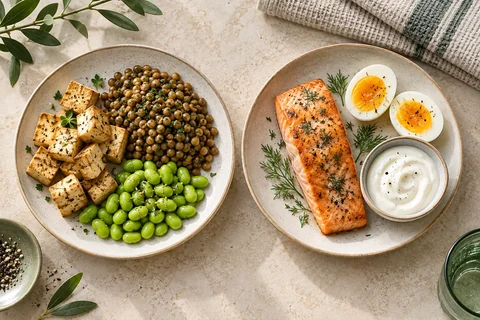
Start with protein-containing foods in regular meals: beans, lentils, tofu, eggs, dairy, fish or other foods that fit your diet. Including protein earlier in the day may make adequate intake easier when most of it otherwise lands at dinner. An exact equal split across meals has not been established as a universal route to better strength or function.
Leucine helps explain meal-related muscle protein synthesis, but a universal “threshold” should not become a meal-planning rule. Studies of isolated proteins and short-term synthesis cannot establish a guaranteed long-term functional benefit. Our leucine and muscle protein synthesis guide covers that distinction. Complete meals, adequate daily intake and a feasible routine remain more useful starting questions than buying a signaling ingredient.

3. Protect movement outside formal workouts
Regular activity serves a different purpose from a twice-weekly strength session. Walking, household tasks and appropriate balance activities help keep movement in everyday life. CDC guidance combines these types of activity because one does not cover every need. When capacity is limited, some activity within that capacity is still worthwhile.
After illness, surgery or a long interruption, the first question is what movement and nutrition are appropriate during recovery. Follow medical restrictions and ask about rehabilitation when needed. Avoid treating unrestricted exercise as an instruction during an acute illness, or treating a supplement as permission to remain inactive. A gradual return plan can connect recovery to the activities that matter to you.
4. Address deficiencies and unexplained decline
Vitamin D deficiency can involve muscle weakness, but correcting a nutritional problem and taking extra vitamin D despite adequate status are different interventions. NIH ODS summarizes inconsistent supplementation findings for muscle outcomes. A higher dose or blood concentration does not automatically produce stronger muscles or better mobility.
Assessment and supplementation should fit the person’s risks and clinical situation. This is not a recommendation for every reader to obtain testing or take high-dose vitamin D. Excess can cause harm, including high calcium levels. The adult upper intake level is a safety boundary, not a muscle-building target. Our vitamin D and fatigue guide explains status and safety in more detail; its fatigue evidence should not be read as proof of improved muscle function.
5. Consider an adjunct only for a defined remaining question
Creatine has evidence as an adjunct to resistance training in older adults. A 2025 meta-analysis of eight trials and 482 participants found a small lean-tissue benefit and a borderline lower-limb strength result, without a significant overall upper-limb strength benefit. These outcomes do not demonstrate preserved walking ability, fewer falls or independent living. Lean-tissue measurements can also include water changes. See our creatine monohydrate guide for the detailed evidence and safety context.
HMB asks a narrower question in disuse than in ordinary training. A small bed-rest trial suggested preservation of lean body mass, but only 19 participants were evaluable, an analysis excluded one participant, and a functional advantage was not demonstrated. Those findings cannot be treated as proof that HMB preserves independence during everyday aging.
By contrast, a 2026 meta-analysis of 13 trials involving 561 adults aged at least 50 found no additional muscle-mass or strength benefit from HMB alongside resistance training. Other populations and preparations contribute to a mixed literature. Our HMB evidence guide explains those differences. Neither the disuse result nor a biological mechanism justifies making HMB a routine purchase for everyone getting older.
An adjunct should have a purpose you can name, an outcome relevant to that purpose and safety appropriate to your circumstances. Filling a food-intake gap is different from expecting a product to reproduce exercise adaptations. You can follow the priorities in this article without buying a muscle-health supplement.
When a change deserves professional attention
Rapid unexplained weight loss, sudden or progressive weakness, recurrent falls, substantial loss of everyday function or a marked appetite decline should not automatically be attributed to aging. Consider professional assessment before treating a new decline as a supplement problem. Mention when the change began, which tasks became harder, recent illness and changes in food intake or medication.
Sudden weakness, especially on one side or with trouble speaking, needs emergency assessment. For a slower decline, a healthcare professional can help determine whether further evaluation is appropriate, while a dietitian or rehabilitation professional may help address nutrition and activity. This article does not identify the cause from symptoms or substitute a home test for that assessment.
Turn the priorities into a realistic next step
Consider two different situations. Someone eating regular meals but doing no strength work has a different starting problem from someone who stopped eating well and walking after hospitalization. The first may need help establishing training; the second may need clinical follow-up, nutrition support and an appropriate return-to-activity plan together. “Which supplement?” is too early a question for either situation.
Choose one practical action that matches your main gap: arrange an adapted strength session, make a missed meal easier to eat, or discuss a new loss of function. Track the habit and the activity you want to maintain, without treating a household scale as a diagnosis. Healthy aging is an ongoing effort to support capability and quality of life; the evidence does not promise rejuvenation or an identical outcome for everyone.
Was this article helpful?
Your anonymous response helps improve our editorial coverage.
Loading feedback options…
Share
Share this article
More from Planet Wellness Report
Continue Reading
Nutrition
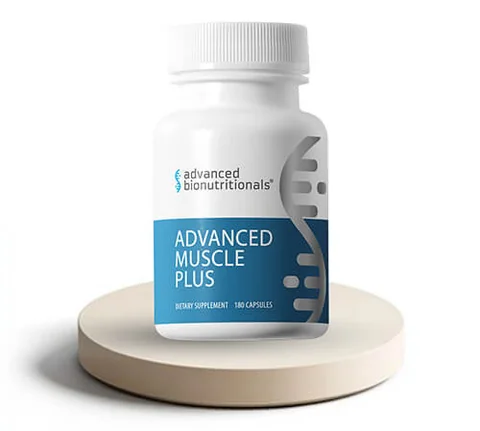
Advanced Muscle Plus Review: Where the Doses Match Research—and Where They Don’t
The dileucine amount resembles small human studies, but Advanced Muscle Plus has no verified finished-formula trial and conflicting official vitamin D information.
10 min read

Nutrition
Creatine Monohydrate for Muscle and Strength: What the Research Actually Shows
Creatine monohydrate can support some training outcomes. Separate strength, hypertrophy, lean mass, and water changes—and understand the safety evidence.
7 min read
Nutrition
Plant Protein vs Animal Protein for Muscle: Amino Acids, Digestibility, and Real-World Results
Compare plant and animal protein for muscle using amino acids, digestibility, acute MPS and longer-term mass and strength evidence.
9 min read
Evidence
Sources
- Cruz-Jentoft AJ, Bahat G, Bauer J, Boirie Y, Bruyère O, Cederholm T, Cooper C, Landi F, Rolland Y, Sayer AA, Schneider SM, Sieber CC, Topinkova E, Vandewoude M, Visser M, Zamboni M, Writing Group for the European Working Group on Sarcopenia in Older People 2 (EWGSOP2), and the Extended Group for EWGSOP2.. Sarcopenia: revised European consensus on definition and diagnosis — Age and ageing (Jan 1, 2019) · DOI
- Volkert D, Beck AM, Cederholm T, Cruz-Jentoft A, Hooper L, Kiesswetter E, Maggio M, Raynaud-Simon A, Sieber C, Sobotka L, van Asselt D, Wirth R, Bischoff SC.. ESPEN practical guideline: Clinical nutrition and hydration in geriatrics — Clinical nutrition (Edinburgh, Scotland) (Mar 5, 2022) · DOI
- Pabla P, Jones EJ, Piasecki M, Phillips BE.. Skeletal muscle dysfunction with advancing age — Clinical science (London, England : 1979) (Jul 1, 2024) · DOI
- Yan R, Chen Y, Zhang R, He J, Lin W, Sun J, Li D.. Optimal resistance training prescriptions to improve muscle strength, physical function, and muscle mass in older adults diagnosed with sarcopenia: a systematic review and meta-analysis — Aging clinical and experimental research (Nov 10, 2025) · DOI
- Centers for Disease Control and Prevention. Older Adult Activity: An Overview — Centers for Disease Control and Prevention (Dec 4, 2025)
- Centers for Disease Control and Prevention. Signs and Symptoms of Stroke — Centers for Disease Control and Prevention (May 19, 2026)
- Office of Dietary Supplements. Vitamin D — Health Professional Fact Sheet — NIH Office of Dietary Supplements
- Liu S, Huang N, Wu W, OuYang X, Luo Y, Zhong Y, Wang M, Xiao L.. The impact of creatine supplementation associated with resistance training on muscular strength and lean tissue mass in the aged: a systematic review and meta-analysis — European review of aging and physical activity : official journal of the European Group for Research into Elderly and Physical Activity (Dec 13, 2025) · DOI
- Wang G, Jawed I, Tufail M, Sharaf MS, Bin Gulzar AH, Qurat Ul Ain H, Umair M, Kumar D, Jabeen S.. Efficacy of HMB supplementation as an adjunct to resistance training in older adults: a comprehensive meta-analysis — Age and ageing (Mar 1, 2026) · DOI
- Deutz NE, Pereira SL, Hays NP, Oliver JS, Edens NK, Evans CM, Wolfe RR.. Effect of β-hydroxy-β-methylbutyrate (HMB) on lean body mass during 10 days of bed rest in older adults — Clinical nutrition (Edinburgh, Scotland) (Mar 4, 2013) · DOI
- Zaromskyte G, Prokopidis K, Ioannidis T, Tipton KD, Witard OC.. Evaluating the Leucine Trigger Hypothesis to Explain the Post-prandial Regulation of Muscle Protein Synthesis in Young and Older Adults: A Systematic Review — Frontiers in nutrition (Jul 8, 2021) · DOI