
ARTICLE
Creatine Monohydrate for Muscle and Strength: What the Research Actually Shows
By Planet Wellness Report · Oct 17, 2026 · 7 min read
Editorial review and publication: Felipe Lopes, Publisher & Editor. This is an editorial review, not a medical review.

Creatine monohydrate can add to the benefits of resistance training, particularly for some strength, power, and lean-mass outcomes. That is a stronger evidence base than many sports supplements have, but it does not mean that creatine builds muscle by itself or improves every test in every person.
The useful question is what changed: the weight on the scale, a body-composition estimate, the size of a muscle, a maximum lift, or repeated exercise performance. Those are different outcomes, and the distinction matters when judging both research and your expectations.
What creatine does in the phosphocreatine system
Creatine is a compound the body makes and also obtains from foods, especially meat and fish. Much of it is stored in muscle as free creatine and phosphocreatine. During a brief, demanding effort, phosphocreatine helps regenerate ATP, the immediate energy currency used for muscle contraction. It is a rapid buffer with limited capacity, not an unlimited fuel supply.
Supplementation can increase muscle creatine stores beyond habitual levels. This helps explain why repeated hard efforts are a better biological fit than a claim about feeling more energetic all day. Creatine does not replace food energy, progressive training, or recovery.
Why monohydrate is the research reference form
Creatine monohydrate is the form used in much of the human exercise literature and the reference discussed in the ISSN position stand. A different chemical form, a higher price, or a claim of superior absorption does not establish better strength or muscle outcomes. Evidence for monohydrate should not automatically be transferred to every proprietary blend.
Dietary creatine and supplemental creatine are also different exposures. Eating a mixed diet supplies some creatine, while trial supplements are designed to raise muscle stores in a controlled way. A study of a supplement does not establish that an ordinary serving of a creatine-containing food produces the same effect.
Loading is a research strategy, not a requirement
Researchers often use a short loading phase followed by a smaller maintenance intake. Other studies use a smaller daily amount from the beginning. In Hultman and colleagues’ muscle-biopsy study of 31 men, 20 grams daily for six days increased muscle creatine relatively quickly; 3 grams daily produced a similar increase more gradually over 28 days.
These are examples of study protocols, not individualized instructions. Their central lesson is that loading is not mandatory for raising muscle stores. Saturation takes time, depends partly on starting stores, and has a ceiling. Taking more after stores are elevated does not guarantee more muscle or better performance. The protocol also changes how soon researchers measure early fluid-related effects.
Strength, repetitions, power, and training volume are separate tests
A one-repetition maximum, or 1RM, measures the heaviest load lifted once under a specified protocol. Repetitions at a fixed load measure a different ability. Power includes how quickly work is performed; training volume describes accumulated work across a session or program. Improvement in one should not be reported as proof that all improved.
A 2025 meta-analysis of 69 studies and 1,937 participants found benefits in outcomes including bench/chest press, squat, vertical jump, and Wingate peak power. Handgrip and leg-press results were not significant overall. This pattern supports an outcome-specific conclusion rather than “creatine always improves strength.”
An additional capacity to repeat hard efforts may help someone train productively over time. However, a plausible pathway through training volume is not proof that every participant completed more work or developed more muscle. The actual training program, comparison group, adherence, and duration still need to be examined.
Lean mass is not a direct measurement of new muscle tissue
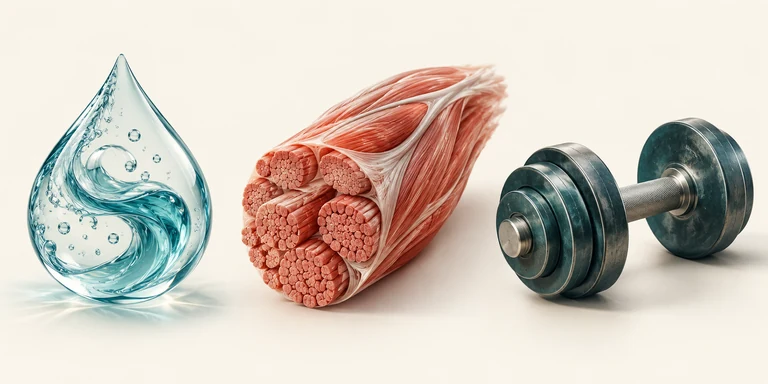
Total body mass includes everything on the scale. Fat-free mass excludes fat but still includes water, bone, organs, and other tissues. DXA-derived lean soft tissue is another estimate, not a direct count of new muscle fibers or contractile protein. Creatine-related intracellular water can contribute to an early rise in weight or lean mass.
A 2025 randomized trial illustrates the measurement issue. Sixty-three adults were assigned to creatine or a control without creatine or placebo. After a seven-day wash-in, the creatine group had a greater DXA lean-mass increase; during the following 12 weeks of resistance training, there was no significant additional between-group growth. The lack of a placebo and the study’s size limit interpretation, but the design shows why the timing of baseline measurements matters.
Direct imaging provides a different perspective. A 2023 synthesis of 10 trials using MRI, CT, or ultrasound found a very small pooled hypertrophy estimate favoring creatine plus training, with uncertainty spanning no effect. That supports modest expectations. Neither “all the gain is water” nor “all the gain is new muscle” accurately summarizes the evidence.
Training experience, diet, age, and sex affect applicability
A 2025 review of 61 trials found that both novice and experienced lifters gained fat-free mass with creatine plus resistance training. The numerical advantage in experienced participants was not statistically significant. Subgroup differences should not be turned into a rule about who must respond best; the endpoint was fat-free mass, not purely muscle tissue.
Vegetarians often begin with lower muscle creatine stores. A systematic review found that supplementation can increase those stores, but evidence was mixed on whether exercise improvements exceed those in omnivores, and included studies had moderate-to-high risk of bias. Lower dietary creatine is relevant context, not a diagnosis or an automatic indication to supplement.
Older adults need their own evidence. A December 2025 review of eight trials involving 482 participants found a small lean-tissue benefit and a borderline lower-limb strength result with resistance training, without a significant overall upper-limb benefit. Evidence about walking, daily function, or treating sarcopenia cannot be inferred from lean-mass changes alone.
An August 2026 trial also reported benefits in middle-aged and older adults. Participants chose their exercise/diet setting before supplement randomization, and 64 completed analysis. It adds useful evidence, but self-selection of the exercise setting limits causal comparisons of training versus no training. It does not establish that a supplement substitutes for exercise.
Research is uneven across age and sex. Smaller or nonsignificant results in a subgroup can reflect imprecision as well as a true difference. Findings dominated by young male participants should not be presented as an equally certain estimate for everyone.
Repeated intense efforts are a better fit than endurance promises
Repeated short, high-intensity efforts and resistance exercise fit the phosphocreatine mechanism. Sprint or power results still depend on the task and recovery intervals; benefit in a laboratory cycling test is not a guaranteed faster race.
For continuous endurance performance, a meta-analysis of 13 placebo-controlled studies in trained participants found no significant overall improvement. Added body mass may also matter in weight-bearing sports. Creatine should not be sold as a general endurance enhancer based on evidence for brief intense exercise.
Kidney tests and other safety questions need context
Creatine is converted into creatinine, a substance used in common kidney-function estimates. A July 2026 meta-analysis of 26 randomized trials found higher serum creatinine and lower creatinine-based estimated filtration, while filtration measured using a creatinine-independent tracer did not significantly differ. This distinction is important: a creatinine rise is not automatically evidence of kidney damage.
It is equally inappropriate to dismiss every abnormal result as harmless. A clinician needs the supplement history, previous values, health conditions, and other findings to interpret the test and decide whether additional assessment is needed. Evidence from studied adults does not authorize unsupervised use in pre-existing kidney disease, including by extrapolation from small dialysis studies.
The 2021 evidence review does not support a general claim that creatine causes dehydration or cramping. Gastrointestinal discomfort can occur, particularly with large single amounts, and body-water or weight changes may be unwelcome. Trial tolerability is not a guarantee of zero adverse effects or of the purity of every commercial product.
People who are pregnant or breastfeeding, have kidney disease, or take medicines affecting kidney function should discuss supplementation with their clinician. Pregnancy and lactation evidence is insufficient for a routine recommendation. Keep ordinary hydration and heat precautions appropriate to the activity; taking creatine does not remove them.
Where creatine fits alongside nutrition and training
Creatine-specific evidence concerns short-term energy buffering and training adaptations. Protein quantity, amino-acid supply, and meal timing answer separate questions. For those foundations, see daily protein needs, protein timing and recovery, and leucine and muscle protein synthesis.
Food choices also deserve their own evidence: protein quality and plant versus animal protein for muscle explain issues that a creatine supplement cannot resolve.
Creatine monohydrate is a reasonable evidence category to consider for resistance-training goals, with average benefits that vary by test, population, and design. Judge claims against the outcome you actually care about, allow for early water changes, and keep the training program central. There is no need to turn a useful optional tool into a requirement for every adult.
Was this article helpful?
Your anonymous response helps improve our editorial coverage.
Loading feedback options…
Share
Share this article
More from Planet Wellness Report
Continue Reading

Healthy Aging
How Muscle Mass Changes With Age—and What Actually Helps Preserve It
Muscle mass, strength and function change differently with age. Use an evidence-informed order of priorities to decide what to address first.
8 min read

Nutrition
BCAA vs. EAA: Comparing Muscle Protein Synthesis, Recovery, and Practical Use
BCAAs are part of the EAA family. Compare amino acid completeness, muscle protein synthesis, soreness, and practical use without assuming a universal winner.
7 min read

Nutrition
Protein for Muscle Health and Recovery: How Much Does Timing Really Matter?
Total daily protein matters more than chasing a 30-minute window, but timing can still be useful. Learn how pre-workout meals, post-workout protein, distribution, and optional pre-sleep intake fit into muscle recovery.
12 min read
Evidence
Sources
- Kreider RB, Kalman DS, Antonio J, Ziegenfuss TN, Wildman R, Collins R, Candow DG, Kleiner SM, Almada AL, Lopez HL.. International Society of Sports Nutrition position stand: safety and efficacy of creatine supplementation in exercise, sport, and medicine — Journal of the International Society of Sports Nutrition (Jun 13, 2017) · DOI
- Hultman E, Söderlund K, Timmons JA, Cederblad G, Greenhaff PL.. Muscle creatine loading in men — Journal of applied physiology (Bethesda, Md. : 1985) (Jul 1, 1996) · DOI
- Kazeminasab F, Kerchi AB, Sharafifard F, Zarreh M, Forbes SC, Camera DM, Lanhers C, Wong A, Nordvall M, Bagheri R, Dutheil F.. The Effects of Creatine Supplementation on Upper- and Lower-Body Strength and Power: A Systematic Review and Meta-Analysis — Nutrients (Aug 25, 2025) · DOI
- Ashtary-Larky D, Mohammadi S, Hajizadeh L, Mousavi SAH, Forbes SC, Candow DG, Antonio J.. Creatine supplementation and resistance training: a comparison between novice and experienced lifters - a systematic review and dose-response meta-analysis — Journal of the International Society of Sports Nutrition (Sep 1, 2025) · DOI
- Burke R, Piñero A, Coleman M, Mohan A, Sapuppo M, Augustin F, Aragon AA, Candow DG, Forbes SC, Swinton P, Schoenfeld BJ.. The Effects of Creatine Supplementation Combined with Resistance Training on Regional Measures of Muscle Hypertrophy: A Systematic Review with Meta-Analysis — Nutrients (Apr 28, 2023) · DOI
- Desai I, Pandit A, Smith-Ryan AE, Simar D, Candow DG, Kaakoush NO, Hagstrom AD.. The Effect of Creatine Supplementation on Lean Body Mass with and Without Resistance Training — Nutrients (Mar 19, 2025) · DOI
- Liu S, Huang N, Wu W, OuYang X, Luo Y, Zhong Y, Wang M, Xiao L.. The impact of creatine supplementation associated with resistance training on muscular strength and lean tissue mass in the aged: a systematic review and meta-analysis — European review of aging and physical activity : official journal of the European Group for Research into Elderly and Physical Activity (Dec 13, 2025) · DOI
- Chun J, Liu Y, Kibler GL, Lee H, Babakhani K, Rhoades N, Bivins I, Ko J, Dickerson B, Gonzalez DE, Sowinski RJ, Rasmussen CJ, Kreider RB.. Effects of creatine supplementation with and without exercise and diet intervention on body composition, cognitive function, and markers of health in middle-aged and older adults — Journal of the International Society of Sports Nutrition (Aug 11, 2026) · DOI
- Kaviani M, Shaw K, Chilibeck PD.. Benefits of Creatine Supplementation for Vegetarians Compared to Omnivorous Athletes: A Systematic Review — International journal of environmental research and public health (Apr 27, 2020) · DOI
- Fernández-Landa J, Santibañez-Gutierrez A, Todorovic N, Stajer V, Ostojic SM.. Effects of Creatine Monohydrate on Endurance Performance in a Trained Population: A Systematic Review and Meta-analysis — Sports medicine (Auckland, N.Z.) (Mar 6, 2023) · DOI
- de Souza Almeida A, da Silva LOD, Takahasi BNA, Terada BD, Gonçalves FGA, Porto BC, da Silva Sardenberg RA, Passerotti CC, Maia RS, Samaan F, Thoman M, Molina WR, Shiomi da Cruz JA.. Impact of creatine supplementation on kidney health: a systematic review and meta-analysis — International urology and nephrology (Jul 27, 2026) · DOI
- Antonio J, Candow DG, Forbes SC, Gualano B, Jagim AR, Kreider RB, Rawson ES, Smith-Ryan AE, VanDusseldorp TA, Willoughby DS, Ziegenfuss TN.. Common questions and misconceptions about creatine supplementation: what does the scientific evidence really show? — Journal of the International Society of Sports Nutrition (Feb 8, 2021) · DOI
- Dietary Supplements for Exercise and Athletic Performance: Fact Sheet for Health Professionals — NIH Office of Dietary Supplements