
ARTICLE
HMB for Muscle Loss, Strength, and Recovery: What Human Research Actually Shows
By Planet Wellness Report · Oct 18, 2026 · 9 min read
Editorial review and publication: Felipe Lopes, Publisher & Editor. This is an editorial review, not a medical review.

HMB has human research on muscle preservation, strength, and recovery, but the findings depend strongly on who is studied and what is measured. Evidence from bed rest or sarcopenia does not establish that a healthy lifter will gain more muscle. Several analyses find little additional benefit when HMB is added to resistance training.
The most useful way to assess HMB is to separate muscle size, lifting strength, blood markers of damage, soreness, and everyday function. A positive result in one category does not settle the others. This guide examines those differences before considering what a multi-ingredient product label can tell you.
What HMB is, and how it relates to leucine
HMB stands for beta-hydroxy-beta-methylbutyrate, a compound the body produces during leucine metabolism. Leucine is an essential amino acid; HMB is a metabolite, rather than another name for leucine. Researchers investigate HMB partly because of effects on pathways involved in muscle protein synthesis and breakdown. Those mechanisms provide a rationale for trials, not a guarantee of larger or stronger muscles.
Two studied supplemental forms are calcium HMB and free-acid HMB. Differences in blood appearance have been reported, but findings are mixed. Faster absorption alone cannot establish superior hypertrophy, recovery, or physical function. Preparation, amount, comparison group, and follow-up all matter when transferring a trial finding to a product.
Muscle mass, strength, and recovery need different measurements
Fat-free mass includes more than skeletal muscle. DXA lean-tissue estimates are useful body-composition measures, but are not identical to direct muscle thickness, cross-sectional area, or muscle-fiber size. Hypertrophy means an increase in muscle size; a change in total body weight is not enough to establish it.
Strength is task-specific: a one-repetition maximum, handgrip test, and repeated contractions answer different questions. Physical function, such as walking speed or a chair-rise task, adds another dimension. Sarcopenia assessment brings together strength, muscle quantity or quality, and sometimes performance; one improved measure does not show that the condition has been prevented or reversed.
Recovery also needs an outcome. Lower creatine kinase (CK) or lactate dehydrogenase (LDH) after exercise indicates a change in indirect damage markers. It does not by itself show less soreness, restored lifting performance, better perceived readiness, or greater long-term adaptation.

Healthy younger adults: training benefits do not prove an HMB effect
A 2020 systematic review analyzed 11 studies after its extraction and exclusion procedures, with 302 participants in body-composition analyses and 248 in strength analyses. HMB produced a small total-body-mass signal, but no significant additional improvement in fat-free mass or strength during resistance training. This is evidence against assuming a reliable extra training benefit in younger adults.
An earlier meta-analysis separated previously untrained and trained young men. It reported small overall and lower-body strength benefits in the untrained group, while effects in trained lifters were trivial. That subgroup finding is not a rule that every beginner benefits. The studies were generally short, and novice training itself produces substantial adaptation.
The 2025 ISSN position stand is more favorable to HMB under selected training conditions. A position statement summarizes and interprets a body of research; its optimism does not erase negative pooled results. Training experience, diet, study duration, and methodological choices help explain why conclusions differ.
Resistance-trained adults: direct muscle measures matter
A meta-analysis focused on trained and competitive athletes found no significant benefit for strength or body composition. This population should be assessed separately from inactive older adults or people recovering from illness. Nor does extending a short study automatically establish a benefit in an experienced lifter.
One 12-week trial randomized 26 resistance-trained men to whey protein plus HMB or whey protein plus leucine. It assessed ultrasound muscle size, muscle-fiber size, body composition, and maximum strength through training, an overreaching phase, and tapering. Both groups improved, without a difference in hypertrophy or strength. Because both received whey plus an added compound, this was not a test of HMB alone against no supplement.
Older adults: selected signals coexist with negative findings
A 2025 review of ten trials in older adults found a borderline handgrip-strength signal and improvement in the Short Physical Performance Battery, without significant improvements in appendicular lean mass, gait speed, or muscle quality. Half the trials were judged at high risk of bias, limiting confidence.
A newer 2026 analysis included 13 randomized trials and 561 adults aged at least 50. It found no additional benefit from HMB alongside resistance training for muscle mass, strength, or fat mass. Strength results were heterogeneous. These findings do not support making HMB a routine addition for everyone who can undertake structured training.
A separate 2025 meta-analysis in people diagnosed with sarcopenia found signals for skeletal muscle mass index and handgrip, without a gait-speed benefit. That clinical population and its interventions differ from healthy exercisers. The evidence supports continued investigation, rather than a claim that an over-the-counter formula treats sarcopenia.
A broader 2025 umbrella review pooled favorable small effects across existing meta-analyses. It combined varied populations and included reviews with low or critically low methodological quality. Reviews can also reuse the same underlying trials. A favorable overall estimate therefore does not settle the narrower question of extra benefit in a healthy trained adult.
Bed rest and hospitalization answer a different question
In a small controlled bed-rest trial, 24 older adults were enrolled and 19 were evaluable after ten days of bed rest. Calcium HMB was associated with better preservation of DXA lean body mass, but the analysis involved an excluded participant and did not demonstrate a corresponding functional advantage. This is a preliminary disuse finding, not proof of extra muscle growth during ordinary training.
Clinical nutrition research sometimes tests HMB within a high-protein, energy-containing supplement. In the 652-person NOURISH trial of malnourished hospitalized older adults, the primary combined outcome of death or readmission did not significantly differ; a secondary mortality outcome favored the nutritional intervention. That trial did not isolate HMB and was not an athletic muscle-building study. Its results cannot be transferred to a different commercial blend.
Does HMB improve soreness or performance recovery?
A meta-analysis of exercise-damage studies found lower CK and LDH with HMB, with duration-dependent findings. A later umbrella review also found support for those biochemical outcomes. These are indirect measures; neither result means that soreness, readiness, and restored performance all improve together.
Some small trials go beyond blood tests. A placebo-controlled study in 28 untrained men reported better preservation of torque and range of motion after a demanding eccentric elbow exercise. This narrow laboratory challenge is different from repeated whole-body training in experienced athletes. Preparation periods, exercise novelty, and the assessment window can change the result.
For a practical recovery claim, look for a relevant comparison and a clear endpoint: for example, the same strength test at a defined time after exercise. Perceived readiness is valuable but subjective; less soreness is not necessarily more adaptation. Evidence for a damage marker should remain a damage-marker claim.
HMB versus leucine, creatine, protein, and EAAs
HMB and leucine have related biology but different evidence. The whey-plus-HMB versus whey-plus-leucine trial does not show that either replaces adequate dietary protein. Protein provides amino acids for tissue building, while a complete essential-amino-acid (EAA) mixture supplies all nine essential amino acids. HMB alone does neither.
Our leucine and muscle protein synthesis guide explains the neighboring signaling question. Protein quality and protein timing and recovery cover dietary questions that an HMB supplement does not resolve. The Advanced Amino Formula review concerns an EAA product, a distinct intervention.
Creatine supports the phosphocreatine system involved in rapidly regenerating ATP during demanding efforts. It is not HMB. See the creatine monohydrate evidence guide for its training outcomes. Separate literatures do not establish that HMB is better than creatine, and shared muscle-health goals do not make their mechanisms interchangeable.
Safety depends on the preparation and the person
Human studies and the ISSN review provide generally reassuring tolerability and laboratory safety findings at studied exposures, including research extending to a year. This does not establish lifetime safety, safety at any intake, or suitability for every clinical population. The trial amount and chemical form should be checked rather than inferred from a branded name.
Gastrointestinal tolerance remains an individual consideration: persistent stomach upset is a reason to reassess a supplement, not to increase it. The available evidence does not justify calling GI reactions inevitable or assigning a precise frequency across all formulations. A blend can also introduce tolerability issues from its other ingredients.
Reassuring kidney and liver laboratory findings in selected study participants do not establish safety in people with kidney or liver disease. Medication use and clinical nutrition needs deserve review with a clinician or pharmacist; do not assume either a specific interaction or universal compatibility without evidence. Pregnancy and breastfeeding have insufficient evidence for routine HMB use. Research protocols discussed here are not personal dosing instructions.
How Advanced Muscle Plus fits this evidence
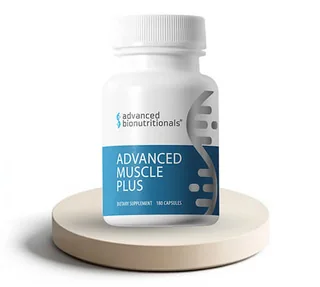
For an adult already considering an HMB-containing blend, Advanced Muscle Plus is a relevant catalog option to examine with a clinician. It combines calcium HMB monohydrate (myHMB), dileucine, vitamin D, and calcium. This is an optional product reference for label comparison, with the limitations below; the evidence does not make it a default supplement for muscle loss or training.
The official Supplement Facts checked on October 18, 2026 lists six tablets per serving and 30 servings per container: calcium HMB monohydrate 1,500 mg, DL185 dileucine 2,000 mg, vitamin D 200 micrograms (8,000 IU), and calcium 195 mg. The 1,500 mg entry is the labeled calcium HMB monohydrate salt amount, not an independently verified free-HMB equivalent. Calcium is supplied through that salt; these entries should not be added as separate masses of ingredients.
The vitamin D amount is especially relevant: 8,000 IU exceeds the adult tolerable upper intake level of 4,000 IU per day described by NIH ODS. That upper limit is not a target. This blend warrants clinician review of total vitamin D, calcium, medical context, and other supplements before use. Do not increase servings to imitate an HMB trial amount.
The official packshot and directions use capsule wording, while Supplement Facts says tablets. That unresolved discrepancy should be clarified with the vendor. Dileucine is also a separate ingredient; evidence for leucine or HMB does not establish its contribution to this complete product. No controlled trial of the finished labeled formula was verified in this research. Its efficacy cannot be attributed to HMB alone, and the formula has not been established here as a replacement for protein, a superior alternative to creatine, or a way to prevent or reverse sarcopenia.
What to take from the research
HMB remains a context-dependent supplement with mixed human findings. Selected disuse and clinical results are more encouraging than the case for routine extra gains in healthy trained adults. Recovery claims are strongest when tied to the exact measured outcome, rather than turning lower blood markers into a broad performance promise.
Before judging a study or product, identify the population, preparation, comparator, duration, and endpoint. Training, adequate nutrition, and clinically appropriate care remain separate decisions. If progressive weakness or unexplained muscle loss is the concern, seek an assessment of the cause rather than using an HMB product as a diagnosis or treatment.
Was this article helpful?
Your anonymous response helps improve our editorial coverage.
Loading feedback options…
Share
Share this article
Selected references
Recommended products
More from Planet Wellness Report
Continue Reading
Nutrition
BCAA vs. EAA: Comparing Muscle Protein Synthesis, Recovery, and Practical Use
BCAAs are part of the EAA family. Compare amino acid completeness, muscle protein synthesis, soreness, and practical use without assuming a universal winner.
7 min read

Nutrition
Protein for Muscle Health and Recovery: How Much Does Timing Really Matter?
Total daily protein matters more than chasing a 30-minute window, but timing can still be useful. Learn how pre-workout meals, post-workout protein, distribution, and optional pre-sleep intake fit into muscle recovery.
12 min read
Nutrition
Protein vs. Essential Amino Acids: What’s the Difference?
Protein and essential amino acids overlap, but they are not nutritionally identical. Learn how foods, protein powders, and EAA supplements differ—and why faster absorption does not automatically mean better results.
11 min read
Evidence
Sources
- Rathmacher JA, Pitchford LM, Stout JR, Townsend JR, Jäger R, Kreider RB, Campbell BI, Kerksick CM, Harty PS, Candow DG, Roberts BM, Arent SM, Kalman DS, Antonio J.. International society of sports nutrition position stand: β-hydroxy-β-methylbutyrate (HMB) — Journal of the International Society of Sports Nutrition (Dec 19, 2024) · DOI
- Jakubowski JS, Nunes EA, Teixeira FJ, Vescio V, Morton RW, Banfield L, Phillips SM.. Supplementation with the Leucine Metabolite β-hydroxy-β-methylbutyrate (HMB) does not Improve Resistance Exercise-Induced Changes in Body Composition or Strength in Young Subjects: A Systematic Review and Meta-Analysis — Nutrients (May 23, 2020) · DOI
- Rowlands DS, Thomson JS.. Effects of beta-hydroxy-beta-methylbutyrate supplementation during resistance training on strength, body composition, and muscle damage in trained and untrained young men: a meta-analysis — Journal of strength and conditioning research (May 1, 2009) · DOI
- Sanchez-Martinez J, Santos-Lozano A, Garcia-Hermoso A, Sadarangani KP, Cristi-Montero C.. Effects of beta-hydroxy-beta-methylbutyrate supplementation on strength and body composition in trained and competitive athletes: A meta-analysis of randomized controlled trials — Journal of science and medicine in sport (Nov 10, 2017) · DOI
- Jakubowski JS, Wong EPT, Nunes EA, Noguchi KS, Vandeweerd JK, Murphy KT, Morton RW, McGlory C, Phillips SM.. Equivalent Hypertrophy and Strength Gains in β-Hydroxy-β-Methylbutyrate- or Leucine-supplemented Men — Medicine and science in sports and exercise (Jan 1, 2019) · DOI
- Bideshki MV, Behzadi M, Jamali M, Jamilian P, Zarezadeh M, Gargari BP.. Ergogenic Benefits of β-Hydroxy-β-Methyl Butyrate (HMB) Supplementation on Body Composition and Muscle Strength: An Umbrella Review of Meta-Analyses — Journal of cachexia, sarcopenia and muscle (Feb 1, 2025) · DOI
- García-Alonso A, Sánchez-González JL, Navarro-López V, Méndez-Sánchez R, Polo-Ferrero L.. The Role of HMB Supplementation in Enhancing the Effects of Resistance Training in Older Adults: A Systematic Review and Meta-Analysis on Muscle Quality, Body Composition, and Physical Function — Nutrients (Nov 20, 2025) · DOI
- Wang G, Jawed I, Tufail M, Sharaf MS, Bin Gulzar AH, Qurat Ul Ain H, Umair M, Kumar D, Jabeen S.. Efficacy of HMB supplementation as an adjunct to resistance training in older adults: a comprehensive meta-analysis — Age and ageing (Mar 1, 2026) · DOI
- Gu WT, Zhang LW, Wu FH, Wang S.. The effects of β-hydroxy-β-methylbutyrate supplementation in patients with sarcopenia: A systematic review and meta-analysis — Maturitas (Feb 20, 2025) · DOI
- Deutz NE, Pereira SL, Hays NP, Oliver JS, Edens NK, Evans CM, Wolfe RR.. Effect of β-hydroxy-β-methylbutyrate (HMB) on lean body mass during 10 days of bed rest in older adults — Clinical nutrition (Edinburgh, Scotland) (Mar 4, 2013) · DOI
- Rahimi MH, Mohammadi H, Eshaghi H, Askari G, Miraghajani M.. The Effects of Beta-Hydroxy-Beta-Methylbutyrate Supplementation on Recovery Following Exercise-Induced Muscle Damage: A Systematic Review and Meta-Analysis — Journal of the American College of Nutrition (Apr 20, 2018) · DOI
- Talebi S, Mohammadi H, Zeraattalab-Motlagh S, Arab A, Keshavarz Mohammadian M, Ghoreishy SM, Abbaspour Tehrani Fard M, Amiri Khosroshahi R, Djafarian K.. Nutritional interventions for exercise-induced muscle damage: an umbrella review of systematic reviews and meta-analyses of randomized trials — Nutrition reviews (Apr 1, 2024) · DOI
- Tsuchiya Y, Hirayama K, Ueda H, Ochi E.. Two and Four Weeks of β-Hydroxy-β-Methylbutyrate (HMB) Supplementations Reduce Muscle Damage Following Eccentric Contractions — Journal of the American College of Nutrition (Dec 27, 2018) · DOI
- Deutz NE, Matheson EM, Matarese LE, Luo M, Baggs GE, Nelson JL, Hegazi RA, Tappenden KA, Ziegler TR, NOURISH Study Group.. Readmission and mortality in malnourished, older, hospitalized adults treated with a specialized oral nutritional supplement: A randomized clinical trial — Clinical nutrition (Edinburgh, Scotland) (Jan 18, 2016) · DOI
- Advanced BioNutritionals. Advanced Muscle Plus — Supplement Facts — Advanced BioNutritionals
- Office of Dietary Supplements. Vitamin D — Health Professional Fact Sheet — NIH Office of Dietary Supplements