
REVIEW
Advanced Muscle Plus Review: Where the Doses Match Research—and Where They Don’t
A 2 g dileucine serving, a calcium HMB dose gap, and conflicting vitamin D information complicate the buying decision.
By Planet Wellness Report · Oct 21, 2026 · 10 min read
Editorial review and publication: Felipe Lopes, Publisher & Editor. This is an editorial review, not a medical review.
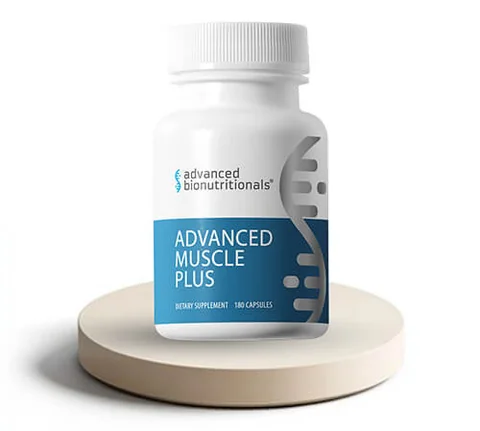
At a glance
Review summary
A formula containing DL185 dileucine, calcium HMB monohydrate (myHMB), vitamin D, and calcium, marketed for muscle health and recovery. Ingredient research and manufacturer claims are distinct from finished-product evidence.
Check current pricingAdvanced Muscle Plus discloses 2 g DL185 dileucine, 1.5 g calcium HMB monohydrate and vitamin D. The dileucine quantity resembles small ingredient trials, but the formula has no verified controlled human trial. Official materials conflict on vitamin D: the panel shows 200 mcg, while one sales page says 20 mcg.
Documentary review of product information and research; no personal use or testing is claimed. How we review supplements.
Verdict: The individually disclosed quantities allow a meaningful dose comparison, but the finished formula’s benefit is unverified and its HMB/vitamin D amounts do not reproduce the relevant combination trial. Consider it only for a specific interest in 2 g dileucine after confirming the actual lot and clinical suitability. For a general buyer, the unresolved label conflict and fixed vitamin D exposure outweigh convenience.
Advanced Muscle Plus combines branded dileucine with calcium HMB and vitamin D. Its most interesting feature is a disclosed 2,000 mg dileucine amount, comparable by labeled weight to doses in small human studies. That does not establish that the finished combination builds muscle. The more immediate buying question is a tenfold vitamin D discrepancy within the manufacturer’s own materials.
Our assessment: the formula has a plausible ingredient rationale, but the research does not justify its broad muscle-growth promises. The official Supplement Facts image lists 200 mcg vitamin D per serving, while another official sales page states 20 mcg. Confirm the actual bottle label and dose suitability before considering it. We cannot tell which formulation would arrive from these conflicting online materials.
This is a documentary review: we visually examined official online label images, checked manufacturer claims and offers, and compared human research on October 21, 2026. We did not purchase, use, swallow, or physically inspect the product. This review concerns Advanced Muscle Plus, not Advanced Muscle Plus Gold.
The label presents four amounts—and two unresolved conflicts
The Supplement Facts panel gives a serving size of 6 tablets and 30 servings per container. Per serving it lists vitamin D as cholecalciferol, 200 mcg, 1,000% Daily Value; calcium, 195 mg, 15% Daily Value; DL185 dileucine, 2,000 mg; and calcium beta-hydroxy-beta-methylbutyrate monohydrate (myHMB), 1,500 mg. Daily Values are not established for dileucine or the calcium HMB entry.
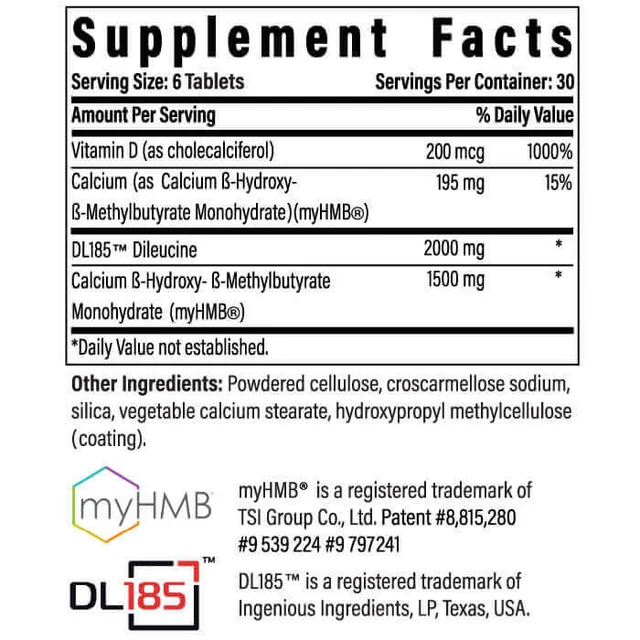
The enlarged panel and the separate back-of-bottle image both show 200 mcg vitamin D. The official New Peptide Pill sales page instead states 20 mcg. These equal 8,000 IU and 800 IU, respectively—a tenfold difference. We use the visible Supplement Facts for this label analysis, without assuming that the sales text is a typo or that every bottle in circulation matches that panel.
There is also a format conflict: Supplement Facts says tablets; the official front image says 180 capsules, and suggested use says six capsules daily, no more than one serving in 24 hours. Those images agree on 30 six-unit servings but do not establish whether the delivered units are tablets or capsules. Ask the manufacturer to identify the current lot’s format and vitamin D amount.
The other ingredients are powdered cellulose, croscarmellose sodium, silica, vegetable calcium stearate, and hydroxypropyl methylcellulose coating. Calcium is listed as coming from calcium HMB monohydrate: do not add 195 mg calcium to 1,500 mg of that salt as though they were unrelated added ingredients. Nor does the salt entry establish 1,500 mg of free HMB.
Dileucine is interesting, but an acute signal is not muscle growth
DL185 is a branded dileucine ingredient: a dipeptide made of two linked leucine units. Leucine’s role in muscle signaling helps explain the interest, but signaling, muscle protein synthesis, strength and muscle size are different outcomes. Our leucine and muscle protein synthesis guide explains that distinction in more detail.
Paulussen and colleagues’ 2021 randomized crossover study gave ten healthy young men 2 g dileucine or 2 g leucine. Over three hours, measured myofibrillar protein synthesis was higher with dileucine; muscle protein breakdown did not differ. Plasma leucine exposure did not differ significantly either. This was an acute metabolic experiment, not a study of months of growth, older adults, or Advanced Muscle Plus.
The sales page’s 159% synthesis figure needs a comparator. The study reports mean rates of 0.075 versus 0.047% per hour: dividing those means gives about 160% of the leucine rate, or about 60% higher—not 159% more muscle. This is our arithmetic comparison, not a separate clinical outcome. Neither those values nor a blood measurement verifies threefold faster absorption of this finished formula.
The training trial supports a narrower claim than the marketing
A 2024 randomized, double-blind trial by Hagele and colleagues followed 34 resistance-trained men, averaging about 28 years old, for ten weeks. Participants received 2 g/day dileucine monohydrate, leucine, or placebo and trained four days per week. Dileucine improved leg-press maximal strength more than placebo and leg-press repetitions more than leucine. There was no significant supplement effect on fat-free mass or the other principal outcomes reported in the abstract.
The paper identifies the study ingredient as RAMPS dileucine monohydrate from Ingenious Ingredients. The product label identifies DL185 from the same supplier. The 2 g amounts are comparable on paper, but the naming and hydration description do not establish analytically identical preparations or delivery. The supplier funded the trial; its small sample and retrospective registration also call for replication.
The manufacturer highlights a large leg-press gain. That should not become a promise of a buyer’s results: the experiment involved a particular machine, trained young men, and structured exercise. It did not demonstrate that this product restores aging muscle, improves balance, or produces muscle growth several times faster than food and exercise.
A newer 2025 crossover experiment adds context rather than confirmation. Aguilera and colleagues studied 12 recreationally active young adults using a beverage with 2 g dileucine inside a 9.15 g EAA mixture. Six-hour leucine retention was similar to BCAAs and higher than collagen; a urinary breakdown marker did not differ. Exploratory serum-treated cell findings were not long-term human muscle gains. The mixture was not Advanced Muscle Plus and cannot isolate dileucine’s contribution.
HMB findings change with the population and the question
HMB is a leucine metabolite, studied as calcium HMB and free-acid HMB. The 2024 International Society of Sports Nutrition position stand describes potential roles in recovery, disuse and selected older populations, while acknowledging mixed performance findings in trained athletes. It is more favorable than some pooled analyses. A position stand is useful context, not a reason to disregard negative trials or combine unlike preparations.
For training, two pooled analyses temper expectations. A 2020 systematic review found no significant additional fat-free-mass or strength benefit in younger adults. A 2026 meta-analysis of 13 trials involving 561 adults aged 50 or older likewise found no significant extra muscle-mass or strength benefit when HMB was added to resistance training. These results do not support routinely buying HMB to make an effective training program work better.
Disuse is a different question. Deutz and colleagues randomized 24 older adults to calcium HMB, reported as 3 g/day, or placebo during ten days of bed rest. Nineteen were evaluable afterward; the findings favored preservation of lean mass, with an analysis excluding one participant. Functional differences were not demonstrated. A small bed-rest study is not evidence that an active adult will gain muscle without training.
That distinction also limits the manufacturer’s muscle-loss percentage: an ingredient result from a specific protocol cannot be turned into a universal reduction in age-related loss. The product’s 1,500 mg calcium HMB monohydrate entry does not reproduce the 3 g/day protocol by labeled amount. Results from free-acid HMB cannot silently fill that gap. Our HMB evidence review separates training, disuse and recovery outcomes.
HMB plus vitamin D was studied—but not in these proportions
Rathmacher and colleagues’ 2020 controlled study evaluated 117 older adults with initially insufficient vitamin D levels over 12 months, with and without resistance exercise. The intervention supplied 3 g/day calcium HMB plus 2,000 IU/day vitamin D3. Some functional benefits were observed, particularly without exercise; lean-mass benefit was not consistently sustained. The design did not separate the independent effects of HMB and vitamin D, so it could not demonstrate synergy.
Compared with that protocol, this product lists half the calcium HMB amount by nominal weight and four times the vitamin D amount when using its 200 mcg panel. That is an important mismatch, not proof of underperformance or improved efficacy. The trial also contained no dileucine. It therefore cannot validate the three-ingredient combination or a claim that vitamin D makes DL185 work better.
Dose comparison: where the match ends
Dileucine: product 2,000 mg DL185 per serving; acute and training studies used 2 g, with the training paper specifying dileucine monohydrate. This is the closest numerical match, with preparation, population and finished-formula uncertainty remaining.
Calcium HMB monohydrate: product 1,500 mg of the labeled salt; the bed-rest and HMB-plus-vitamin-D trials used 3 g/day calcium HMB as reported. These are different nominal amounts. We have not converted the product’s salt weight to a verified free-HMB equivalent or assumed all study reports use an identical weight basis.
Vitamin D3: panel 200 mcg, equivalent to 8,000 IU; conflicting sales text 20 mcg, equivalent to 800 IU; the HMB combination trial used 50 mcg, or 2,000 IU/day. Neither online version reproduces that trial’s dose. Changing the number of units yourself would also change dileucine and HMB exposure and is not a way to validate the formula.
Vitamin D is the practical safety decision
NIH lists the U.S. adult tolerable upper intake level for vitamin D as 100 mcg, or 4,000 IU/day, from all sources. The visible 200 mcg serving is twice that level before other supplements or food. The upper limit is not an instant-toxicity threshold, and clinicians sometimes prescribe higher intakes for specific reasons; it is also not a target for muscle building.
Excess vitamin D can raise blood calcium and harm the kidneys. Review total vitamin D and calcium exposure, including multivitamins and bone-health products, with a clinician or pharmacist. Kidney impairment, hypercalcemia, hyperparathyroidism, or use of thiazide diuretics makes that discussion particularly relevant. The formula adds 195 mg calcium. Pregnancy, breastfeeding and use by minors require separate professional guidance; the manufacturer says it is not intended for people under 18.
Correcting low vitamin D status and adding more vitamin D to someone already sufficient are different decisions. The research reviewed here does not establish a dose-response in which more vitamin D produces more muscle benefit. A muscle-health goal alone does not justify accepting the high vitamin D amount shown on the current panel while the manufacturer’s materials remain inconsistent.
What the finished product has not demonstrated
We did not locate a controlled human trial of the exact Advanced Muscle Plus formula in the manufacturer’s cited literature, PubMed/Europe PMC searches, or an exact-name ClinicalTrials.gov search checked October 21, 2026. That is a search finding, not proof that no unpublished study exists. None of the three dileucine studies above tested this product.
Manufacturer positioning centers on mTOR activation, faster growth, less breakdown, improved strength and benefits in older adults, sometimes without hard exercise. Ingredient evidence offers limited support for particular mechanisms and selected outcomes. Finished-product evidence remains unverified for added growth, strength, absorption, recovery, balance, energy and synergy. Testimonials and early-user reports do not resolve those questions.
It is also not a protein powder, a complete protein, or a complete EAA mixture. It cannot stand in for adequate dietary protein. Our daily protein guide addresses that separate foundation. No creatine appears on the inspected panel; there is no basis here for calling this a creatine replacement or a superior alternative.
What the current price buys
The official product-page order grid checked October 21, 2026 displayed US$99.95 for one bottle, US$269.85 for three, and US$499.80 for six, marked as one-time payments. With 30 labeled servings per bottle, these work out to about US$3.33, US$3.00 and US$2.78 per serving before any applicable taxes or delivery charges. The three- and six-bottle offers advertise free shipping; destination eligibility was not checked.
Another official sales page still promotes US$2.15 a day while displaying the higher six-bottle grid. We cannot reconcile that promotional figure with US$499.80 divided by 180 servings. The existing catalog affiliate link leads to a separate official offer, whose final price and terms may differ. We did not place an order or verify checkout totals.
You are paying for branded dileucine, calcium HMB, vitamin D and the convenience of a fixed combination. Convenience comes with less dose control: wanting 2 g dileucine also means accepting the accompanying HMB and vitamin D amounts. We have not demonstrated savings over separate ingredients. Multiple ingredients and bundle pricing do not establish good value when the outcome advantage is uncertain.
Who has a reason to consider it—and who should pass
An adult specifically interested in the studied 2 g dileucine approach might put it on a shortlist after the manufacturer confirms the actual lot’s composition and after checking whether that vitamin D amount is appropriate for their total intake. Its clearest strength is that the major ingredient quantities are individually disclosed, allowing this comparison. That is a conditional reason to investigate the product, not a routine recommendation for muscle health.
It is a poor fit for anyone seeking proven results from the finished formula, independent control of HMB or vitamin D, a protein replacement, or a supplement to reverse unexplained weakness. If you already take vitamin D, cannot resolve the labeling conflict, or need a predictable low-dose supplement, the fixed formula is a reason to skip it. New or progressive weakness deserves assessment rather than a marketing-based supplement choice.
Our verdict would change with an independently replicated, controlled trial of the exact formula measuring meaningful strength and muscle outcomes in its intended users; consistent lot-specific label information; clearer preparation and HMB weight disclosure; or a formulation allowing a more appropriate vitamin D exposure. A lower delivered price could improve value, but it would not supply missing efficacy evidence.
Advanced Muscle Plus earns attention for a research-relevant dileucine quantity, not confidence in the complete formula’s promises. For now, uncertain finished-product benefit, mismatched HMB/vitamin D research doses, and contradictory official labeling outweigh the convenience for a general buyer.
Was this article helpful?
Your anonymous response helps improve our editorial coverage.
Loading feedback options…
Share
Share this article
Selected references
Recommended products
More from Planet Wellness Report
Continue Reading

Healthy Aging
How Muscle Mass Changes With Age—and What Actually Helps Preserve It
Muscle mass, strength and function change differently with age. Use an evidence-informed order of priorities to decide what to address first.
8 min read

Nutrition
HMB for Muscle Loss, Strength, and Recovery: What Human Research Actually Shows
HMB research differs across lifters, older adults, and clinical settings. Separate muscle size, strength, soreness, biomarkers, and function before judging a claim.
9 min read
Nutrition
Creatine Monohydrate for Muscle and Strength: What the Research Actually Shows
Creatine monohydrate can support some training outcomes. Separate strength, hypertrophy, lean mass, and water changes—and understand the safety evidence.
7 min read
Evidence
Sources
- Advanced BioNutritionals. Advanced Muscle Plus — Supplement Facts — Advanced BioNutritionals
- Advanced Bionutritionals. Advanced Muscle Plus — official product page, claims, directions and offers — Advanced Bionutritionals
- Advanced Bionutritionals. Advanced Muscle Plus — New Peptide Pill sales page — Advanced Bionutritionals
- Paulussen KJM, Alamilla RA, Salvador AF, McKenna CF, Askow AT, Fang HY, Li Z, Ulanov AV, Paluska SA, Rathmacher JA, Jäger R, Purpura M, Burd NA.. Dileucine ingestion is more effective than leucine in stimulating muscle protein turnover in young males: a double blind randomized controlled trial — Journal of applied physiology (Bethesda, Md. : 1985) (Jul 29, 2021) · DOI
- Hagele AM, Krieger JM, Gaige CJ, Holley KF, Gross KN, Iannotti JM, Allen LE, Sutton PJ, Orr LS, Mumford PW, Purpura M, Jager R, Kerksick CM.. Dileucine ingestion, but not leucine, increases lower body strength and performance following resistance training: A double-blind, randomized, placebo-controlled trial — PloS one (Dec 31, 2024) · DOI
- Aguilera JA, Tinline-Goodfellow CT, Lees MJ, Kortebi I, West DWD, Abou Sawan S, Sharma M, Bashir R, Barnes TM, Ulanov AV, Burd NA, Moore DR.. Dileucine-supplemented essential amino acids support whole-body anabolism after resistance exercise and serum-stimulated cell-based anabolism — Journal of the International Society of Sports Nutrition (Nov 30, 2025) · DOI
- Jakubowski JS, Nunes EA, Teixeira FJ, Vescio V, Morton RW, Banfield L, Phillips SM.. Supplementation with the Leucine Metabolite β-hydroxy-β-methylbutyrate (HMB) does not Improve Resistance Exercise-Induced Changes in Body Composition or Strength in Young Subjects: A Systematic Review and Meta-Analysis — Nutrients (May 23, 2020) · DOI
- Wang G, Jawed I, Tufail M, Sharaf MS, Bin Gulzar AH, Qurat Ul Ain H, Umair M, Kumar D, Jabeen S.. Efficacy of HMB supplementation as an adjunct to resistance training in older adults: a comprehensive meta-analysis — Age and ageing (Mar 1, 2026) · DOI
- Deutz NE, Pereira SL, Hays NP, Oliver JS, Edens NK, Evans CM, Wolfe RR.. Effect of β-hydroxy-β-methylbutyrate (HMB) on lean body mass during 10 days of bed rest in older adults — Clinical nutrition (Edinburgh, Scotland) (Mar 4, 2013) · DOI
- Rathmacher JA, Pitchford LM, Stout JR, Townsend JR, Jäger R, Kreider RB, Campbell BI, Kerksick CM, Harty PS, Candow DG, Roberts BM, Arent SM, Kalman DS, Antonio J.. International society of sports nutrition position stand: β-hydroxy-β-methylbutyrate (HMB) — Journal of the International Society of Sports Nutrition (Dec 19, 2024) · DOI
- Rathmacher JA, Pitchford LM, Khoo P, Angus H, Lang J, Lowry K, Ruby C, Krajek AC, Fuller JC Jr, Sharp RL.. Long-term Effects of Calcium β-Hydroxy-β-Methylbutyrate and Vitamin D3 Supplementation on Muscular Function in Older Adults With and Without Resistance Training: A Randomized, Double-blind, Controlled Study — The Journals of Gerontology: Series A (Aug 28, 2020) · DOI
- Office of Dietary Supplements. Vitamin D — Health Professional Fact Sheet — NIH Office of Dietary Supplements