
REVIEW
Advanced Mitochondrial Formula Review: Many Ingredients, Which Dose Matches?
Compare Advanced Mitochondrial Formula’s listed quantities with human research and dated cost per serving, without assuming 11 ingredients improve dose alignment.
By Planet Wellness Report · Oct 10, 2026 · 7 min read
Editorial review and publication: Felipe Lopes, Publisher & Editor. This is an editorial review, not a medical review.

At a glance
Review summary
Two-capsule multi-ingredient formula with individually disclosed amounts, including CoQ10 50 mg, acetyl L-carnitine 190 mg and PQQ disodium salt 5 mg. Ingredient research does not establish the combination’s energy effect.
Check current pricingAdvanced Mitochondrial Formula puts individually disclosed quantities into two capsules, including CoQ10 50 mg, acetyl L-carnitine 190 mg and PQQ disodium salt 5 mg. CoQ10 has relevant human fatigue research, and the fixed formula may suit someone who deliberately wants these ingredients together. That is ingredient-level context: differing doses, preparations and populations prevent a reliable prediction of benefit, and no controlled efficacy trial of the current combination was verified.
Documentary review of product information and research; no personal use or testing is claimed. How we review supplements.
Verdict: An adult who deliberately wants these disclosed ingredients and amounts together may reasonably consider the two-capsule format after a suitability check. Convenience and individual-dose disclosure are the clearest product strengths; CoQ10 provides the most direct fatigue-research connection in this review. The 50 mg entry and the other components do not establish a match to the relevant interventions or a benefit from the finished formula. Choose individually controlled dosing when one studied preparation is the goal. Savings over separate supplements were not demonstrated, and unexplained persistent fatigue needs assessment.
Eleven ingredients do not answer the most useful buying question: do these particular amounts match the intervention you intend to evaluate? Advanced Mitochondrial Formula lists CoQ10 50 mg, acetyl L-carnitine 190 mg and PQQ disodium salt 5 mg in a two-capsule serving. A known amount makes comparison possible; it does not establish a meaningful fatigue benefit. [2]
We rechecked the current official panel and offer on October 19, 2026. This is an analysis of dose alignment, clinical context and dated package costs, not personal use, batch testing or a claim of improved energy.
What you get in one bottle
The rechecked official panel lists two capsules per serving and 30 servings per container: 60 capsules, or 30 labeled daily servings. These individual quantities make the blend more inspectable than a proprietary total. [2]
The product card identifies the same product and affiliate route reviewed here. It does not verify an effect from combining the listed compounds.
The confirmed formula
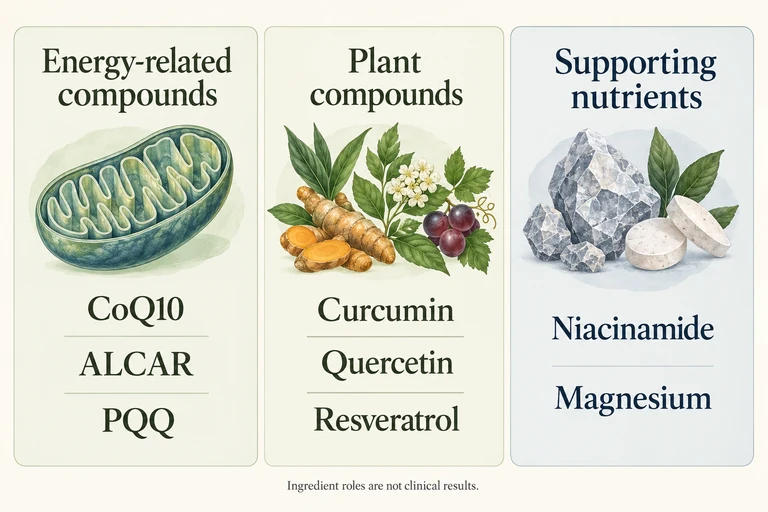
All quantities below are per two-capsule serving on the official panel: niacinamide 200 mg; magnesium as magnesium malate 45 mg; curcumin extract standardized to 95% curcuminoids 180 mg; black pepper extract, labeled BioPerine, 10 mg; quercetin dihydrate 65 mg; acetyl L-carnitine 190 mg; coenzyme Q10 50 mg; R-alpha lipoic acid 50 mg; D-ribose 250 mg; trans-resveratrol 25 mg; and pyrroloquinoline quinone disodium salt 5 mg.
The panel also lists an HPMC capsule, cellulose, silica, and calcium stearate. It prints a botanical name for the pepper extract that warrants clarification with the manufacturer if botanical identity matters to your decision. We have retained the panel's plain ingredient name instead of silently correcting that detail. Check the label on the bottle you receive because formulations can change.
A mitochondrial theme is not a dose-matching method
The manufacturer positions the product [1] around mitochondrial health and energy production. That theme connects several of its ingredients, but biological involvement in energy metabolism is different from demonstrating that supplementation makes someone feel more energetic.
CoQ10, niacin-related metabolism and magnesium have real biological roles. Curcumin, quercetin and other compounds add research themes. Those connections do not show that smaller quantities complement one another to produce the result of a different intervention.
Read each research result with its dose and outcome
CoQ10: the strongest direct fatigue research in this review
A 2022 meta-analysis pooled 13 CoQ10 trials involving 1,126 participants and found less fatigue overall across varied protocols. Its CoQ10-only subgroup was favorable, while compound formulations did not show the same statistically significant result. The label’s 50 mg CoQ10 is interpretable as an ingredient amount; the synthesis does not establish that 50 mg in these capsules reproduces the result. The panel does not identify it as ubiquinol. [2] [5]
A 2025 meta-analysis in people with depression [6] found no statistically significant fatigue benefit, based on only two fatigue trials with substantial heterogeneity. It studied a different clinical context and does not erase the earlier result, but it shows why a uniform energy promise would be excessive. Our guide to CoQ10 and energy covers the wider evidence without turning this review into a second CoQ10 article.
Acetyl L-carnitine: relevant research in selected populations
A randomized trial in 96 adults over 70 with a defined fatigue context reported improvements with acetyl L-carnitine. The population and intervention do not establish a benefit from this formula’s 190 mg in otherwise healthy younger adults. We do not label 190 mg a proven ineffective dose; we also do not count the ingredient’s presence as a successful study match. [2] [8]
PQQ: a useful example of a marker versus a result you feel
The PQQ trial gave 23 untrained men 20 mg/day or placebo alongside training. It changed a mitochondrial-biogenesis-related marker without improving aerobic performance more than placebo. This label lists 5 mg of PQQ disodium salt, not the same stated quantity or necessarily the same mass basis. Neither matching the 20 mg number nor adding other ingredients would convert that null performance finding into an energy promise. [2] [7]
Alpha-lipoic acid: study context matters
Alpha-lipoic acid has clinical research beyond the energy-supplement category. A 2024 Cochrane review in diabetic peripheral neuropathy [9] found little or no improvement in symptoms at six months. That review concerns a specific condition and endpoint. It neither proves an energy benefit for this formula nor establishes that the formula is ineffective; it illustrates why citing “human research” requires naming what was actually tested.
Niacinamide and magnesium: nutrients with real roles
The NIH niacin fact sheet [10] explains vitamin B3's role in NAD and NADP. The labeled 200 mg of niacinamide is not interchangeable with evidence for other NAD-related interventions, and it should not be described as a proven energy upgrade in a nutrient-replete adult.
The NIH magnesium fact sheet [11] describes its role in energy production and other biochemical processes. The 45 mg serving contributes magnesium, but this product should be evaluated as a combined formula rather than a dedicated high-dose magnesium supplement. A biological requirement is not proof that extra intake improves energy when intake is already adequate.
The remaining compounds
Curcumin 180 mg, quercetin dihydrate 65 mg, trans-resveratrol 25 mg, D-ribose 250 mg and pepper extract 10 mg expand the list. Their disclosed weights do not show that this selection compensates for a smaller amount of another component. If your objective is one ingredient at a controlled dose, adding unrelated compounds makes adjustment harder rather than demonstrating deeper evidence. [2]
What would test the many-ingredient hypothesis?
No independent controlled efficacy trial of the exact currently labeled Advanced Bionutritionals formula was verified in the literature reviewed. Mechanisms and trials of different combinations do not fill that gap.
A direct trial of this composition against placebo could test its effect; a relevant comparison with a simpler formula could test added benefit. Until then, the ingredient count is not evidence that the chosen modest amounts are sufficient or synergistic.
Safety and fit with your circumstances
A multi-ingredient supplement deserves a medication check, especially if you already take overlapping products. NCCIH's CoQ10 guidance [12] notes possible interactions with warfarin and insulin and potential incompatibility with some cancer treatments. Mild digestive symptoms or insomnia can occur with CoQ10.
Magnesium can interfere with absorption of some antibiotics and other medicines, and impaired kidney function requires additional caution. Review the complete formula with a pharmacist rather than assuming that amounts below those in a trial guarantee compatibility. Pregnancy, breastfeeding, active treatment, or a planned procedure are circumstances where suitability needs an individual discussion.
Persistent unexplained fatigue should not be attributed to “aging mitochondria” from a sales page. Our guide to tiredness despite sleep puts that symptom into a broader context. Supplement comparison can sit alongside the habits in getting more energy naturally.
A dated cost for this composition—not for an imagined stack
The official offer checked October 19, 2026 displayed $79.95 for one bottle, $214.95 for three, and $399.90 for six. At 30 servings per bottle, the product-only cost is about $2.67, $2.39 and $2.22 per serving. Add applicable shipping/tax and check the actual payment selection. The retail page was not retrievable for an independent cross-check. [1] [3]
The offer describes a 90-day return promise including empty bottles; earlier general-policy wording referred to unopened bottles and buyer-paid return shipping. We could not re-retrieve the general policy in this update. Confirm the order-specific written conditions rather than assuming identical terms across sales routes. [3] [4]
We did not price a dose-equivalent set of separate supplements, so no saving from combining 11 ingredients was demonstrated. Reconstructing the bottle is also not the same as buying a clinically useful intervention. Decide the target ingredient, dose and purpose first; a fixed mixture may reduce the number of containers while reducing dose control.
Choose the fixed amounts—or keep individual control
An adult who deliberately prefers these exact quantities together and has checked suitability may consider the two-capsule format. Its useful feature is individual disclosure. Someone trying to reproduce a particular ingredient intervention should prefer a formulation whose preparation and amount can actually be matched; persistent fatigue needs assessment, not an assumption about mitochondria.
The answer to whether many ingredients compensate for modest amounts is unresolved, not yes by ingredient count. A controlled trial of the current formula, clearer preparation identities, or a formulation change toward a relevant tested intervention could change the judgment. A lower package price would change cost but would not establish a clinical advantage.
Planet Wellness Report may earn a commission if you purchase through qualifying links on this page. Affiliate compensation does not determine how evidence is evaluated or the conclusions of this review.
Editorial update, October 19, 2026: Replaced breadth-led endorsements with dose and outcome comparisons, preserved null findings, and calculated dated per-serving costs without a fictional separate-supplement saving. This is a documentary reassessment; no personal use or clinical product test is claimed.
Was this article helpful?
Your anonymous response helps improve our editorial coverage.
Loading feedback options…
Share
Share this article
More from Planet Wellness Report
Continue Reading

Energy
CoQ10 vs PQQ for Mitochondrial Health: Evidence, Energy, and Practical Use
Compare CoQ10 and PQQ by human evidence, fatigue, exercise, cognition, safety, and combination research—without assuming a universal winner.
9 min read

Energy
Acetyl-L-Carnitine for Energy and Fatigue: What Human Research Actually Shows
Acetyl-L-carnitine has fatigue research in selected clinical and older populations. See what the findings mean for healthy adults, exercise, and safety.
8 min read
Energy
PQQ and Mitochondrial Health: What Human Research Actually Shows
What do PQQ supplements actually do? Explore human research on mitochondrial markers, energy, fatigue, sleep, cognition, and exercise performance.
7 min read
Evidence
Sources
- Advanced Mitochondrial Formula — Advanced Bionutritionals
- Advanced Mitochondrial Formula — Supplement Facts — Advanced Bionutritionals
- Advanced Mitochondrial Formula — Official offer and FAQ — Advanced Bionutritionals
- Shipping and Returns — Advanced Bionutritionals
- I-Chen Tsai; Chih-Wei Hsu; Chun-Hung Chang; Ping-Tao Tseng; Ke-Vin Chang. Effectiveness of Coenzyme Q10 Supplementation for Reducing Fatigue: A Systematic Review and Meta-Analysis of Randomized Controlled Trials — Frontiers in Pharmacology (Aug 24, 2022) · DOI
- Effects of Coenzyme Q10 Supplementation on Depressive Symptoms and Fatigue: A Systematic Review and Meta-Analysis of Randomized Controlled Trials — Journal of Clinical Psychopharmacology (Nov 26, 2025) · DOI
- Hwang PS, Machek SB, Cardaci TD, Wilburn DT, Kim CS, Suezaki ES, Willoughby DS.. Effects of Pyrroloquinoline Quinone (PQQ) Supplementation on Aerobic Exercise Performance and Indices of Mitochondrial Biogenesis in Untrained Men — Journal of the American College of Nutrition (Dec 20, 2019) · DOI
- Malaguarnera M, Gargante MP, Cristaldi E, Colonna V, Messano M, Koverech A, Neri S, Vacante M, Cammalleri L, Motta M.. Acetyl L-carnitine (ALC) treatment in elderly patients with fatigue — Archives of gerontology and geriatrics (Jul 20, 2007) · DOI
- Baicus C, Purcarea A, von Elm E, Delcea C, Furtunescu FL.. Alpha-lipoic acid for diabetic peripheral neuropathy — The Cochrane database of systematic reviews (Jan 11, 2024) · DOI
- Niacin — Health Professional Fact Sheet — NIH Office of Dietary Supplements
- Magnesium — Health Professional Fact Sheet — NIH Office of Dietary Supplements (Jan 6, 2026)
- Coenzyme Q10 — National Center for Complementary and Integrative Health