
ARTICLE
Phosphatidylserine for Memory: What Human Research Actually Shows
By Planet Wellness Report · Oct 19, 2026 · 8 min read
Editorial review and publication: Felipe Lopes, Publisher & Editor. This is an editorial review, not a medical review.

Phosphatidylserine has a real role in cell membranes. That does not establish that taking extra phosphatidylserine meaningfully improves memory. Human supplementation studies are mixed, and their findings depend on the preparation, the people studied, and the particular cognitive test.
The most useful answer is cautious: selected studies in adults with memory complaints or cognitive impairment report benefits on particular measures, but consistent improvement in healthy adults has not been established. A 2026 randomized preprint did not meet its primary memory endpoint. Neither that trial nor older research establishes prevention or treatment of dementia.
What phosphatidylserine does in the body
Phosphatidylserine, usually shortened to PS, is a phospholipid: a fat-containing component of cell membranes. It is made within the body and participates in membrane organization and cellular signaling. Its presence in nerve cells helps explain scientific interest; a normal biological function is a reason to investigate supplementation, not proof that more is better.
PS also occurs in foods, including fish, meat, and some plant foods. Dietary intake is different from swallowing a concentrated preparation. Modern supplements commonly use plant-derived material, including soy lecithin. A label should identify the source and the amount of PS itself, if disclosed, rather than leaving the reader to infer it from the weight of a complex.
The phosphatidylserine ingredient overview provides broader context. This article focuses on measured human cognitive outcomes, where a plausible membrane mechanism has to stand up to controlled testing.
Memory is several different outcomes
Episodic memory concerns events and experiences. Recall tests ask someone to retrieve information, such as a word list, either immediately or after a delay. Recognition, which supplies possible answers, is another task. A change in one does not automatically mean better performance in the others.
Working memory is the short-term handling of information while doing something with it. Attention concerns selecting and sustaining focus. Processing speed measures how quickly information is handled; motor speed also depends on executing a response. Executive function includes planning, switching tasks, and controlling responses. None is interchangeable with remembering an appointment.
Subjective memory complaints describe what someone notices about their own memory. Global cognition combines broader abilities into a score. Dementia-related outcomes include sustained cognitive decline, everyday functioning, and disease progression. A short test improvement cannot establish that a supplement prevents dementia or preserves independent living.

What the 2026 trial actually found
A September 2026 medRxiv preprint studied 70 adults aged 35–65 with subjective memory complaints. Participants received 300 mg daily of soybean-derived PS or placebo for 12 weeks. The available report describes the participants as healthy adults with complaints; this is not the same population as people with diagnosed dementia, or adults without any perceived memory difficulty.
In the prespecified primary analysis, the composite memory score did not differ significantly between groups at week 12. This is the trial's principal result. It does not support describing the trial as a successful demonstration of improved overall memory.
Exploratory secondary analyses suggested differences in working memory and motor speed. These findings can guide future studies, but they cannot replace the non-significant primary endpoint. Testing several outcomes increases the opportunity for chance findings, and motor speed is not itself proof of better memory. The reported variation with blood fatty-acid profiles is also exploratory.
This report was available as a preprint when checked on October 19, 2026; peer review and independent replication matter. It is reasonable to retain the possibility of a selective effect while recognizing that meaningful everyday benefit remains uncertain.
Older adults: encouraging findings sit beside negative trials
A 2022 systematic review and meta-analysis reported a favorable memory signal in older adults with cognitive decline. It included nine studies: five randomized trials and four pre-post studies. The distinction matters because improvement over time without a placebo comparison can reflect practice, expectations, or other changes. A positive pooled conclusion should not erase differences between designs and preparations.
A randomized 2001 study is an important counterweight. It assigned 120 older adults with age-associated memory impairment to placebo, 300 mg soy-derived PS, or 600 mg daily. At 6 and 12 weeks, it found no significant treatment differences across the measured cognitive outcomes, including the primary delayed-recall and recognition measures. Planning, attention, and reaction-time testing did not establish a general cognitive benefit either.
A 2010 Japanese trial enrolled 78 adults aged 50–69 with memory complaints and tested 100 or 300 mg soy-derived PS for six months. Scores improved across groups, including placebo. The reported signals in people with lower baseline scores, particularly delayed verbal recall, require more caution than a clear overall treatment effect. Subgroup and within-group improvements are not equivalent to broad superiority over placebo.
These studies leave uncertainty about who might benefit and by how much. They do not justify promising that any older adult will notice sharper memory, nor do they establish a standard dose for everyone. The memory and aging guide addresses the broader context of everyday cognitive health.
Clinical populations and combination products answer different questions
A 12-month randomized trial published in 2024 enrolled 190 Chinese older adults with mild cognitive impairment. Its supplement included PS alongside alpha-linolenic acid, ginkgo components, and B vitamins. Improvements in selected short-term memory and other tests apply to that combination and clinical population. The design cannot determine which ingredient produced an effect.
Earlier dementia research also includes bovine-derived PS and combinations such as soy-derived PS plus phosphatidic acid. A 2014 report of earlier pilot studies described selected memory or daily-function findings with PS plus phosphatidic acid. Short follow-up, combination treatment, and analysis choices limit what can be concluded about PS alone. Such findings do not establish dementia prevention, reversal, or disease modification.
A 2026 systematic review of controlled trials examined citicoline and PS-containing interventions in mental disorders. Its 11 studies included pediatric ADHD and adult psychiatric populations, with heterogeneous and inconsistent results and substantial methodological concerns. Attention or impulsivity findings in children with ADHD are not evidence of memory enhancement in healthy adults. Citicoline results are not PS results.
Likewise, two exploratory 2026 trials of a standardized ginkgo–PS combination reported selected cognitive or stress findings. They cannot isolate PS, and they do not validate a different retail blend. Readers comparing ingredients can consult the separate Bacopa evidence article and Ginkgo evidence article, rather than assuming that ingredients with similar marketing have equivalent evidence.
Why historical PS research may not fit today's bottle
Much of the PS literature is decades old. Early studies often used material derived from bovine cortex. Modern soy-derived products have a different source and lipid composition. Other studies use PS enriched with fatty acids, PS plus phosphatidic acid, or multi-ingredient preparations.
These products share a name or component, but they are not automatically interchangeable interventions. Source, purity, actual PS amount, accompanying lipids, and other active ingredients can all matter. An older positive bovine-PS study cannot simply be assigned to a modern soy complex; a negative soy trial should also be identified by its preparation.
This makes a precise label more useful than a large number on the front of a bottle. Even matching a trial's nominal milligrams would not guarantee the same effect, and matching the weight of a complex is not necessarily matching the amount of PS.
Safety: short studies leave long-term questions
A randomized safety study in 120 older adults evaluated 300 or 600 mg of soy-derived PS daily for 12 weeks. It found no significant group differences in the assessed safety measures after statistical correction. The 2026 preprint also reported good tolerability. These results are reassuring within those study conditions, rather than a guarantee for years of use or for every medical condition.
Cleveland Clinic lists upset stomach, gas, and insomnia among possible PS side effects; the controlled PS evidence does not provide a dependable frequency estimate for each symptom. If symptoms begin after use, stop and discuss them with a clinician. Do not assume that a reaction to a blend identifies PS as the cause.
Soy-derived products require attention to the actual allergy labeling. Safety evidence during pregnancy and breastfeeding is insufficient. Long-term medication-interaction evidence for isolated PS is also limited; this review did not verify a reliable basis for declaring a specific anticoagulant interaction with PS itself. A blend containing ginkgo requires its own medication assessment, rather than attributing all possible interactions to PS.
New or worsening memory problems, especially those affecting daily activities, deserve clinical assessment. Supplements should not postpone evaluation of potentially treatable causes or suspected cognitive disease.
How Advanced Memory Formula fits this evidence
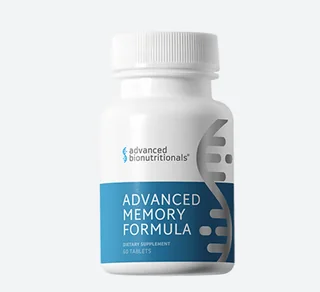
For readers already comparing multi-ingredient memory supplements, Advanced Memory Formula is a contextual option to examine with a clinician. Its current official Supplement Facts image lists “Phosphatidylserine Complex (from soy lecithin)” at 150 mg per serving of 2 tablets. The panel does not establish that this equals 150 mg of purified PS, and this article does not treat it as equivalent to the PS doses used in trials.
The formula also includes ginkgo, bacopa, a GPC ingredient supplying alpha-GPC, acetyl L-carnitine, blueberry, luteolin, lecithin, coffee fruit concentrate, calcium, and phosphorus. These additional ingredients change both the evidence question and the safety assessment. The current label image used here differs from some older manufacturer page text; check the physical bottle before use.
Studies of PS do not prove efficacy of the finished Advanced Memory Formula product. No controlled study of the complete currently labeled formula was verified for this article. Its inclusion is an opportunity to assess composition and limitations, not an endorsement that it improves memory. The Advanced Memory Formula review covers the product separately; the recommendation card below is the article's single affiliate recommendation.
A realistic decision about phosphatidylserine
PS is biologically relevant, but the clinical question remains unsettled. Evidence is more substantial in people with memory complaints or cognitive impairment than in healthy adults without complaints, yet results within those populations are mixed. Selected test findings do not establish global cognitive enhancement, dementia prevention, or a noticeable daily-life benefit.
If considering supplementation, identify the exact preparation and actual disclosed PS content, decide which outcome matters, and review the full product with a clinician. The non-significant primary endpoint in the 2026 preprint and the negative older soy trial belong in that decision alongside the more encouraging findings.
Was this article helpful?
Your anonymous response helps improve our editorial coverage.
Loading feedback options…
Share
Share this article
Selected references
Recommended products
More from Planet Wellness Report
Continue Reading
Focus
What to Look for in a Memory Supplement: Ingredients, Doses, and Evidence
Learn how to evaluate a memory supplement before buying: active amounts, standardized extracts, study populations, memory outcomes, and evidence for the complete formula.
12 min read

Focus
Advanced Memory Formula Review: Reading the Doses Behind the Ingredient List
The two-tablet formula lists individual amounts, but disclosure is uneven: its GPC line implies about 125 mg alpha-GPC, while 150 mg PS complex does not identify pure PS content. Some ingredients have human cognitive research; the current combination has no controlled efficacy trial verified in this review.
8 min read

Focus
Bacopa vs Ginkgo for Memory: Evidence, Differences, and Practical Use
Compare Bacopa and Ginkgo evidence by cognitive outcome, population, extract, duration, safety, and the limits of the 2026 network meta-analysis.
9 min read
Evidence
Sources
- Kucuksahin NG, Kaya TT, Halac E, Sut E, Ciray RO.. The Impact of Citicoline/Phosphatidylserine Supplementation on Cognitive Performance and Executive Functions in Mental Disorders: A Systematic Review of Controlled Trials — Human psychopharmacology (Sep 1, 2026) · DOI
- Liu Y, Tang Y, Neoh GK, Lu Y, Takara T, Jiang S.. Effects of Soybean-derived Phosphatidylserine on Working Memory and Motor Speed in Healthy Adults with Subjective Memory Complaints: A 12-Week Randomized, Placebo-Controlled Trial — medRxiv (Sep 24, 2026) · DOI
- Jorissen BL, Brouns F, Van Boxtel MP, Ponds RW, Verhey FR, Jolles J, Riedel WJ.. The influence of soy-derived phosphatidylserine on cognition in age-associated memory impairment — Nutritional neuroscience (Jan 1, 2001) · DOI
- Kato-Kataoka A, Sakai M, Ebina R, Nonaka C, Asano T, Miyamori T.. Soybean-derived phosphatidylserine improves memory function of the elderly Japanese subjects with memory complaints — Journal of clinical biochemistry and nutrition · DOI
- Jorissen BL, Brouns F, Van Boxtel MP, Riedel WJ.. Safety of soy-derived phosphatidylserine in elderly people — Nutritional neuroscience (Oct 1, 2002) · DOI
- Glade MJ, Smith K.. Phosphatidylserine and the human brain — Nutrition (Burbank, Los Angeles County, Calif.) (Nov 4, 2014) · DOI
- Moré MI, Freitas U, Rutenberg D.. Positive effects of soy lecithin-derived phosphatidylserine plus phosphatidic acid on memory, cognition, daily functioning, and mood in elderly patients with Alzheimer's disease and dementia — Advances in therapy (Nov 21, 2014) · DOI
- Duan H, Xu N, Yang T, Wang M, Zhang C, Zhao J, Li Z, Chen Y, Yan J, Zhang M, Li W, Yue Z, Ma F, He R, Huang G.. Effects of a food supplement containing phosphatidylserine on cognitive function in Chinese older adults with mild cognitive impairment: A randomized double-blind, placebo-controlled trial — Journal of affective disorders (Sep 22, 2024) · DOI
- Hawkins K, Davis J, Matias CA, Wilson G, Lowery R, Misiano P, Petrangolini G, Wilson J.. Health Benefits of a Standardized Ginkgo biloba Extract Associated With Phosphatidylserine in Alleviating Mental Stress and Cognitive Performance: Results From Two Exploratory Randomized Trials — Food science & nutrition (Jun 11, 2026) · DOI
- Eun Young Kang, Fengjiao Cui, Hyun Kyung Kim, Hadia Nawaz, Sumin Kang, Hayoon Kim, Jihye Jang, Gwang-woong Go. Effect of phosphatidylserine on cognitive function in the elderly: A systematic review and meta-analysis — Korean Journal of Food Science and Technology · DOI
- Advanced Memory Formula — Supplement Facts — Advanced Bionutritionals
- National Institute on Aging. Memory Problems, Forgetfulness, and Aging — National Institute on Aging / National Institutes of Health
- Cleveland Clinic. Phosphatidylserine: What It Is, Benefits, Side Effects & Uses — Cleveland Clinic (Jul 14, 2023)