ARTICLE
Signs You’re Not Getting Enough Protein: What to Watch For
Low protein intake can affect muscle and overall nutrition, but most warning signs are nonspecific. Here is how to interpret them without jumping to conclusions.
By Planet Wellness Report · Sep 29, 2026 · 13 min read
Editorial review and publication: Felipe Lopes, Publisher & Editor. This is an editorial review, not a medical review.
Protein is essential for building and maintaining tissues, producing enzymes and other functional molecules, supporting immune function, and providing amino acids the body cannot make on its own. When intake is consistently inadequate, the effects can eventually become noticeable—but they are not always obvious or specific.
That distinction matters because symptoms commonly blamed on low protein, such as fatigue, hair changes, weakness, or slower recovery, can have many other causes. A single symptom cannot confirm a protein deficiency, and clinical malnutrition is assessed using a broader picture that includes dietary intake, weight change, muscle and fat loss, fluid accumulation, functional status, health conditions, and other findings.
For adults with reliable access to food and an otherwise balanced diet, severe isolated protein deficiency is uncommon. Mildly inadequate intake is more likely to show up as part of a broader nutrition problem, low calorie intake, restrictive eating pattern, illness, poor appetite, or increased nutritional needs.
Signs You May Not Be Getting Enough Protein: The Short Answer
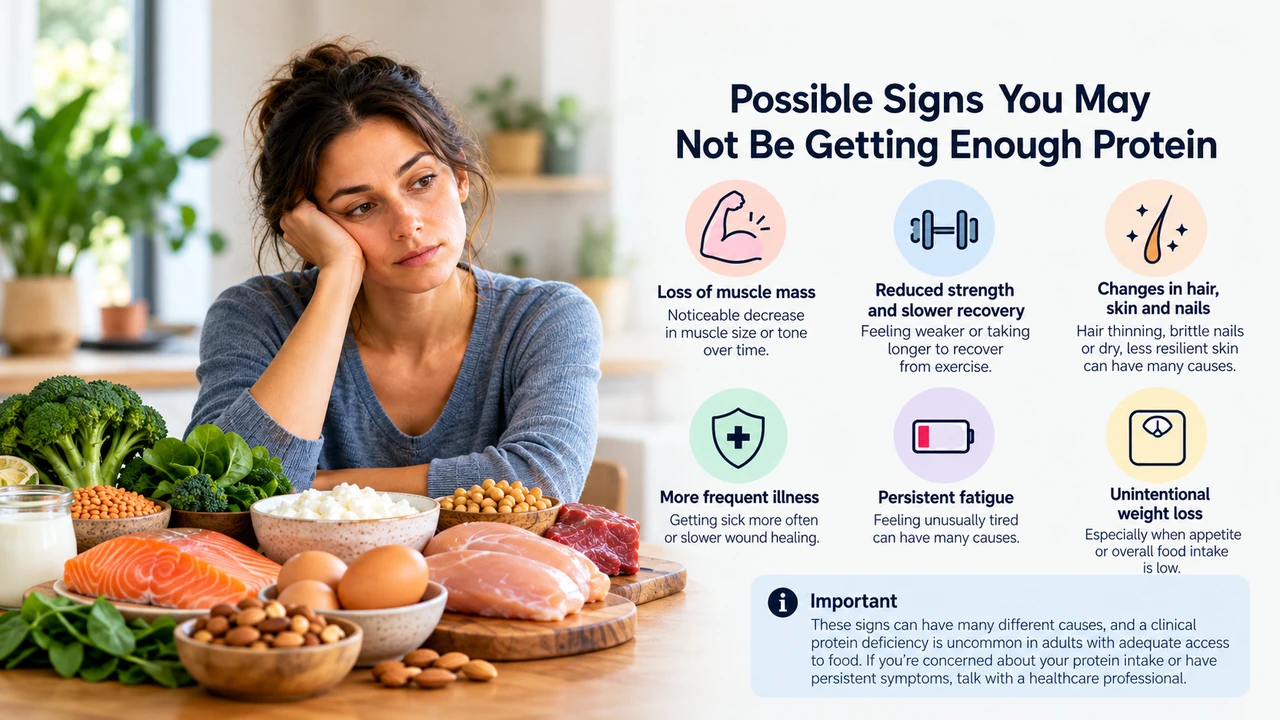
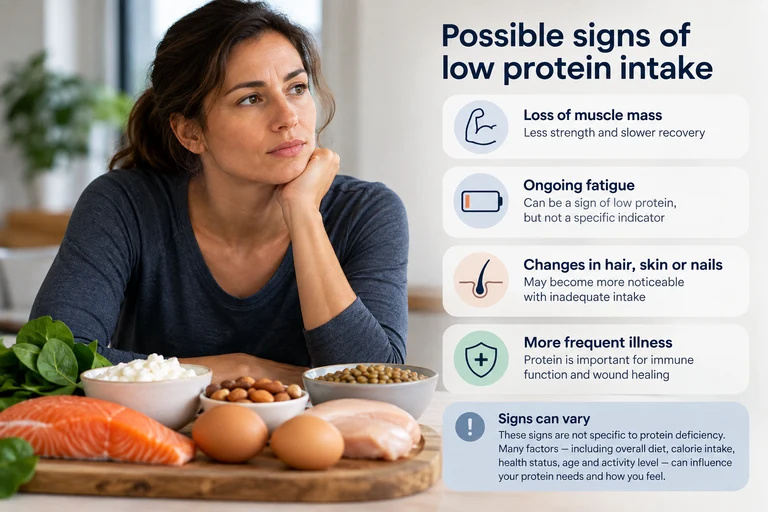
Possible signs can include loss of muscle mass, reduced strength, slower recovery, unintended weight loss, changes in hair, skin, or nails, and more frequent illness or slower wound healing. In severe protein-energy malnutrition, swelling caused by fluid accumulation can also occur.
However, none of these findings is specific to protein deficiency. Fatigue can result from poor sleep, stress, anemia, thyroid disease, infection, medications, depression, dehydration, or many other causes. Hair loss can have hormonal, genetic, nutritional, or medical explanations. Loss of muscle can reflect aging, inactivity, illness, or inadequate overall calorie intake as well as low protein.
The most useful question is not whether one symptom matches a checklist. It is whether your overall diet, weight trend, appetite, health status, physical function, and protein intake suggest that nutritional intake may be inadequate.
What Does Protein Deficiency Actually Mean?
Protein deficiency exists on a spectrum. At one end, a person may simply consume less protein than is appropriate for their needs for an extended period. At the other end is severe protein-energy malnutrition, which usually occurs alongside insufficient calorie intake, illness, impaired absorption, or other major nutritional problems.
The adult Recommended Dietary Allowance for protein is 0.8 grams per kilogram of body weight per day for healthy adults in the general population. This reference is intended to meet the needs of nearly all healthy adults, but it is not a universal target for every circumstance.
Older adults, people recovering from illness, individuals with poor appetite, and people with unusually high activity or training demands may have different practical needs. A low number on a tracking app also does not automatically mean a clinical deficiency exists.
1. Loss of Muscle Mass
Muscle tissue is continually being broken down and rebuilt. Dietary protein supplies the amino acids required for muscle protein synthesis, so persistently inadequate protein intake can make it harder to maintain muscle, especially when total calorie intake is also low.
This does not mean every loss of muscle is caused by low protein. Aging, inactivity, prolonged bed rest, chronic illness, weight loss, low energy intake, and changes in hormones or medications can all contribute.
In older adults, observational evidence has found lower protein intake among people with sarcopenia compared with those without it. That association does not prove that low protein alone causes sarcopenia, but it supports considering protein intake as one part of a broader muscle-health assessment.
2. Reduced Strength or Slower Recovery
Strength can decline when muscle mass decreases, and inadequate nutrition can also make recovery from training, illness, or injury more difficult. Because protein contributes amino acids needed for tissue repair and remodeling, consistently inadequate intake can be relevant when strength or recovery is worsening.
Still, poor recovery has many possible explanations. Training volume may be too high, sleep may be inadequate, total calorie or carbohydrate intake may be low, or an illness or medical condition may be interfering with recovery.
For that reason, reduced strength or slower recovery should be viewed as a reason to examine the whole routine rather than as proof that more protein is automatically the answer.
3. Unintended Weight Loss
Unintentional weight loss is an important nutritional warning sign, especially when it occurs alongside poor appetite, reduced food intake, weakness, or loss of muscle.
In these situations, the issue is often broader than protein alone. A person who is eating too little overall may be falling short on protein, calories, vitamins, minerals, and other nutrients at the same time.
Persistent or unexplained weight loss deserves medical evaluation because it can also be associated with gastrointestinal disease, endocrine disorders, cancer, infection, depression, medication effects, and other conditions unrelated to protein intake.
4. Changes in Hair, Skin, or Nails
Proteins are structural components of many tissues, including hair, skin, and nails. Severe or prolonged nutritional inadequacy can therefore be associated with changes in these tissues.
Possible changes may include hair thinning, brittle nails, or skin that appears less resilient. But these findings are especially nonspecific. Iron deficiency, thyroid disease, hormonal changes, stress, aging, genetics, illness, and other nutrient deficiencies can produce similar changes.
Hair or nail changes alone are not a reliable way to judge protein status.
5. More Frequent Illness or Slower Wound Healing
Protein contributes to immune proteins, enzymes, antibodies, and the repair of damaged tissues. Severe malnutrition can impair immune function and wound healing.
This relationship is most relevant in the context of broader undernutrition, illness, surgery, or inadequate food intake. Someone who catches several colds in one season should not assume that the cause is low protein.
Slow wound healing or frequent infections can also reflect diabetes, circulation problems, immune disorders, medications, smoking, age, or other medical factors that require appropriate evaluation.
6. Persistent Fatigue
Fatigue is often included on lists of protein deficiency symptoms, but it is one of the least specific signs. Low overall calorie intake, anemia, sleep problems, stress, depression, infection, dehydration, medication effects, endocrine disease, and many other conditions can cause tiredness.
Low protein could contribute when fatigue appears as part of a broader pattern of inadequate food intake, weight loss, muscle loss, or malnutrition. Fatigue by itself is not enough to infer a protein problem.
If persistent fatigue is the main concern, it makes more sense to evaluate sleep, total diet, activity, stress, medications, and possible medical causes rather than simply increasing protein intake.
7. Swelling or Edema in Severe Malnutrition
Fluid accumulation and swelling can occur in severe protein-energy malnutrition. This is not the kind of symptom expected from being slightly below a preferred protein target for a few days.
Edema has many potentially serious causes, including heart, kidney, liver, vascular, and medication-related problems. New or unexplained swelling should be medically evaluated rather than self-treated with dietary protein.
Why These Symptoms Do Not Diagnose Protein Deficiency
Clinical malnutrition is not diagnosed from a single symptom. Consensus guidance from the Academy of Nutrition and Dietetics and A.S.P.E.N. emphasizes a broader assessment that can include insufficient energy intake, weight loss, loss of muscle mass, loss of subcutaneous fat, localized or generalized fluid accumulation, and reduced functional status.
The underlying cause also matters. Poor intake because of loss of appetite is different from impaired absorption, chronic disease, severe inflammation, or a restrictive diet. Protein status cannot be separated completely from overall energy intake and health.
That is why symptom lists are best used as prompts to look more closely at nutrition and health rather than as diagnostic tools.
Who May Be More Likely to Have Inadequate Protein Intake?
Risk tends to be higher when overall food intake is low. This can occur in older adults with poor appetite, people with difficulty chewing or swallowing, individuals recovering from illness or surgery, and people whose medical conditions interfere with eating or nutrient absorption.
Highly restrictive diets can also make adequate protein harder to achieve if protein-rich foods are removed without suitable alternatives. Vegetarian and vegan diets can provide adequate protein, but they still need sufficient total food intake and a variety of protein-containing foods.
People intentionally losing weight may also need to pay attention to protein because aggressive calorie restriction can reduce both total protein intake and lean tissue.
How to Check Whether You Are Actually Eating Enough Protein
Before assuming symptoms are caused by protein, look at your actual intake. The general adult RDA is 0.8 grams per kilogram of body weight per day. For a 70-kilogram adult, that is about 56 grams per day.
A short food log can help show whether protein-containing foods appear consistently across the day. Useful sources include meat, poultry, seafood, eggs, dairy foods, beans, peas, lentils, nuts, seeds, and soy products.
The goal is not necessarily to track every gram forever. A few representative days can often reveal whether intake is clearly low, comfortably adequate, or difficult to estimate.
When Higher Protein Needs May Be Relevant
The standard RDA is a useful baseline for healthy adults, but some people may benefit from higher intakes. Regularly exercising adults, particularly those performing resistance training, often use higher protein targets to support training adaptation and muscle maintenance.
Older adults can also have different practical considerations because preserving muscle mass and strength becomes increasingly important with age. However, age alone does not prove that a specific person needs a particular protein target.
Health conditions, medications, kidney function, appetite, total energy intake, and individual goals can all influence what is appropriate.
When to Talk to a Healthcare Professional
Seek medical or nutritional guidance if you have persistent unexplained weight loss, noticeable loss of muscle or strength, ongoing poor appetite, difficulty eating, persistent fatigue, recurrent illness, slow wound healing, swelling, or other symptoms that concern you.
A registered dietitian or healthcare professional can evaluate whether protein intake is actually low and whether the bigger issue is total calorie intake, another nutrient deficiency, a medical condition, medication effects, or something else.
This is particularly important because increasing protein on your own will not correct a problem caused by another medical condition.
Bottom Line
Consistently inadequate protein intake can contribute to loss of muscle, reduced strength, poor recovery, and broader signs of undernutrition. Severe malnutrition can also affect immune function, wound healing, skin and hair, and fluid balance.
But these signs are not specific enough to diagnose protein deficiency on their own. Fatigue, hair changes, weakness, weight loss, and swelling all have many possible causes.
If you are concerned, start by looking at your overall food intake and whether you regularly include protein-rich foods. If symptoms are persistent, unexplained, or accompanied by weight loss or declining function, professional evaluation is more appropriate than simply adding more protein.
Was this article helpful?
Your anonymous response helps improve our editorial coverage.
Loading feedback options…
Share
Share this article
Selected references
Recommended products
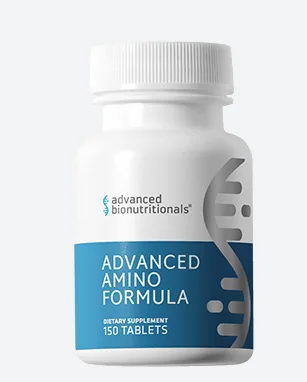 Advanced Amino Formula
A dietary supplement from Advanced Bionutritionals combining eight essential amino acids to support protein intake, muscle health, physical performance, and recovery.
View product details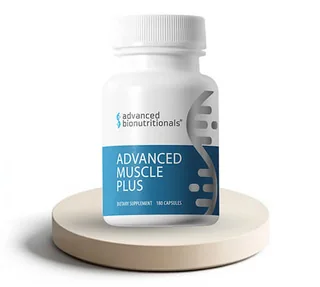 Advanced Muscle Plus
A formula containing DL185 dileucine, calcium HMB monohydrate (myHMB), vitamin D, and calcium, marketed for muscle health and recovery. Ingredient research and manufacturer claims are distinct from finished-product evidence.
View product details
More from Planet Wellness Report
Continue Reading
Nutrition
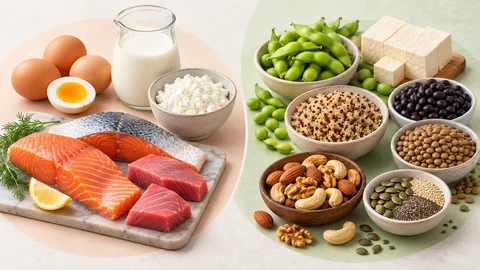
Foods High in Essential Amino Acids: Compare Real Meal Portions
Compare eggs, yogurt, chicken, tofu, beans, and rice using stated portions and USDA data. See why all nine EAAs does not make every serving equivalent.
7 min read
Nutrition
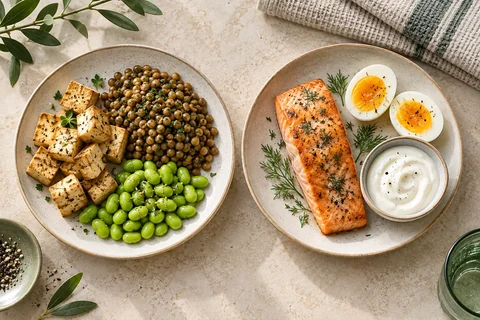
Plant Protein vs Animal Protein for Muscle: Amino Acids, Digestibility, and Real-World Results
Compare plant and animal protein for muscle using amino acids, digestibility, acute MPS and longer-term mass and strength evidence.
9 min read

Nutrition
Protein Quality Explained: DIAAS, PDCAAS, Amino Acids, and What the Scores Really Mean
Understand DIAAS and PDCAAS, limiting amino acids, digestibility and why technical protein quality does not rank the healthfulness of whole diets.
8 min read
Evidence
Sources
- Protein in diet — MedlinePlus / U.S. National Library of Medicine
- U.S. National Library of Medicine. Malnutrition — MedlinePlus / U.S. National Library of Medicine (Aug 29, 2025)
- Institute of Medicine; Food and Nutrition Board. Dietary Reference Intakes for Energy, Carbohydrate, Fiber, Fat, Fatty Acids, Cholesterol, Protein, and Amino Acids — National Academies Press · DOI
- Joint FAO/WHO/UNU Expert Consultation on Protein and Amino Acid Requirements in Human Nutrition. Protein and Amino Acid Requirements in Human Nutrition: Report of a Joint FAO/WHO/UNU Expert Consultation — World Health Organization
- Jane V. White, Peggi Guenter, Gordon Jensen, Ainsley Malone, Marsha Schofield, Academy of Nutrition and Dietetics Malnutrition Work Group, A.S.P.E.N. Malnutrition Task Force. Consensus Statement of the Academy of Nutrition and Dietetics/American Society for Parenteral and Enteral Nutrition: Characteristics Recommended for the Identification and Documentation of Adult Malnutrition (Undernutrition) — Journal of the Academy of Nutrition and Dietetics (May 1, 2012) · DOI
- Protein Intake and Sarcopenia in Older Adults: A Systematic Review and Meta-Analysis — International Journal of Environmental Research and Public Health (Jul 18, 2022) · DOI