
ARTICLE
GABA for Sleep: Does Oral GABA Actually Improve Sleep?
By Planet Wellness Report · Oct 19, 2026 · 8 min read
Editorial review and publication: Felipe Lopes, Publisher & Editor. This is an editorial review, not a medical review.

Oral GABA has not been established as a reliable way to improve sleep. Small controlled trials suggest a possible effect on how quickly some people fall asleep, but evidence is less consistent for sleeping longer, staying asleep, or functioning better the next day. A calming feeling is not automatically a clinically meaningful sleep benefit.
GABA is an important inhibitory neurotransmitter in the brain. The supplement question is different: what happens when GABA is swallowed? Human trials, rather than the familiar role of GABA inside the brain, have to answer whether an oral product helps.
What oral GABA is, and what it is not
Gamma-aminobutyric acid, or GABA, is made in the body and helps regulate nerve signaling. It also occurs in foods and can be produced through fermentation. Trials have examined GABA-enriched foods and supplements made with fermentation-derived material, including rice-germ preparations.
This research should not be conflated with prescription medicines that alter GABA receptors or with GABA analogues. Those substances have their own absorption, brain exposure, effects, and risks. Nor does a GABA-producing probiotic test the same intervention as a measured oral dose of GABA.
Fermentation is a production method, not proof of superior sleep effects. Differences in food matrix, dose, formulation, and trial population prevent assuming that every fermented or synthetic preparation will behave identically. Evidence about a specific material should remain attached to that material.
Can oral GABA cross the blood–brain barrier?
The blood–brain barrier regulates movement from the circulation into the brain. Older experiments and later reviews generally indicate limited entry of externally administered GABA, but the literature varies by species, method, and conditions. Saying that GABA never crosses is more certain than the evidence supports; saying that an oral supplement reliably raises human brain GABA is also unsupported.
An increase in blood GABA after ingestion demonstrates systemic exposure, not necessarily a meaningful increase at the relevant brain receptors. EEG changes measure electrical activity; they do not directly trace a swallowed molecule across the barrier. Neither observation alone demonstrates an effective insomnia treatment.
Researchers have proposed indirect routes involving the gut, peripheral nerves, autonomic signaling, or other gut–brain pathways. A 2025 mechanism review discusses these possibilities and potential transport mechanisms. These remain explanations to investigate. A plausible peripheral route does not prove that a person will fall asleep sooner or wake less often.
The practical consequence is to keep two questions separate: how an effect might happen, and whether a well-controlled human trial actually shows a useful effect. Mechanistic uncertainty does not prove oral GABA is ineffective, but it also cannot fill gaps in the clinical evidence.

What the systematic review found
A 2020 systematic review included 14 placebo-controlled human studies of oral GABA and stress or sleep, searching literature through February 2020. It judged the evidence for stress benefits limited and the evidence for sleep benefits very limited. The studies differed in products, doses, duration, and measurements; small samples and links to industry also limit confidence.
Some studies measured stress-task responses, heart-rate variability, or relaxation-related EEG activity. These are different endpoints from overnight sleep. A reduction in a stress marker does not establish shorter sleep latency, longer sleep duration, fewer awakenings, or improved daytime alertness.
For healthy adults without substantial sleep complaints, a dependable benefit has not been demonstrated. Trials in people reporting poor sleep are somewhat more relevant to the supplement's sleep claim, but short studies in selected participants still do not establish long-term treatment of chronic insomnia.
The small insomnia trial: compare groups, not just before and after
A 2018 randomized, double-blind trial enrolled 40 adults with insomnia symptoms. Thirty received 300 mg daily of fermented rice-germ-derived GABA and ten received placebo for four weeks. Researchers used questionnaires and polysomnography, which records physiological sleep measures.
The GABA group's average sleep latency decreased from 13.4 to 5.7 minutes. That before-and-after change should not be presented as a guaranteed placebo-adjusted benefit. The later systematic review identified a between-group signal for sleep latency, while several other apparent improvements were within the GABA group rather than clear superiority over placebo.
In particular, the systematic review did not find convincing between-group effects on total sleep time, sleep efficiency, wake after sleep onset, or several sleep-stage measures in that trial. The paper's favorable summary therefore needs more qualification than “GABA improves sleep quality.” The uneven allocation and small placebo group also make estimates less secure.
A separate short study of 100 mg GABA reported reduced latency and increased non-REM sleep time, while another similarly brief study found only a trend for latency. These findings are signals for replication, not enough to promise deeper or more restorative sleep.
Which sleep outcomes have support?
Sleep latency is the interval between trying to sleep and falling asleep. It has the clearest preliminary signal in the small GABA literature. That does not establish that the change is large enough to matter to someone with persistent insomnia. The guide to how long falling asleep should take explains the broader context.
Total sleep time means actual time asleep. Sleep efficiency is the proportion of time in bed spent asleep. Awakenings and wake after sleep onset concern continuity. Evidence for consistent improvement in these outcomes remains insufficient; a latency finding cannot stand in for them.
Subjective sleep quality is what participants report about their nights. It is valuable, but distinct from EEG or polysomnography. Daytime sleepiness and next-day functioning require their own measurements. GABA has not established a consistent advantage across all these categories, and feeling sedated should not be counted as proof of restorative sleep.
What changed in the evidence search through October 2026?
The registry entry UMIN000059224 describes a systematic review of GABA supplementation and sleep quality in healthy adults. When checked on October 19, 2026, its status was Completed, but its publication field still said Unpublished and the results fields were blank. No completed results publication linked to that registration was verified. A finished registry status is not a published finding or an effect estimate.
Newer studies also require careful classification. A 2026 randomized trial in older women examined GABA together with a home-based exercise program and reported subjective sleep outcomes. That setting is relevant, but it does not by itself establish objective sleep gains or a benefit for all adults. The complete trial report was not available for detailed appraisal in this search, so it is not used here to quantify benefit.
A 2026 randomized study of the probiotic Lactiplantibacillus plantarum Lp815 reported sleep findings and higher urinary GABA. The intervention was a probiotic, not isolated oral GABA. Urinary GABA does not demonstrate brain entry or show that a GABA capsule would have the same effect. Similarly, exploratory GABA–L-theanine studies and other multi-ingredient sleep formulas cannot identify GABA's independent contribution.
These distinctions leave the direct oral-GABA evidence limited. Readers interested in other compounds can use the separate L-theanine article or Apigenin for Sleep; their findings should not be pooled into a claim that GABA works.
Safety, drowsiness, and medication context
A 2021 United States Pharmacopeia safety review found no clear serious adverse-event signal in the clinical studies it examined, but study durations and safety reporting were limited. Reported symptoms included abdominal discomfort, headache, drowsiness, and, in some higher-dose studies, throat or skin burning sensations. This does not establish that every product or long-term regimen is safe.
Drowsiness matters if driving or doing tasks that require attention. Direct clinical interaction evidence for GABA combined with sedative medicines or alcohol is limited; a predictable interaction magnitude has not been established. As a practical precaution, discuss combinations with a pharmacist and avoid adding alcohol or several sleep aids while assessing a sleep product, particularly one that already contains melatonin.
Some human studies found modest, transient reductions in blood pressure. The USP review identifies a plausible risk of added blood-pressure lowering with antihypertensive medicines, rather than a well-quantified interaction. People with low blood pressure, dizziness, or blood-pressure treatment should seek advice before use.
Pregnancy and breastfeeding data are inadequate. A lack of reported serious events in short trials cannot resolve those uncertainties. Safety of GABA alone also cannot establish safety of a blend containing several biologically active ingredients.
How Yu Sleep fits, and what its blend cannot tell you
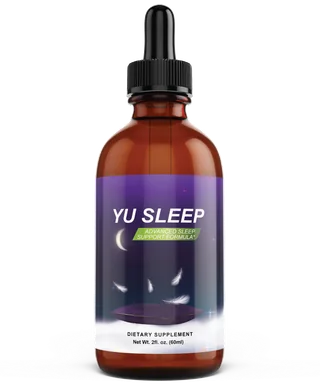
For readers already evaluating combination sleep supplements, Yu Sleep is a contextual product to discuss with a clinician or pharmacist. The Supplement Facts information lists GABA within a 637 mg proprietary blend per 2 mL serving, alongside tart cherry concentrate, magnesium glycinate, apigenin, lemon balm, 5-HTP, and L-theanine. The individual GABA amount is not disclosed. The 637 mg total must not be described as 637 mg of GABA.
The same record lists melatonin separately at 0.9 mg, as well as vitamins B2 and B6. This is a multi-ingredient formula with a different safety and efficacy question from isolated GABA. Other ingredients may contribute effects or medication concerns; those should not be attributed to GABA alone. For example, the presence of 5-HTP warrants review of serotonergic medicines, while melatonin contributes its own sleepiness considerations.
Isolated GABA trials do not establish finished-product efficacy, and any effect of Yu Sleep cannot be assigned to GABA alone. No controlled study of the complete currently labeled Yu Sleep formula was verified for this article. Check the current bottle label with a pharmacist because the full combination, rather than GABA alone, determines the medication review.
The Yu Sleep review examines the formula separately. The single recommendation card below offers that product for further label evaluation; it is not an endorsement of proven sleep efficacy. An undisclosed GABA amount prevents a meaningful dose comparison with the isolated-GABA trials.
A reasonable conclusion about oral GABA
Oral GABA may influence sleep onset in some people, but the evidence does not establish a dependable, clinically meaningful improvement across sleep outcomes. The blood–brain barrier question remains nuanced, and proposed indirect pathways do not supply missing clinical proof.
For persistent difficulty sleeping or substantial daytime impairment, seek assessment instead of escalating an uncertain supplement or stacking several blends. A sleep diary can help distinguish trouble falling asleep from awakenings or insufficient sleep time. Those are different problems, and the current GABA evidence should not be treated as a solution to all of them.
Was this article helpful?
Your anonymous response helps improve our editorial coverage.
Loading feedback options…
Share
Share this article
Selected references
Recommended products
More from Planet Wellness Report
Continue Reading

Sleep
The Sleep Reset Review: What It Includes, Evidence, and Value
A review of The Sleep Reset’s 14 audio sessions, one-time price, delivery and refund terms, component evidence, and practical fit as an optional wind-down tool.
8 min read

Sleep
How Long Should It Take to Fall Asleep? What Sleep Research Suggests
Learn what sleep latency means, why typical ranges are not diagnostic cutoffs, and how to interpret patterns alongside sleep opportunity and daytime functioning.
7 min read
Sleep
Yu Sleep Review: A Known Melatonin Dose Inside an Undisclosed Blend
Yu Sleep’s owner-confirmed formula provides 0.9 mg melatonin in a 2 mL serving, plus a 637 mg blend whose seven ingredient amounts are hidden. Its liquid format is a preference feature; the disclosure cannot establish how much magnesium, theanine, apigenin, GABA or other blend constituents a serving supplies.
10 min read
Evidence
Sources
- Hepsomali P, Groeger JA, Nishihira J, Scholey A.. Effects of Oral Gamma-Aminobutyric Acid (GABA) Administration on Stress and Sleep in Humans: A Systematic Review — Frontiers in neuroscience (Sep 17, 2020) · DOI
- Byun JI, Shin YY, Chung SE, Shin WC.. Safety and Efficacy of Gamma-Aminobutyric Acid from Fermented Rice Germ in Patients with Insomnia Symptoms: A Randomized, Double-Blind Trial — Journal of clinical neurology (Seoul, Korea) (Apr 27, 2018) · DOI
- Oketch-Rabah HA, Madden EF, Roe AL, Betz JM.. United States Pharmacopeia (USP) Safety Review of Gamma-Aminobutyric Acid (GABA) — Nutrients (Aug 10, 2021) · DOI
- Boonstra E, de Kleijn R, Colzato LS, Alkemade A, Forstmann BU, Nieuwenhuis S.. Neurotransmitters as food supplements: the effects of GABA on brain and behavior — Frontiers in psychology (Oct 6, 2015) · DOI
- Progress in Research on the Mechanism of GABA in Improving Sleep (Nov 1, 2025)
- Grant AD, Erfe MCB, Delebecque CJ, Keller D, Zimmerman NP, Kazaryan A, Oliver PL, Moos J, Luna V, Craft N.. Lactiplantibacillus plantarum Lp815 improves sleep and increases urinary GABA in a randomized, double-blind, placebo-controlled study of sleep disturbance — Scientific reports (Jan 19, 2026) · DOI
- Yu Sleep. Yu Sleep — Current Formula and Supplement Facts (owner-confirmed) — Yu Sleep
- Japan Clinical Trial Association. Systematic Review on the Effects of Gamma-Aminobutyric Acid (GABA) Supplementation on Sleep Quality — UMIN Clinical Trials Registry (Sep 30, 2025)
- Cristina Oliveira Trindade et al.. GABA supplementation combined with home-based exercise improves subjective sleep quality and body composition in elderly women: A randomized trial — The Journal of Nutritional Physiology · DOI
- Memorial Sloan Kettering Cancer Center. 5-HTP — Memorial Sloan Kettering Cancer Center
- Melatonin: What You Need To Know — National Center for Complementary and Integrative Health (NCCIH), National Institutes of Health