
ARTICLE
How Long Should It Take to Fall Asleep? What Sleep Research Suggests
Typical ranges, measurement differences, and when a persistent pattern deserves attention.
By Planet Wellness Report · Oct 12, 2026 · 7 min read
Editorial review and publication: Felipe Lopes, Publisher & Editor. This is an editorial review, not a medical review.
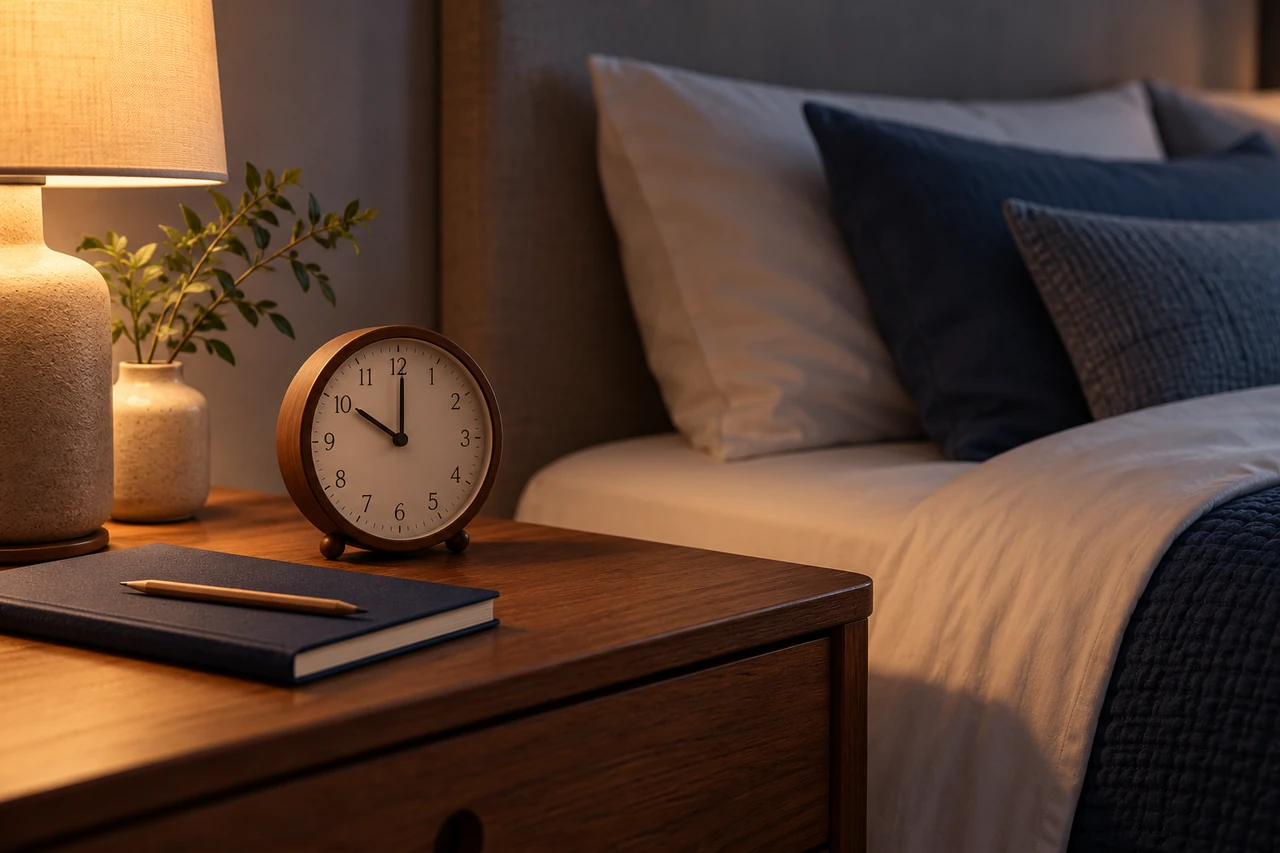
For many adults, falling asleep takes roughly 10 to 20 minutes. That is a useful orientation, not a deadline: a slower night does not automatically mean insomnia, and falling asleep the instant your head reaches the pillow is not necessarily the healthiest goal. The more useful questions are whether the pattern persists, whether you have enough opportunity to sleep, and how you function the next day.
Sleep research calls this interval sleep onset latency. Interpreting it requires knowing when the clock starts and how sleep is identified. A remembered estimate, a watch reading, and a laboratory measurement may describe the same night differently without any one of them telling the whole story.
What sleep latency measures—and what it leaves out
Sleep onset latency is the time between trying to fall asleep and the beginning of sleep. In a sleep diary, that usually means estimating how long you were awake after you started trying to sleep. A study may instead time the interval from lights out to the first scored sleep epoch. Its methods should specify the definition used. Reading in bed before you intend to sleep is therefore different from lying awake while actively trying.
Latency is only one part of sleep continuity. It does not tell you how often you woke later, how much sleep you obtained, or whether you felt restored. Someone can fall asleep promptly and still have a disrupted night; another person may take a little longer but then sleep adequately. Comparing onset time without those other details can turn a narrow measurement into an overly broad judgment.
A typical range is not a diagnostic cutoff
Cleveland Clinic’s 2026 patient guidance describes approximately 10 to 20 minutes as a common range and emphasizes individual variation. The National Sleep Foundation’s public guidance asks whether falling asleep took 30 minutes or less, alongside other indicators of sleep quality. Its 2017 consensus report considered several continuity measures across age groups. These references answer different questions: a familiar range is not the same thing as a quality benchmark or a clinical diagnosis.
A night of 25 minutes does not become unhealthy just because it exceeds 20, and a night of 35 minutes does not establish a disorder by crossing 30. Age, circumstances, sleep opportunity, distress, and daytime functioning matter. Likewise, a recommendation to step away from bed when you have been awake and frustrated for a while is a behavioral cue—not a requirement to watch a stopwatch or a test that diagnoses insomnia.
The practical interpretation is to use ranges as context for a pattern. If your usual experience changes markedly, ask what changed around it. If you generally feel well and obtain adequate sleep, an occasional longer transition deserves a different response from repeated long delays that shorten your nights and interfere with your days.
Why your estimate and a device can disagree
The Consensus Sleep Diary developed by Carney and colleagues standardizes questions about when you tried to sleep, perceived time to fall asleep, awakenings, and the following morning. It records your experience; it does not directly record brain activity. Polysomnography uses physiological signals, including brain activity, to score sleep. Movement-based actigraphy and most consumer wearables infer sleep from signals such as movement and heart rate rather than directly observing it in the same way.
Quiet wakefulness can be difficult for an inference-based device to distinguish from sleep. Remembered onset time also involves uncertainty: you do not normally register the precise moment you stop being awake. A 2025 theoretical review of sleep-state misperception discusses differences between reported and measured sleep, while noting that retrospective reporting and perception are difficult to separate. This does not mean a person’s distress is imaginary, or that every disagreement between a watch and a diary indicates misperception.
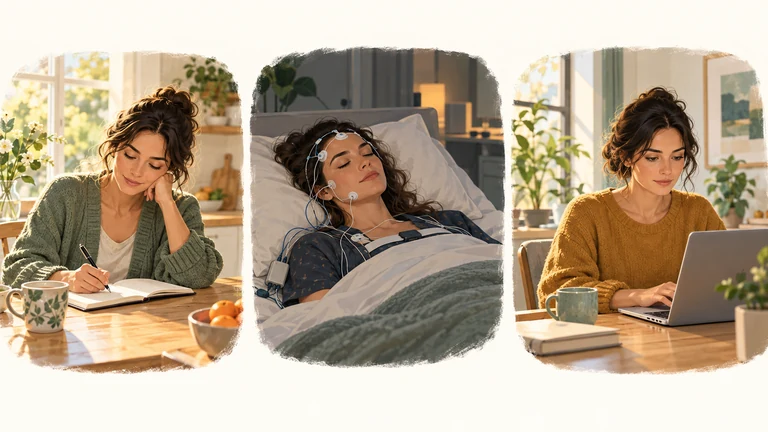
The AASM’s consumer sleep technology position statement cautions against using unvalidated consumer measurements to diagnose or treat sleep disorders. Devices have evolved since that 2018 statement, so accuracy should be assessed for the specific model, algorithm, and outcome. A minute-by-minute sleep score is not automatically a clinical measurement. Share useful trends with a clinician when appropriate, but do not let a single estimated latency become a nightly pass-or-fail test.
Sleep pressure, timing, and arousal change the transition
Sleep pressure generally builds with time awake and eases with sleep. A long or late nap can leave less pressure at your intended bedtime. So can dozing on the couch before moving to bed. Going to bed substantially earlier to compensate for a poor night may simply create more time awake in bed if you are not yet sleepy. This is a reason to examine timing—not an instruction to deliberately deprive yourself of sleep or begin a strict sleep-restriction protocol without appropriate guidance.
Your circadian system also affects when sleep comes easily. A schedule that shifts substantially between workdays and weekends can place your attempted bedtime at different biological times. Stress, planning tomorrow’s tasks, and worrying about the consequences of not sleeping can keep arousal high even when you feel tired. Sleepiness and feeling worn out are not identical. Our guide to sleep regularity explores the schedule question in more depth.
Light and engaging evening activities can contribute to alertness. In a controlled study by Chang and colleagues, evening light-emitting eReader use delayed sleep onset compared with reading a printed book. That specific experimental exposure does not imply that every brief screen use has the same effect. Consider brightness, duration, timing, and whether the activity itself keeps you engaged. The bedtime routine guide covers building a calmer transition without requiring a perfectly scripted evening.
Caffeine is another distinct influence. Gardiner and colleagues’ 2023 meta-analysis of 24 studies found longer sleep onset latency on average with caffeine, alongside changes in other sleep outcomes. A pooled average is not your personal response or a universal cutoff. Review both amount and timing: the separate guides to caffeine before bed and daily caffeine intake address those decisions without treating a supplement or relaxation recording as a way to cancel caffeine.
Why instant sleep is not a universal target
Very rapid sleep onset can occur after insufficient sleep or substantial sleep pressure. It is therefore not proof that a bedtime routine is working exceptionally well. Conversely, a short latency on its own is not a diagnosis. Consider adequate sleep opportunity and whether you are unintentionally dozing during the day. A steady pattern that lets you obtain sufficient sleep and function well is more informative than trying to achieve the smallest possible number.
When difficulty falling asleep deserves attention
An unfamiliar room, a stressful day, travel, or a schedule change can produce occasional difficulty without establishing chronic insomnia. Persistent difficulty despite adequate opportunity to sleep, especially with daytime impairment or significant distress, deserves professional assessment. NHLBI describes chronic insomnia as occurring at least three nights a week for at least three months. These frequency and duration criteria belong to clinical assessment; they are not a reason to wait three months when you are already struggling.
Seek advice sooner if sleep problems meaningfully affect work, mood, concentration, or safe driving, or accompany symptoms such as loud snoring with breathing pauses, troublesome leg sensations, or marked daytime sleepiness. A clinician considers sleep and medical history, medications, schedule, and other possible explanations. The European Insomnia Guideline recommends interview and sleep diaries; a laboratory study is used when indicated, rather than being necessary for every complaint. No single onset-time estimate identifies the cause.
A useful next step: observe the pattern without chasing minutes
For one to two weeks, make a brief morning note of when you tried to sleep, your approximate latency, final wake time, naps, caffeine timing, and how you felt during the day. Use an estimate instead of repeatedly checking the clock. Look for repeated patterns and make one manageable adjustment, such as moving a late caffeine serving earlier or protecting a consistent wake time. This is observation and ordinary habit support, not a self-diagnostic exercise.
If you prefer guided audio as an optional wind-down cue, The Sleep Reset is the related product selected here. The UsefulPrograms offer describes short relaxation recordings; it is not a medical intervention or a solution proven to shorten sleep latency. Our The Sleep Reset review examines its contents, evidence, price, and alternatives. A free calming recording or a quiet activity may suit the same preference without a purchase.
The goal is a more workable sleep pattern, not winning a race against the clock. Interpret onset time alongside the rest of the night and the following day. If difficulties persist, assessment is more useful than repeatedly switching sleep products; clinical guidelines favor CBT-I for chronic insomnia, while sleep hygiene alone is not equivalent to that treatment.
Was this article helpful?
Your anonymous response helps improve our editorial coverage.
Loading feedback options…
Share
Share this article
Selected references
Recommended products
More from Planet Wellness Report
Continue Reading

Sleep
The Sleep Reset Review: What It Includes, Evidence, and Value
A review of The Sleep Reset’s 14 audio sessions, one-time price, delivery and refund terms, component evidence, and practical fit as an optional wind-down tool.
8 min read

Sleep
How to Improve Sleep Quality Naturally: What to Change First
Trouble settling, repeated awakenings, unrefreshing sleep, or weekend shifts? Identify the pattern and choose what to address first.
6 min read
Sleep
Yu Sleep Review: A Known Melatonin Dose Inside an Undisclosed Blend
Yu Sleep’s owner-confirmed formula provides 0.9 mg melatonin in a 2 mL serving, plus a 637 mg blend whose seven ingredient amounts are hidden. Its liquid format is a preference feature; the disclosure cannot establish how much magnesium, theanine, apigenin, GABA or other blend constituents a serving supplies.
10 min read
Evidence
Sources
- Cleveland Clinic. How Long Should It Take To Fall Asleep? — Cleveland Clinic (Jan 28, 2026)
- Ohayon M, Wickwire EM, Hirshkowitz M, Albert SM, Avidan A, Daly FJ, Dauvilliers Y, Ferri R, Fung C, Gozal D, Hazen N, Krystal A, Lichstein K, Mallampalli M, Plazzi G, Rawding R, Scheer FA, Scheer FA, Somers V, Vitiello MV.. National Sleep Foundation's sleep quality recommendations: first report — Sleep health (Dec 23, 2016) · DOI
- National Sleep Foundation. What Is Sleep Quality? — National Sleep Foundation
- Carney CE, Buysse DJ, Ancoli-Israel S, Edinger JD, Krystal AD, Lichstein KL, Morin CM.. The consensus sleep diary: standardizing prospective sleep self-monitoring — Sleep (Feb 1, 2012) · DOI
- Khosla S, Deak MC, Gault D, Goldstein CA, Hwang D, Kwon Y, O'Hearn D, Schutte-Rodin S, Yurcheshen M, Rosen IM, Kirsch DB, Chervin RD, Carden KA, Ramar K, Aurora RN, Kristo DA, Malhotra RK, Martin JL, Olson EJ, Rosen CL, Rowley JA, American Academy of Sleep Medicine Board of Directors.. Consumer Sleep Technology: An American Academy of Sleep Medicine Position Statement — Journal of clinical sleep medicine : JCSM : official publication of the American Academy of Sleep Medicine (May 15, 2018) · DOI
- Joo EH, Altier HR, Selai C, Gratton MK, Kim-Dahl A, Allen H, Cheng X, Reid MJ.. Neurobiological mechanisms of sleep state misperception in insomnia disorder: A theoretical review — Sleep medicine reviews (Apr 27, 2025) · DOI
- National Heart, Lung, and Blood Institute. Insomnia: Diagnosis — National Heart, Lung, and Blood Institute
- Riemann D, Espie CA, Altena E, Arnardottir ES, Baglioni C, Bassetti CLA, Bastien C, Berzina N, Bjorvatn B, Dikeos D, Dolenc Groselj L, Ellis JG, Garcia-Borreguero D, Geoffroy PA, Gjerstad M, Gonçalves M, Hertenstein E, Hoedlmoser K, Hion T, Holzinger B, Janku K, Jansson-Fröjmark M, Järnefelt H, Jernelöv S, Jennum PJ, Khachatryan S, Krone L, Kyle SD, Lancee J, Leger D, Lupusor A, Marques DR, Nissen C, Palagini L, Paunio T, Perogamvros L, Pevernagie D, Schabus M, Shochat T, Szentkiralyi A, Van Someren E, van Straten A, Wichniak A, Verbraecken J, Spiegelhalder K.. The European Insomnia Guideline: An update on the diagnosis and treatment of insomnia 2023 — Journal of sleep research (Dec 1, 2023) · DOI
- Jack D. Edinger; J. Todd Arnedt; Suzanne M. Bertisch; et al.. Behavioral and psychological treatments for chronic insomnia disorder in adults: an American Academy of Sleep Medicine clinical practice guideline — Journal of Clinical Sleep Medicine / American Academy of Sleep Medicine (Feb 1, 2021) · DOI
- Healthy Sleep Habits — National Heart, Lung, and Blood Institute (NHLBI), NIH (Mar 24, 2022)
- The Effect of Caffeine on Subsequent Sleep: A Systematic Review and Meta-Analysis — Sleep Medicine Reviews (Jun 1, 2023) · DOI
- Anne-Marie Chang, Daniel Aeschbach, Jeanne F. Duffy, Charles A. Czeisler. Evening Use of Light-Emitting eReaders Negatively Affects Sleep, Circadian Timing, and Next-Morning Alertness — Proceedings of the National Academy of Sciences (Jan 27, 2015) · DOI
- UsefulPrograms / Digistore24. The Sleep Reset: 14 Nights to Rebooting Your Rest — official offer — UsefulPrograms / Digistore24