
ARTICLE
Caffeine and L-Theanine for Focus: Does the Combination Add Anything?
What acute attention trials show compared with placebo and either ingredient alone, and why task-specific findings are not a promise of better cognition.
By Planet Wellness Report · Oct 8, 2026 · 8 min read
Editorial review and publication: Felipe Lopes, Publisher & Editor. This is an editorial review, not a medical review.
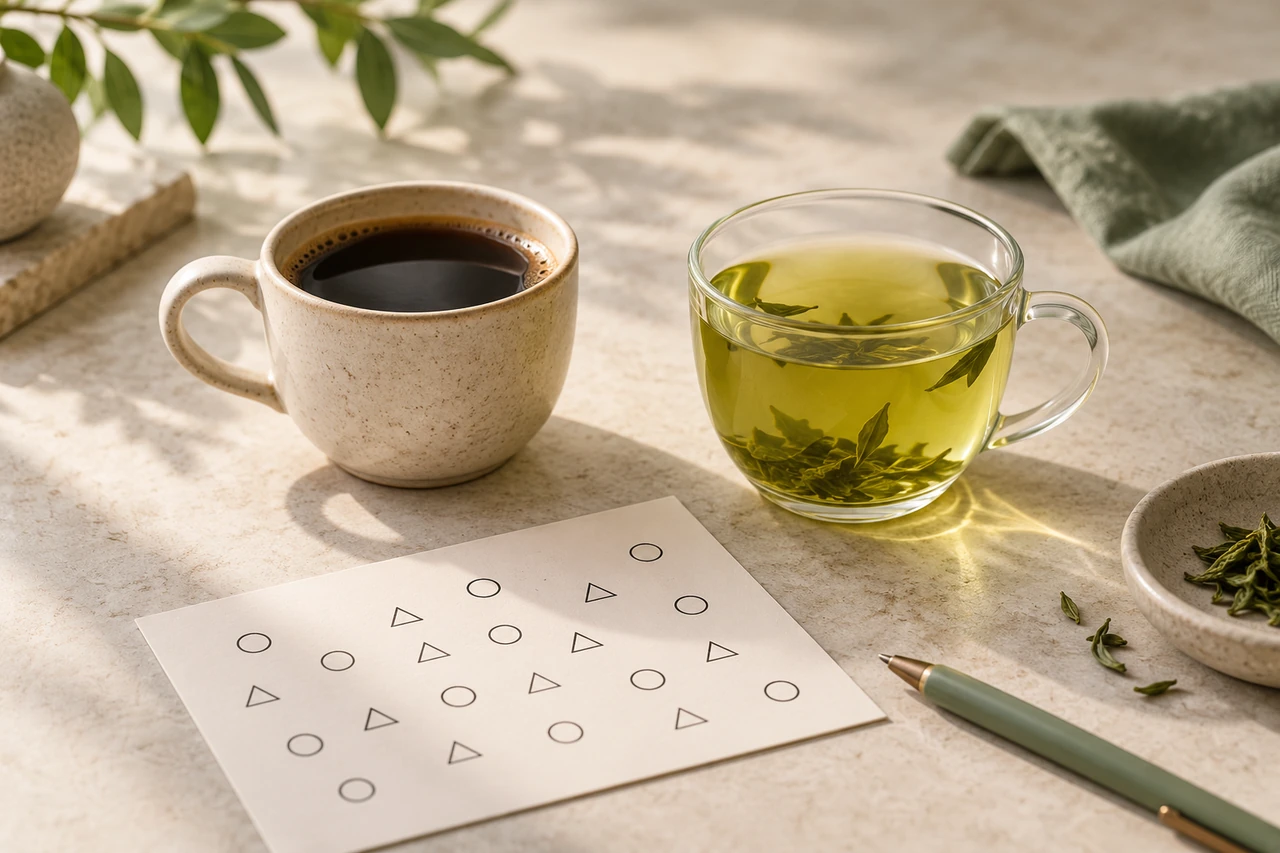
Caffeine and L-theanine together can improve some short-term attention measures compared with placebo. The harder question is whether adding L-theanine meaningfully improves on caffeine alone. Small trials have produced different answers across tasks and doses, so the combination should not be presented as a broadly proven nootropic or a reliable way to eliminate caffeine's unwanted effects.
The evidence is mainly about acute effects: changes measured during a testing session after a dose. It does not establish lasting improvements in everyday focus, memory, learning, or brain health. To judge a claim, ask what was measured, when it was measured, and which treatment the combination actually beat.
Why caffeine and L-theanine are studied together
Caffeine is a stimulant that acts mainly by blocking adenosine receptors. Research on caffeine alone supports short-term improvements in selected attention measures in healthy adults. That is useful background, but it cannot prove that adding another ingredient produces an extra benefit.
L-theanine is an amino acid found in tea. Researchers have investigated its effects on nervous system activity, attention, and subjective states such as relaxation. It is different from caffeine, and evidence for it alone must be kept separate from evidence for the pairing. Its proposed mechanisms are reasons to conduct trials, not proof of improved performance.
Because tea contains both compounds, researchers have tested whether their joint effects differ from either one alone. This question concerns specific cognitive and subjective outcomes. It is separate from whether L-theanine helps with winding down, which our article on L-theanine for sleep examines.
The comparison matters as much as the result
A placebo comparison asks whether the combination changes an outcome relative to an inactive treatment. A caffeine-only comparison asks whether adding L-theanine changes that outcome beyond caffeine's effect. A theanine-only comparison asks what changes when caffeine is added. A trial with all four conditions can address these questions within the same experiment; a combination-versus-placebo trial cannot separate the ingredients' contributions.
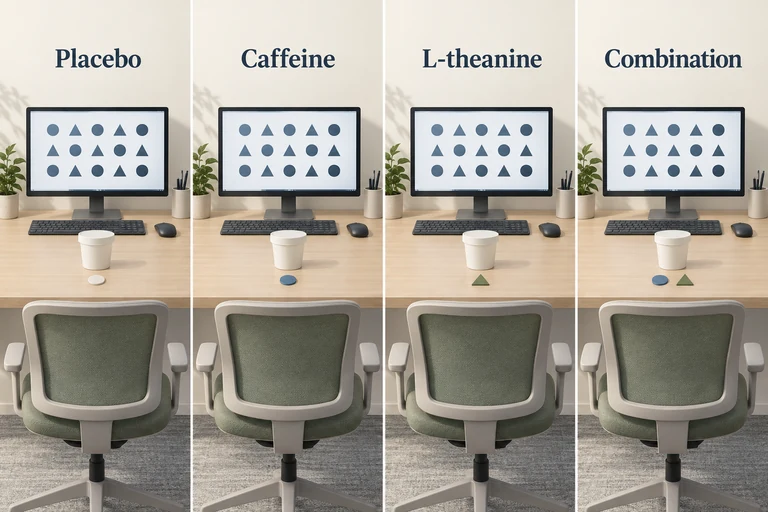
Another common error is to call the combination superior because it was statistically significant against placebo while caffeine alone was not. Those two results do not themselves establish a significant difference between the active treatments. A direct comparison or an appropriate interaction analysis is needed. Likewise, showing an interaction on one task does not establish a general synergistic effect across cognition.
What the combination research found
A systematic review shows selective benefits over placebo
Payne and colleagues' 2025 systematic review and meta-analysis examined tea, L-theanine, and L-theanine plus caffeine in healthy participants. For the combination versus placebo, pooled results favored digit-vigilance accuracy and attention-switching accuracy in the second hour after intake. Other estimates, including first-hour choice reaction time and second-hour overall mood, had confidence intervals that included no difference. Favorable average estimates therefore should not all be described as statistically established benefits.
The review found uncertainty around many estimates and variation between studies. It assessed no study as having low overall risk of bias. The research included tea-industry funding and authors employed by tea-related companies. These disclosures do not invalidate the findings, but reinforce the need for independent replication. The central support is for selected short-term tasks, especially against placebo; it is not a consistent demonstration that the combination outperforms caffeine alone.
Four-condition trials produced different patterns
In Haskell and colleagues' 2008 double-blind crossover trial, 27 participants received placebo, 150 mg caffeine, 250 mg L-theanine, or both. Caffeine alone improved selected vigilance measures and reduced increases in self-rated mental fatigue. The combination also improved outcomes including simple reaction time, numeric working-memory response time, and sentence-verification accuracy, alongside some subjective ratings. A significant caffeine-by-theanine interaction appeared for delayed word-recognition reaction time.
That experiment supports the possibility that joint effects differ on particular outcomes. It does not establish that every combination result was significantly better than caffeine alone, or that the interaction extends to all forms of attention. Theanine alone did not reproduce the combination's pattern and worsened some measures. The listed amounts describe this trial, not a recommended regimen.
Dodd and colleagues' 2015 crossover trial provides a contrasting result. Twenty-four healthy adults received placebo, 75 mg caffeine, 50 mg L-theanine, or both, with cognitive testing beginning 30 minutes after intake. Caffeine alone improved selected attention-task and mood outcomes. Adding theanine did not provide a positive behavioral effect; selected caffeine-associated benefits versus placebo were no longer apparent with the combination. A brain blood-flow measurement also changed, but a physiological change is not equivalent to better focus.
Some encouraging trials could not isolate an added effect
Owen and colleagues studied 27 healthy volunteers in 2008 using placebo, 50 mg caffeine, and caffeine plus 100 mg L-theanine. They reported improvements with the combination in attention-switching speed and accuracy at 60 minutes and less susceptibility to distracting information during a memory task. Caffeine alone also improved selected outcomes. There was no theanine-only condition, and the pattern of results against placebo should not be mistaken for proof of superiority on every direct comparison.
A 2010 trial by Giesbrecht and colleagues tested 97 mg L-theanine plus 40 mg caffeine against placebo in 44 young adults, measuring outcomes at 20 and 70 minutes. Task-switching accuracy and subjective alertness improved, and participants reported less tiredness. Visual search, choice reaction time, and mental rotation did not significantly improve. With no caffeine-only or theanine-only arms, this study cannot determine how much benefit came from adding theanine to caffeine.
Newer studies remain specific to their participants and tasks
The 2025 review searched through August 2023, so later trials add useful context. Nawarathna and colleagues' 2025 crossover study gave 37 overnight sleep-deprived young adults either a combination of 200 mg L-theanine and 160 mg caffeine or placebo. The combination improved selected accuracy and reaction-time measures on a traffic-scene attention task. Without single-ingredient arms, it cannot establish added benefit over caffeine. A laboratory traffic task also does not show that the combination makes sleep-deprived driving safe or replaces sleep.
In a 2026 single-blind crossover trial, Arslan and colleagues studied 15 professional male esports athletes. Caffeine plus L-theanine improved auditory reaction time and Aim Lab performance scores compared with caffeine alone, while visual reaction time did not differ. This is a direct added-benefit finding for those outcomes, but the small, specialized sample and lack of placebo or theanine-only conditions limit its wider meaning.
A different 2026 double-blind crossover study by Tuncer and colleagues tested 20 competitive athletes under four conditions: caffeine, L-theanine, their combination, and placebo. It found no significant differences in computerized eye-hand coordination. These studies measured different tasks in different populations; they should not be averaged informally into a general promise of better cognition.
Feeling focused and performing better are different outcomes
Reaction time measures how quickly a response occurs. Accuracy measures correct responses or errors. Vigilance involves maintaining attention, while task switching involves changing the rule or target guiding a response. These outcomes are related, but improvement on one does not establish improvement on the others. A faster response also needs to be interpreted alongside accuracy.
Alertness, mental fatigue, tension, and subjective focus are self-reported experiences. They can matter to a reader, but feeling more awake or less tired does not demonstrate better reasoning or more productive work. The trials above do not support treating every favorable mood rating as a measured improvement in focus.
Statistical significance concerns how compatible a result is with a statistical model, including a no-difference assumption. Practical relevance concerns whether the size of the change matters in daily life. A small difference in a brief laboratory task may be detectable without noticeably improving a workday. Small samples, multiple outcomes, different tests, and inconsistent findings make broad promises especially difficult to defend.
Does L-theanine reliably reduce caffeine jitters?
That claim is stronger than the evidence supports. Rogers and colleagues tested caffeine, theanine, their combination, and placebo in 48 healthy adults, using 250 mg caffeine and 200 mg theanine. Caffeine increased self-rated alertness and jitteriness. Theanine did not significantly change jitteriness, alertness, or other mood measures, even though it altered the caffeine-related blood-pressure response. A physiological finding should not be generalized into a promise that the combination feels calmer or neutralizes adverse effects.
Different doses and settings may produce different subjective experiences. That uncertainty is a reason to avoid claims such as 'eliminates jitters' or guaranteed 'smooth energy.' L-theanine should not be used as permission to increase caffeine exposure or ignore symptoms.
What these studies do not establish
The acute trials do not establish an optimal dose, ratio, or daily routine. Protocols differ substantially, and a popular two-to-one theanine-to-caffeine ratio is not a universal rule demonstrated by these studies. Nor do a few hours of testing establish chronic benefit, long-term safety of a daily combination, or effectiveness across all adult ages and health circumstances.
Evidence from standardized preparations cannot automatically be transferred to an ordinary cup of tea, adding theanine to an unmeasured coffee, or a commercial blend with other active ingredients. These findings do not justify claims to treat ADHD, anxiety disorders, depression, or neurological disease.
Keep the caffeine tradeoffs in view
Individual sensitivity, habitual intake, medicines, and health circumstances influence caffeine's effects. Count exposure from drinks, supplements, and other products together. Jitters, anxiety, palpitations, or sleep disruption remain relevant even when theanine is included. Our guide to how much caffeine is too much explains the intake and sensitivity context in more detail.
Timing matters because a brief attention benefit can coexist with worse sleep later. The combination trials discussed here do not establish that theanine protects sleep from caffeine. For that separate question, see how long before bed to stop drinking caffeine. If you are pregnant, breastfeeding, taking regular medicines, or managing a health condition, discuss supplement and caffeine decisions with a qualified healthcare professional.
For sustained difficulty concentrating, the useful next step is to consider the broader context rather than repeatedly adding ingredients. Our guide to improving focus and concentration covers everyday habits; what causes brain fog addresses possible contributors and when persistent symptoms deserve assessment.
The practical takeaway on caffeine plus L-theanine
The combination has credible but limited evidence for improvements in selected acute attention tasks versus placebo. Added benefit over caffeine alone is less consistent, subjective effects vary, and some tasks do not improve. Read the comparator and outcome before accepting a claim. Current findings support a focused research question, not a universal promise of better cognition, a treatment claim, or an assurance that caffeine's downsides disappear.
Was this article helpful?
Your anonymous response helps improve our editorial coverage.
Loading feedback options…
Share
Share this article
More from Planet Wellness Report
Continue Reading

Focus
How to Improve Focus and Concentration Naturally: 10 Evidence-Informed Strategies
Improving concentration is rarely about one perfect routine or supplement. Explore ten evidence-informed strategies for supporting attention while recognizing the limits of the research.
12 min read

Focus
NeuroVera Review: Six Ingredients, Uneven Dose Transparency
NeuroVera discloses six ingredient weights in two capsules, but those numbers vary in interpretability. Bacopa lacks bacoside standardization, lion’s mane is a powder, and the DHA entry is marked 10%. Human evidence is more relevant for Bacopa and lion’s mane than for several other components, yet it does not validate this combination.
8 min read

Focus
What Causes Brain Fog? Describe the Pattern Before the Cause
Describe what brain fog is making harder, when it began, what surrounds it, and how it affects daily life. Use that pattern to choose an appropriate next step.
6 min read
Evidence
Sources
- Edward R. Payne; Magaly Aceves-Martins; Joy Dubost; Arno Greyling; Baukje de Roos. Effects of Tea (Camellia sinensis) or its Bioactive Compounds L-Theanine or L-Theanine plus Caffeine on Cognition, Sleep, and Mood in Healthy Participants: A Systematic Review and Meta-Analysis of Randomized Controlled Trials — Nutrition Reviews (May 2, 2025) · DOI
- Crystal F. Haskell; David O. Kennedy; Anthea L. Milne; Keith A. Wesnes; Andrew B. Scholey. The effects of L-theanine, caffeine and their combination on cognition and mood — Biological Psychology · DOI
- Gail N. Owen; Holly Parnell; Eveline A. De Bruin; Jane A. Rycroft. The combined effects of L-theanine and caffeine on cognitive performance and mood — Nutritional Neuroscience · DOI
- Fiona L. Dodd; David O. Kennedy; Leigh M. Riby; Crystal F. Haskell-Ramsay. A double-blind, placebo-controlled study evaluating the effects of caffeine and L-theanine both alone and in combination on cerebral blood flow, cognition and mood — Psychopharmacology · DOI
- Peter J. Rogers; Jessica E. Smith; Susan V. Heatherley; C. W. Pleydell-Pearce. Time for tea: mood, blood pressure and cognitive performance effects of caffeine and theanine administered alone and together — Psychopharmacology · DOI
- Timo Giesbrecht; Jane A. Rycroft; M. J. Rowson; Eveline A. De Bruin. The combination of L-theanine and caffeine improves cognitive performance and increases subjective alertness — Nutritional Neuroscience · DOI
- Kasper Kløve; Anders Petersen. A Systematic Review and Meta-analysis of the Acute Effect of Caffeine on Attention — Psychopharmacology (Sep 1, 2025) · DOI
- Spilling the Beans: How Much Caffeine is Too Much? — U.S. Food and Drug Administration (FDA)
- The Effect of Caffeine on Subsequent Sleep: A Systematic Review and Meta-Analysis — Sleep Medicine Reviews (Jun 1, 2023) · DOI
- Gayani S. Nawarathna; Dewasmika I. Ariyasinghe; Tharaka L. Dassanayake. High-dose L-theanine-caffeine combination improves neurobehavioural and neurophysiological measures of selective attention in acutely sleep-deprived young adults: a double-blind, placebo-controlled crossover study — British Journal of Nutrition (Aug 12, 2025) · DOI
- Sedat Arslan; Burcin Akcay; Ozan Bahadir Turkmen; Ebru Kaya Mutlu. Synergistic effects of caffeine, L-theanine, and diaphragmatic breathing on esports performance: A randomized controlled crossover trial — Nutrition Research (Apr 23, 2026) · DOI
- Selin Yildirim Tuncer; Serhat Ozdenk; Ulas Can Yildirim; Dilara Erkan; Cengizhan Sari; Mehmet Can Gundem; Halit Sar; Busra Yilmaz; Izzet Karakulak; Firat Akca. Acute effects of combined and isolated caffeine and theanine supplementation on physical and cognitive performance in competitive athletes: a randomized, double-blind, placebo-controlled crossover study — Frontiers in Nutrition (Jan 26, 2026) · DOI