
REVIEW
Joint Genesis Review: Where the Label and Human Evidence Diverge
By Planet Wellness Report · Oct 26, 2026 · 12 min read
Editorial review and publication: Felipe Lopes, Publisher & Editor. This is an editorial review, not a medical review.
At a glance
Review summary
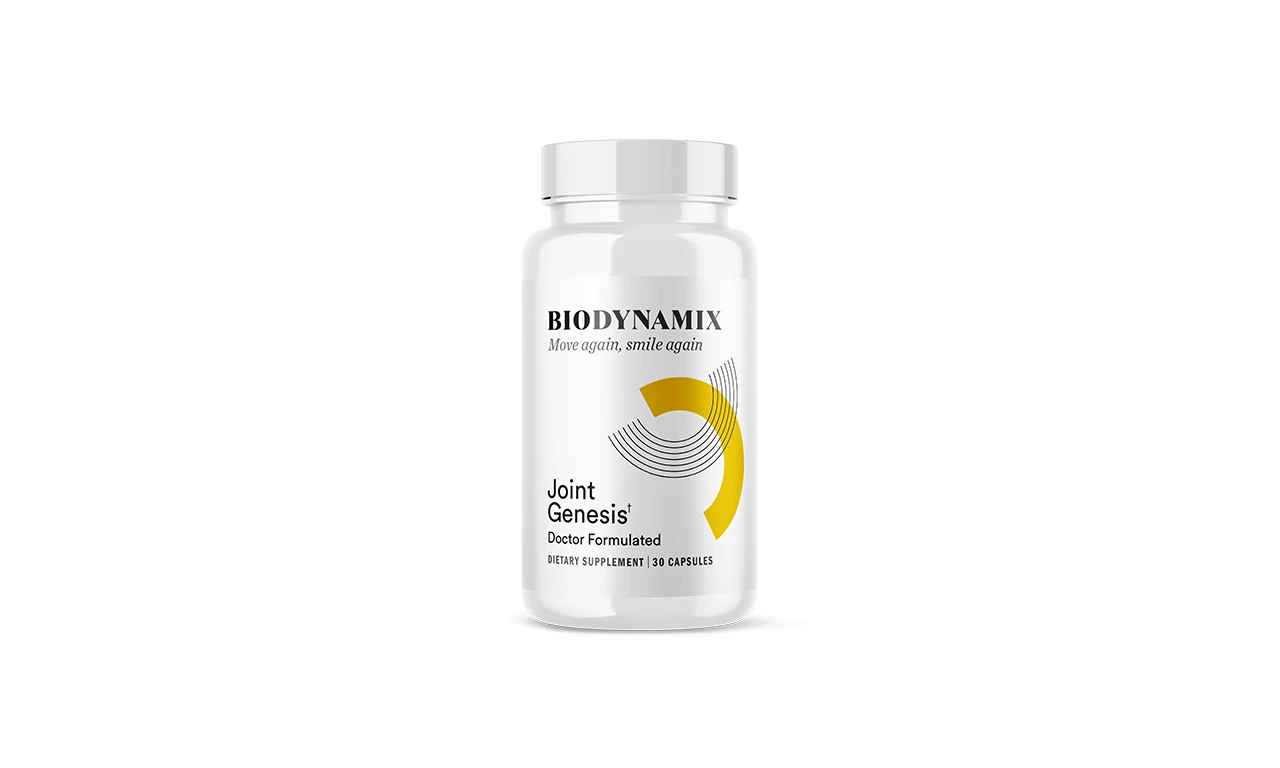
Capsule supplement marketed for joint comfort and mobility, with ginger, boswellia, a hyaluronic acid matrix, pine bark and black pepper. Official label versions differ.
Check current pricingJoint Genesis offers a relatively compact five-ingredient formula with individually listed doses and a plausible joint-comfort rationale. Its 80 mg Mobilee matrix is a meaningful numerical match to human ingredient trials, and several ingredients have joint-related human research. Official labels nevertheless conflict on pine bark and matrix specifications, some preparations do not clearly match those studied, and no controlled trial of the exact finished formula was identified.
Documentary review of product information and research; no personal use or testing is claimed. How we review supplements.
Verdict: Joint Genesis may be reasonable to consider for an adult who wants a convenient fixed joint-support formula and accepts uncertain benefit, after confirming the current formulation and medication suitability. The strongest case is its 80 mg Mobilee connection and relevant ingredient-level human evidence; whether the supplied matrix and extracts reproduce studied preparations remains unresolved. It is not proven cartilage repair, disease-modifying treatment or a clinically validated finished blend.
Joint Genesis brings five joint-support ingredients into a one-capsule serving with individually listed doses. Its clearest evidence connection is the 80 mg hyaluronic acid matrix associated with Mobilee, a meaningful numerical match to human ingredient trials. That gives the formula a plausible joint-comfort rationale and a practical convenience case, while preparation differences and the absence of a trial of this finished capsule leave the size of any benefit uncertain.
Our assessment is conditional: Joint Genesis may interest someone who wants a convenient botanical/matrix formula and accepts ingredient-level evidence rather than finished-product proof. The current label must first be clarified: pine bark is listed at 25 mg in one official asset and 150 mg in another, and matrix specifications also differ. We did not identify a controlled human trial of the exact Joint Genesis formula. Someone seeking demonstrated cartilage repair or a proven treatment for osteoarthritis should not read the marketing as that evidence.
This is a documentary review of official materials and human research, checked October 26, 2026. We did not buy, take or physically inspect the supplement, and make no claim about swallowing, delivery or personal pain relief. Planet Wellness Report may earn a commission through qualifying links; that relationship does not determine this assessment.
The label conflict changes the dose comparison
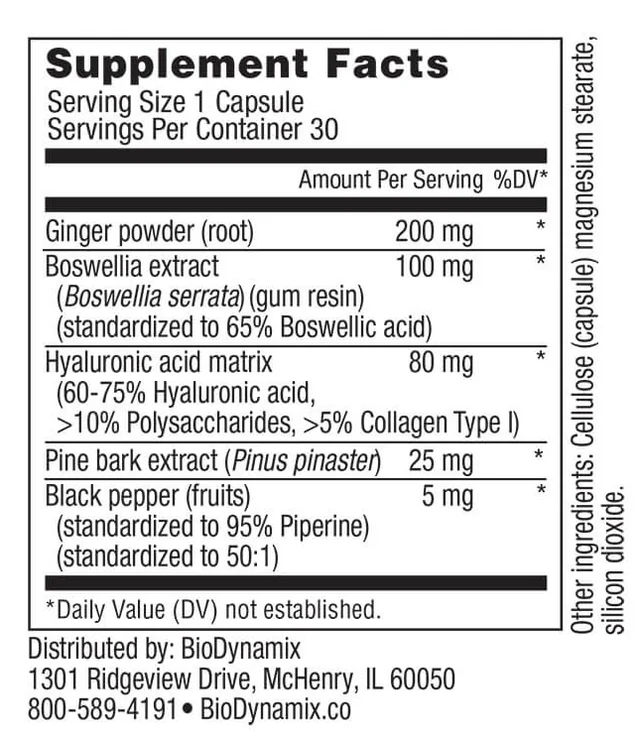
BioDynamix identifies Joint Genesis as a 30-capsule supplement, with one capsule per serving and 30 servings per bottle. Both official labels show ginger root powder 200 mg, boswellia extract 100 mg, a hyaluronic acid matrix 80 mg and black pepper 5 mg. Directions say one capsule daily or as recommended by a healthcare professional; the product-page FAQ adds water, preferably in the morning. These are manufacturer directions, not a personal dosing recommendation.
Boswellia is identified as gum-resin extract standardized to 65% boswellic acid. Black pepper is identified as fruit, standardized to 95% piperine and 50:1. Those specifications are more useful than ingredient names alone, although they still need to match the preparation tested in a relevant study.
The official inline Supplement Facts image lists Pinus pinaster pine bark extract at 25 mg. The full wraparound label, marked SAMPLE and linked from the same shop, lists 150 mg. The affiliate landing serves that same full label. Neither document establishes which composition will arrive in a particular order. We have not chosen a version by assuming one image is newer.
The matrix specifications also differ: the inline panel lists 60–75% hyaluronic acid, more than 10% polysaccharides and more than 5% collagen Type I. The full/sample label lists 60–80% hyaluronic acid and different printed polysaccharide/collagen ranges, with collagen Type II. Accordingly, 80 mg is the stated matrix mass; it is not 80 mg of pure hyaluronic acid or a verified dose of a particular collagen type.
Both panels list cellulose for the capsule and magnesium stearate, with silica/silicon dioxide wording also present. The FAQ's vegan-friendly positioning conflicts with Bioiberica's description of Mobilee as an extract from rooster comb containing collagen. Dietary preferences and relevant allergies require clarification for the actual bottle; a capsule shell or an “egg-free” statement does not resolve the matrix's origin.
Mobilee has the closest amount match, with important outcome limits
Bioiberica describes Mobilee as a branded matrix of hyaluronic acid, polysaccharides and collagen, rather than isolated hyaluronic acid. A product claiming that preparation should be evaluated against its trials, not against every oral or injected hyaluronic acid study. Matching “80 mg” is a useful starting point, not a certificate of equivalent absorption or efficacy.
A 2014 randomized, double-blind study gave adults with mild joint discomfort yogurt containing 80 mg Mobilee daily for 90 days. It excluded people with clinical osteoarthritis. Seventy-seven people entered; nine were removed from the authors' intended-to-treat population for noncompliance, leaving 68. The report described improvements in pain and synovial effusion, alongside blood-gene-expression analyses in a small subset. Removing participants after enrollment and the exploratory biomarker work limit the strength of inference. Neither gene expression nor less effusion demonstrates cartilage regrowth.
This study had public research support and a contract with Bioiberica within a Spanish government project; two coauthors were employed by the ingredient supplier. The report states that Bioiberica did not influence scientific interpretation or reporting. Those disclosures matter when judging independence, without making the findings automatically invalid.
A separate 2015 trial randomized 80 adults with mild knee pain to yogurt with 80 mg rooster-comb extract or control yogurt for 12 weeks. Its abstract reported better knee muscle torque, work and power in men, with no corresponding differences in women. That is a sex-specific muscle-performance finding in a defined test, not proof that everyone will have less pain, walk farther or regain unrestricted mobility. Full funding details for this report were not accessible in the materials we could verify; two coauthors were also identified as supplier employees in the 2014 report.
Joint Genesis therefore matches the stated matrix amount used in these studies, but not their complete intervention. Its capsule contains four other ingredients, and its conflicting matrix specifications leave preparation equivalence unresolved. The evidence is more specific than a generic “joint support” label, yet narrower than a reliable benefit claim for this bottle.
Boswellia: 100 mg of one extract is not 100 mg of every extract
The product's 100 mg boswellia entry can look persuasive beside trials using the same number. A frequently cited randomized trial enrolled 75 people with knee osteoarthritis and compared 100 mg or 250 mg of 5-Loxin daily with placebo for 90 days. It reported improvements in pain and some function measures. However, 5-Loxin was enriched to 30% AKBA, a specific boswellic acid. Joint Genesis instead declares 65% boswellic acid without identifying an equivalent AKBA specification or that branded extract.
The trial was funded by the extract developer, with employee and consultant links disclosed. Its small size and short follow-up limit generalization. Its measurement of a cartilage-degrading enzyme does not turn a symptom trial into evidence of rebuilt cartilage.
A 2024 systematic review also shows why broad summaries need care. Its overall analyses did not find statistically significant differences in WOMAC or pain VAS across heterogeneous comparisons, while a placebo-comparison subgroup favored boswellia. Preparations, comparators and study quality varied. The practical conclusion is that some standardized extracts have promising knee-OA data, not that any 100 mg boswellia capsule has reproduced those results.
Ginger: powder and concentrated extract answer different questions
A meta-analysis of five placebo-controlled trials involving 593 people with osteoarthritis found small average benefits for pain and disability. The standardized effects were about −0.30 for pain and −0.22 for disability. Participants receiving ginger were more likely to stop because of adverse events. The authors rated the evidence moderate quality, with limitations including small samples and incomplete intention-to-treat analyses. These are modest symptom findings, not structural repair.
An important positive knee-OA trial used 510 mg daily of a concentrated extract combining Zingiber officinale and Alpinia galanga for six weeks. Among 247 evaluable participants, 63% versus 50% met the standing-pain response criterion. Gastrointestinal complaints were more common with the extract; quality-of-life change did not differ. That extract is not the product's 200 mg ginger root powder.
Powder evidence is not uniformly positive either. An eight-week trial of 60 people with knee osteoarthritis found no significant benefit from 1,000 mg daily of powdered ginger for pain, symptoms, daily activities or quality of life compared with placebo. The product's 200 mg is one-fifth of that powder amount, but the more important point is that the larger amount did not establish benefit in that trial. Neither an extract result nor increasing a powder dose by arithmetic guarantees success.
Pine bark: the disputed amount is only half the question
A 100-person, three-month trial in mild-to-moderate knee osteoarthritis tested 150 mg daily of Pycnogenol, a particular standardized maritime pine bark extract, and reported improved symptoms compared with placebo. Joint Genesis's inline panel is far below that amount at 25 mg; its full/sample label reaches the same numerical amount at 150 mg. Neither panel identifies the ingredient as Pycnogenol or supplies a matching constituent specification.
The broader evidence remains uncertain. A 2020 Cochrane review included three osteoarthritis studies within a larger review and judged the available knee-OA evidence very low certainty, with small trials and reporting limitations. A favorable individual trial should be considered alongside that assessment. Even if a seller confirms 150 mg, species and mass alone do not prove standardized-extract equivalence or establish disease modification.
Piperine raises a medication question, not proof of a stronger formula
The 5 mg black pepper entry is positioned as an absorption aid. Its stated 95% piperine specification does not demonstrate that the other ingredients achieve the exposures or effects observed in their trials. A pharmacokinetic change and a meaningful joint outcome are different findings.
A review of concentrated piperine describes human drug-interaction findings and limited safety characterization. Many interaction studies used different amounts or exposure schedules, so they cannot predict a specific effect from Joint Genesis's labeled serving. They do justify a medication review: improving absorption is not automatically beneficial when a prescription drug is involved. There is no basis here for declaring the mixture interaction-free or assigning it an independent joint-pain benefit.
Ginger can cause abdominal discomfort, heartburn or diarrhea. Boswellia and pine bark deserve attention alongside anticoagulant or antiplatelet medicines: clinical herb references flag possible additive bleeding effects, while the significance of some laboratory findings remains uncertain. This is a reason to discuss the complete formula with a pharmacist or clinician, not a claim that every user will bleed or an instruction to stop prescribed treatment. Pregnancy, breastfeeding, planned surgery and relevant allergies also warrant individual advice rather than assumptions based on the word “natural.”
Mobilee's rooster-comb origin and the conflicting collagen descriptions are particularly relevant to ingredient-source questions. The trials reviewed do not establish safety for every allergy or medication combination. Obtain confirmation of the actual formulation before treating an online list as a complete suitability assessment.
We did not find a controlled trial of the finished product
Finished-product RCT found: NO. Searches of PubMed, Europe PMC and ClinicalTrials.gov for Joint Genesis and JointGenesis, alongside official documentation, did not identify a controlled human trial of this exact formula as of October 26, 2026. Name-based public searches cannot rule out unpublished data or studies indexed under another name. We would reassess if a verifiable protocol and report of the current formula were supplied.
The distinction matters because several plausible ingredients do not prove that a combination is additive or synergistic. The 2026 ATLAS trial illustrates the issue with a different mixture: the study recruited 84 adults with symptomatic knee OA and compared a mixture of boswellia, pine bark, MSM, curcumin and piperine with placebo for 12 weeks. Pain improvement did not differ between groups; the estimated difference was 0.16 mm on a 100 mm scale, with a confidence interval of −6.81 to 7.12 mm. That is not a Joint Genesis trial and does not prove this product ineffective. It shows why another formula's ingredient rationale cannot substitute for testing the actual combination.
Comfort and lubrication claims do not establish cartilage repair
Manufacturer positioning emphasizes comfort, flexibility and rehydrating synovial fluid, including a tenfold hyaluronan claim. Those statements should be kept separate from the human evidence above. Supplier materials include cell-culture work on hyaluronan production; responses in cultured synoviocytes do not show a tenfold increase inside a customer's joint after a capsule. We did not verify such an in-vivo result for Joint Genesis.
The strongest defensible evidence statement is that certain preparations of these ingredients have produced symptom or performance signals in selected human studies. The strongest overextension is carrying that evidence into assured lubrication, tissue restoration or disease modification by the finished product. We did not locate a literal “regrows cartilage” promise on the shop page checked; we also found no human structural evidence that would justify interpreting the cartilage-nourishment narrative as repair.
Pain, stiffness and self-reported function are distinct from walking distance, range of motion and quality of life. All are distinct from an imaging-confirmed structural change. Osteoarthritis populations are also different from adults with nonspecific discomfort or inflammatory arthritis. Neither an age-related narrative nor a favorable pain score identifies the cause of a reader's symptoms.
This review belongs in Healthy Aging because it evaluates a purchase aimed at comfort and movement with age. It does not establish muscle preservation, better balance or protection against osteoporosis. Our muscle-preservation guide addresses strength and function; our balance guide addresses steadiness. A joint supplement should not be substituted for those separate priorities.
What the current offers cost—and what a refund cannot establish
The public BioDynamix shop checked October 26, 2026 showed one-time prices of $59 for one bottle, $147 for three and $234 for six. With 30 servings per bottle and one serving daily, nominal cost per serving and per day is approximately $1.97, $1.63 or $1.30, respectively, before shipping, taxes and extras. Subscription options are separate recurring purchases, not the same offer.
The existing ClickBank link led to a different landing page. Its visible two-, three- and six-bottle cards showed totals of $158, $207 and $294, or approximately $2.63, $2.30 and $1.63 per serving/day. That page also mentioned $59 for a 30-day supply in its narrative, conflicting with the visible package cards. We did not complete a checkout, and do not present either route as a guaranteed final payable price. Check package size, recurring billing, shipping, taxes and any add-ons before paying.
The vendor advertises a 180-day empty-bottle money-back guarantee. Its return policy requires remaining unopened bottles to be returned and makes return shipping the buyer's responsibility; wording about original shipping reimbursement is inconsistent. Terms also contain narrower discretionary language. BioDynamix directs customers to product support and ClickBank order support. Confirm the written conditions for the actual order rather than treating the headline as unconditional. A refund policy is a commercial term, not evidence that the supplement works.
The purchase buys a fixed mixture with unresolved label details. We did not establish that it is cheaper than a preparation-matched alternative or offers greater clinical benefit than simpler options. Buying six bottles lowers an advertised unit price but increases the commitment before either formulation clarity or individual benefit has been established.
Who might consider it—and what would change our verdict
An adult who has already discussed persistent joint symptoms, wants a convenient fixed botanical/matrix formula for joint-comfort support and accepts an uncertain magnitude of benefit may reasonably consider Joint Genesis after confirming the current label and medication suitability. Its practical strengths are a relatively compact ingredient list, individually disclosed doses and the 80 mg Mobilee connection to human ingredient research. The main uncertainty is whether the supplied matrix and extracts reproduce the preparations studied. The unresolved label conflict makes the purchase difficult to evaluate confidently until the seller confirms the current formulation.
The current evidence does not support expectations of cartilage regeneration, reversal of osteoarthritis, or replacement of assessment, rehabilitation or prescribed treatment. Someone who requires a finished-product RCT, precise extract equivalence or independent control of ingredient doses has a clear reason to choose a different approach. Joint discomfort is not itself a diagnosis. Persistent or worsening pain warrants evaluation; a hot swollen joint with fever or feeling unwell needs urgent medical attention. Do not trial a supplement first for that pattern.
A single reconciled, batch-relevant label, clearer extract specifications and a well-conducted controlled trial of the current finished formula would materially strengthen the case. Such a trial would need to separate pain, function, walking and structural outcomes, with enough follow-up and transparent funding. A lower price would improve cost, but could not resolve an evidence gap. For a buyer who values the fixed formula and accepts uncertain benefit, the ingredient research provides a conditional reason to consider it once formulation and suitability are confirmed; it does not support the certainty conveyed by the marketing.
Was this article helpful?
Your anonymous response helps improve our editorial coverage.
Loading feedback options…
Share
Share this article
Selected references
Recommended products
More from Planet Wellness Report
Continue Reading

Healthy Aging
How Hearing Changes With Age—and Why It Matters Beyond Hearing
Hearing a sound and understanding a conversation are different. Explore age-related hearing changes, communication support and patterns that deserve assessment.
10 min read

Healthy Aging
How Bone Density Changes With Age—and What Actually Helps Protect It
Bone health depends on more than a scan number. Understand remodeling, skeletal loading, nutritional adequacy and when fracture risk deserves a closer look.
9 min read

Healthy Aging
How Muscle Mass Changes With Age—and What Actually Helps Preserve It
Muscle mass, strength and function change differently with age. Use an evidence-informed order of priorities to decide what to address first.
8 min read
Evidence
Sources
- Sánchez J, Bonet ML, Keijer J, van Schothorst EM, Mölller I, Chetrit C, Martinez-Puig D, Palou A.. Blood cells transcriptomics as source of potential biomarkers of articular health improvement: effects of oral intake of a rooster combs extract rich in hyaluronic acid — Genes & nutrition (Jul 15, 2014) · DOI
- Solà R, Valls RM, Martorell I, Giralt M, Pedret A, Taltavull N, Romeu M, Rodríguez À, Moriña D, Lopez de Frutos V, Montero M, Casajuana MC, Pérez L, Faba J, Bernal G, Astilleros A, González R, Puiggrós F, Arola L, Chetrit C, Martinez-Puig D.. A low-fat yoghurt supplemented with a rooster comb extract on muscle joint function in adults with mild knee pain: a randomized, double blind, parallel, placebo-controlled, clinical trial of efficacy — Food & function (Aug 24, 2015) · DOI
- Sengupta K, Alluri KV, Satish AR, Mishra S, Golakoti T, Sarma KV, Dey D, Raychaudhuri SP.. A double blind, randomized, placebo controlled study of the efficacy and safety of 5-Loxin for treatment of osteoarthritis of the knee — Arthritis research & therapy (Jul 30, 2008) · DOI
- Dalmonte T, Andreani G, Rudelli C, Isani G.. Efficacy of Extracts of Oleogum Resin of Boswellia in the Treatment of Knee Osteoarthritis: A Systematic Review and Meta-Analysis — Phytotherapy research : PTR (Sep 23, 2024) · DOI
- Bartels EM, Folmer VN, Bliddal H, Altman RD, Juhl C, Tarp S, Zhang W, Christensen R.. Efficacy and safety of ginger in osteoarthritis patients: a meta-analysis of randomized placebo-controlled trials — Osteoarthritis and cartilage (Oct 7, 2014) · DOI
- Altman RD, Marcussen KC.. Effects of a ginger extract on knee pain in patients with osteoarthritis — Arthritis and rheumatism · DOI
- Niempoog S, Pawa KK, Amatyakul C.. The efficacy of powdered ginger in osteoarthritis of the knee — Journal of the Medical Association of Thailand = Chotmaihet thangphaet
- Cisár P, Jány R, Waczulíková I, Sumegová K, Muchová J, Vojtassák J, Duraćková Z, Lisý M, Rohdewald P.. Effect of pine bark extract (Pycnogenol) on symptoms of knee osteoarthritis — Phytotherapy research : PTR · DOI
- Robertson NU, Schoonees A, Brand A, Visser J.. Pine bark (Pinus spp.) extract for treating chronic disorders — The Cochrane database of systematic reviews (Sep 29, 2020) · DOI
- Ziegenhagen R, Heimberg K, Lampen A, Hirsch-Ernst KI.. Safety Aspects of the Use of Isolated Piperine Ingested as a Bolus — Foods (Basel, Switzerland) (Sep 8, 2021) · DOI
- Yuan S, Liu X, Bracken K, Christensen R, Deveza LA, Collins S, Harnett JE, McLachlan AJ, Robbins S, Venkatesha V, Bowden JL, Hunter DJ.. Effect of an oral complementary medicine combination for symptomatic knee osteoarthritis: A double-blind, randomized, placebo-controlled trial — Osteoarthritis and cartilage (Jun 22, 2026) · DOI
- BioDynamix. Joint Genesis — Official Product Page — BioDynamix
- BioDynamix. Joint Genesis — Inline Supplement Facts (25 mg pine bark) — BioDynamix
- BioDynamix. Joint Genesis — Full SAMPLE Label (150 mg pine bark) — BioDynamix
- BioDynamix. Joint Genesis — ClickBank Landing Offer — BioDynamix
- BioDynamix. BioDynamix Return Policy — BioDynamix
- BioDynamix. BioDynamix Terms & Conditions — BioDynamix
- Bioiberica. Mobilee — Hyaluronic Acid Matrix Ingredient — Bioiberica
- NIH NCCIH. Ginger: Usefulness and Safety — NIH NCCIH
- Memorial Sloan Kettering Cancer Center. Boswellia — Memorial Sloan Kettering Cancer Center
- Memorial Sloan Kettering Cancer Center. Pine Bark Extract — Memorial Sloan Kettering Cancer Center
- NHS. Joint pain — NHS