
COMPARISON
Beetroot vs. L-Citrulline for Nitric Oxide Support: Which Fits Your Goal?
Two pathways, different preparations, and evidence that depends on what you want to measure.
By Planet Wellness Report · Oct 7, 2026 · 8 min read
Editorial review and publication: Felipe Lopes, Publisher & Editor. This is an editorial review, not a medical review.
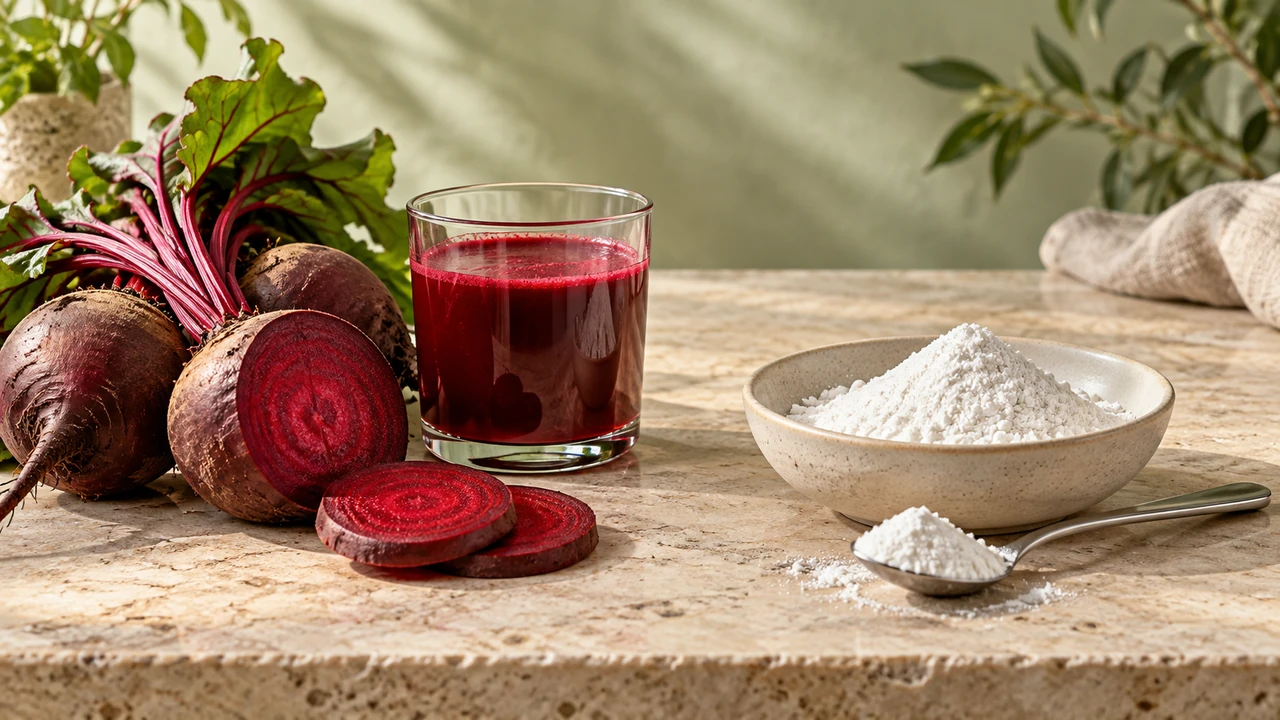
Side by side
Quick comparison
INGREDIENT
- Beet Root
Beet root is a nutrient-rich root vegetable that naturally contains dietary nitrates, which the body can convert into nitric oxide.
- L-Citrulline
L-Citrulline is an amino acid commonly used to support nitric oxide production, circulation, and exercise-related performance.
Beetroot vs. L-citrulline: the quick answer
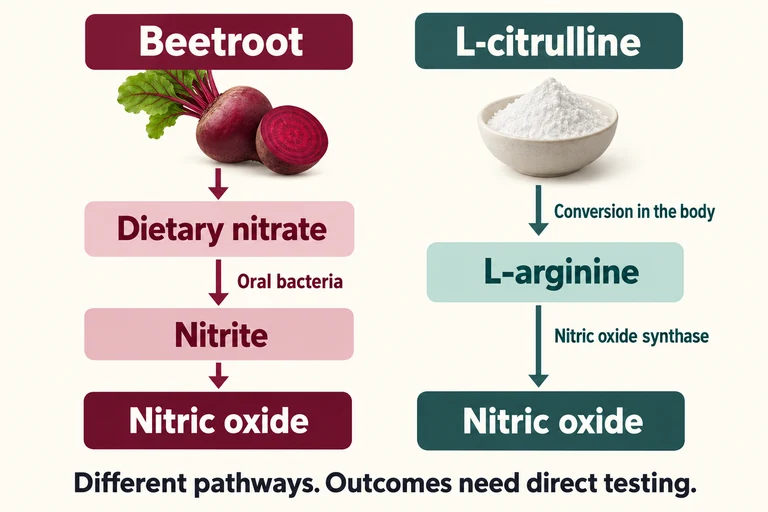
Beetroot and L-citrulline can support pathways involved in nitric oxide production, but they are different strategies. Beetroot supplies dietary nitrate, which can become nitrite and then nitric oxide. L-citrulline can become L-arginine, the substrate used by nitric oxide synthase enzymes. Choosing between them starts with your goal: a measurable nitrate source, a particular exercise task, or a vascular outcome studied over time.
For selected exercise outcomes, standardized dietary nitrate has a broader evidence base and may be the more research-supported starting point. That is an interpretation of separate bodies of research, not proof that beetroot beats L-citrulline in a direct comparison. Citrulline has encouraging findings for some vascular measures, while exercise results are mixed and often involve citrulline malate rather than pure L-citrulline. Neither is a universal winner or a treatment for circulation problems.
This comparison focuses on ingredients and preparations, not brands. For the underlying physiology, start with what nitric oxide does in the body.
Two different routes to nitric oxide
Beetroot: the dietary nitrate–nitrite pathway
Beet root is a vegetable that can supply inorganic nitrate. After absorption, some nitrate returns to the mouth through saliva. Oral bacteria convert part of it to nitrite; after swallowing, nitrite can contribute to nitric oxide formation in the stomach and tissues. This route does not directly require nitric oxide synthase and can be particularly relevant under lower-oxygen conditions.
The nitrate amount matters more than the word beetroot on a label. Whole beets, juice, concentrated shots, and powders differ in composition. A serving with several grams of beetroot powder does not necessarily deliver the nitrate amount used in a successful trial.
L-citrulline: the citrulline–arginine pathway
L-citrulline is an amino acid made by the body and found in foods including watermelon. The body converts it to L-arginine, substantially through the kidneys. Nitric oxide synthase then uses arginine, oxygen, and supporting molecules to make nitric oxide. Supplying more precursor is only one part of that regulated process.
Pure L-citrulline and citrulline malate should be distinguished. The latter combines citrulline with malate, so its total gram weight is not its L-citrulline content. Watermelon, a mixed pre-workout, and pure L-citrulline also cannot be assumed to reproduce one another's results.
What the evidence shows, using the same criteria
Nitric oxide availability: precursor changes are not the final outcome
For beetroot, nitrate-rich preparations can raise circulating nitrate and nitrite, supplying compounds that participate in nitric oxide generation. These measurements show that the dietary pathway responded. They do not measure a lasting pool of nitric oxide or prove that all tissues receive more blood. Our article on how long nitric oxide stays in your system explains the distinction between the short-lived signal and its precursors.
For L-citrulline, a randomized, double-blind crossover study by Schwedhelm and colleagues tested one-week dosing regimens in 20 volunteers. Citrulline raised circulating arginine; the highest regimen also increased urinary nitrate and cyclic GMP, a marker of nitric oxide signaling. No treatment significantly improved flow-mediated dilation in that experiment. It is a useful example of a biochemical response without a demonstrated improvement in the measured vascular outcome.
The practical comparison is therefore nitrate and nitrite availability versus arginine availability and downstream signaling. Neither a higher precursor concentration nor a stronger feeling of muscle pump establishes a health or performance benefit.
Circulation: vascular tests give a narrower answer than marketing
A 2021 systematic review of beetroot-derived inorganic nitrate reported improvements in some vascular measures, including flow-mediated dilation and arterial stiffness. These tests assess aspects of vessel responsiveness and stiffness; they do not establish relief from every symptom described as poor circulation.
A 2026 beetroot dose-comparison trial illustrates why more precursor is not automatically better. Plasma nitrate and nitrite rose after ingestion, but endothelial function improved only after the middle nitrate dose, while aortic systolic blood pressure improved only after the highest. Arm blood pressure and plasma cyclic GMP did not improve. This was an acute crossover experiment using baseline control measurements, not a long-term clinical-outcomes trial or a beetroot-versus-citrulline test.
For citrulline, the Smeets meta-analysis found a modest improvement in flow-mediated dilation with longer-term supplementation, but no acute post-meal vascular benefit. A November 2025 review of eight trials in middle-aged and older adults also found an endothelial-function signal, while overall pulse-wave velocity did not significantly improve. Some included interventions combined citrulline with other ingredients, which limits attribution to pure L-citrulline.
Both approaches have promising findings for selected vascular markers. Separate reviews cannot establish which is better for a given person's circulation, and a surrogate-marker improvement is not proof of fewer heart attacks or other clinical events. Persistent symptoms deserve assessment rather than a choice based on a nitric oxide label.
Exercise performance: compare the activity and preparation
The 2025 dietary nitrate umbrella review included 20 systematic reviews representing 180 primary studies. It found benefits for time-to-exhaustion tasks, distance covered, muscular endurance, and certain power measures, but no significant improvement for several other outcomes. Most included reviews had low or critically low methodological quality. A longer laboratory time to exhaustion should not be read as a guaranteed faster race time.
Citrulline's aerobic evidence is less consistent. A 2022 systematic review found no significant benefit across the aerobic outcomes it assessed. The June 2026 citrulline malate review pooled 30 randomized trials and found a small overall performance effect, with low to very low certainty, wide prediction intervals, and no significant pooled reduction in perceived exertion. Importantly, it excluded L-citrulline-only studies, so its estimate cannot be assigned to pure L-citrulline.
For someone considering a supplement for a specific exercise task, dietary nitrate has the more established sports-use rationale. Citrulline-related findings warrant more cautious expectations, especially when the label differs from the studied preparation. Training status, test design, habitual diet, and protocol affect results for both. Neither the pooled effects nor their relative sizes constitute a head-to-head ranking.
Practical use: what to check before choosing
Beetroot: check nitrate content and the setting of use
If your goal is a food-based nitrate source, beetroot can fit into ordinary meals; a concentrated supplement is optional. If your goal is to resemble an exercise study, look for stated nitrate content per serving rather than beetroot weight alone. The 2022 expert sports consensus discusses taking the final nitrate dose 2–4 hours before exercise. That is sports-protocol context, not a universal prescription for daily circulation support.
Whole beetroot adds fiber and food variety. Juice and concentrated shots may be easier to use around training, but taste, carbohydrate content, serving volume, and stomach tolerance differ. Oral bacteria participate in nitrate processing, and research suggests some antibacterial rinses can interfere with that conversion. Keep normal oral care and follow dental guidance, including prescribed mouthwash.
L-citrulline: check the actual amount and form
Look for the amount of L-citrulline per serving and whether the ingredient is pure L-citrulline or citrulline malate. A total blend weight or a citrulline malate serving does not necessarily tell you the amount of L-citrulline. The Schwedhelm trial's highest regimen used 3 grams twice daily; that describes a short mechanistic study, not an established daily dose for better circulation or workouts.
An amino-acid powder may suit someone who prefers a clearly quantified supplement over beet juice. That is a convenience preference, not an efficacy advantage. The 2026 citrulline malate review did not establish reliable dosing, timing, or target populations. There is also no sound basis here to promise that combining beetroot and citrulline outperforms either alone.
Ingredient evidence does not prove a finished product's claims
A trial supports the preparation tested, at its tested amount, in its population and setting. It does not validate every capsule, lozenge, or pre-workout containing the same ingredient name. Check nitrate standardization, actual citrulline content, added stimulants, and whether the complete product has relevant controlled trials. Independent quality testing helps assess contents and contamination; it does not prove effectiveness.
A label that says supports nitric oxide does not by itself establish improved circulation, endurance, energy, or recovery. Multi-ingredient products also make it harder to attribute a result to beetroot or citrulline. Our CircO2 review evaluates a finished combination separately; this ingredient comparison should not be interpreted as an endorsement of that formula or any other brand.
Safety and reasons to seek individual guidance
Beetroot can temporarily color urine or stool, and concentrated preparations may cause stomach discomfort. Citrulline studies have generally been short, and the NIH notes that safety evidence is limited. Neither approach has an established safety profile for every person or indefinite high-dose use. A multi-ingredient product needs its own assessment.
Before using concentrated products, discuss the specific label with a clinician or pharmacist if you have low blood pressure, kidney or cardiovascular disease, take medicines affecting blood pressure or vascular function, or are pregnant or breastfeeding. These are reasons for individualized review, not a claim that food nitrate is equivalent to prescription nitrate medication. Supplements should not replace prescribed treatment.
Which approach may fit your goal?
Beetroot may fit someone who wants a nitrate-containing food or a standardized nitrate preparation for an exercise task supported by research. Its advantage is the direct connection to dietary nitrate studies, provided the product actually supplies a comparable preparation. It still may add little for some activities or highly trained athletes.
L-citrulline may fit someone who prefers a quantified amino-acid format and understands the uncertainty around translating arginine availability into outcomes. It has a rationale for further vascular research, but that is not enough to recommend it as a treatment or to assume citrulline malate performance findings apply to pure L-citrulline.
If the goal is everyday wellness rather than a defined exercise outcome, a supplement may be unnecessary. For the broader food-and-movement approach, see how to support nitric oxide naturally. If you choose an optional product, define what would count as a meaningful result before adding it, and test tolerance during ordinary training rather than first use at a competition.
The takeaway: choose by outcome, not by a universal winner
Beetroot's nitrate pathway and L-citrulline's arginine pathway are biologically distinct. Dietary nitrate offers the stronger sports-use case for selected tasks; citrulline has signals for some vascular measures and uncertain, preparation-specific performance evidence. Match the goal, preparation, and protocol to the actual research. Neither a plausible mechanism nor an ingredient on a label proves that a finished product will improve your health or performance.
Was this article helpful?
Your anonymous response helps improve our editorial coverage.
Loading feedback options…
Share
Share this article
Selected references
Recommended products
More from Planet Wellness Report
Continue Reading
Energy
CircO2 Review: What the 420 mg Blend Reveals—and Hides
CircO2’s lozenge discloses vitamin C 100 mg, B12 1,000 mcg and a 420 mg total blend. It does not disclose individual beetroot, hawthorn, citrulline or sodium-nitrite amounts, nitrate content, or a separate elemental-magnesium dose. That prevents the dose comparisons central to its nitric-oxide positioning.
9 min read
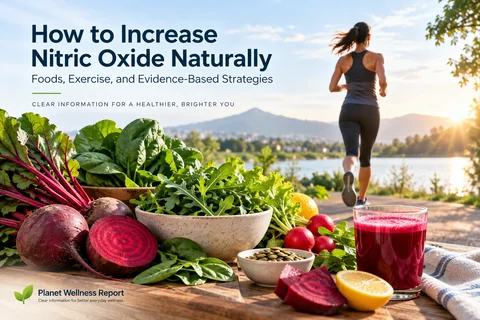
Energy
How to Increase Nitric Oxide Naturally: Foods, Exercise, and Evidence-Based Strategies
Food and exercise come first when supporting the body's nitric oxide pathways, and oral bacteria also play an important role. Beetroot and L-citrulline may be useful in specific contexts, but claims about boosting nitric oxide deserve cautious interpretation.
13 min read

Energy
What Is Nitric Oxide? How It Supports Circulation, Energy, and Exercise
Nitric oxide helps regulate blood vessel tone and circulation, but it is not a stimulant or a direct source of energy. Learn how the body produces it, what exercise research shows, and where beetroot and L-citrulline fit.
10 min read
Evidence
Sources
- Vikas Kapil, Rukshana S. Khambata, David A. Jones et al. The Noncanonical Pathway for In Vivo Nitric Oxide Generation: The Nitrate-Nitrite-Nitric Oxide Pathway — Pharmacological Reviews (Jul 1, 2020) · DOI
- Andrew M. Jones, Anni Vanhatalo, Douglas R. Seals, Matthew J. Rossman, Barbora Piknova, Kristin L. Jonvik. Dietary Nitrate and Nitric Oxide Metabolism: Mouth, Circulation, Skeletal Muscle, and Exercise Performance — Medicine & Science in Sports & Exercise (Feb 1, 2021) · DOI
- Eric T. C. Poon, Jason C. K. Iu, Wai M. K. Sum et al.. Dietary Nitrate Supplementation and Exercise Performance: An Umbrella Review of 20 Published Systematic Reviews with Meta-analyses — Sports Medicine (May 1, 2025) · DOI
- Aitor Viribay, Javier Fernández-Landa, Alejandro Castañeda-Babarro et al.. Effects of Citrulline Supplementation on Different Aerobic Exercise Performance Outcomes: A Systematic Review and Meta-Analysis — Nutrients (Sep 1, 2022) · DOI
- Dietary Supplements for Exercise and Athletic Performance: Fact Sheet for Health Professionals — NIH Office of Dietary Supplements
- Leila Sadat Bahrami; Seyyed Mostafa Arabi; Zahra Feizy; Reza Rezvani. The effect of beetroot inorganic nitrate supplementation on cardiovascular risk factors: A systematic review and meta-regression of randomized controlled trials — Nitric Oxide (Oct 1, 2021) · DOI
- Katelyn E Senkus; Kristi M Crowe-White. Influence of mouth rinse use on the enterosalivary pathway and blood pressure regulation: A systematic review — Critical Reviews in Food Science and Nutrition (Sep 23, 2019) · DOI
- Ellen T H C Smeets; Ronald P Mensink; Peter J Joris. Effects of l-citrulline supplementation and watermelon consumption on longer-term and postprandial vascular function and cardiometabolic risk markers: a meta-analysis of randomised controlled trials in adults — British Journal of Nutrition (Dec 6, 2021) · DOI
- Edzard Schwedhelm; Renke Maas; Ralf Freese; Donald Jung; Zoltan Lukacs; Alen Jambrecina; William Spickler; Friedrich Schulze; Rainer H. Böger. Pharmacokinetic and pharmacodynamic properties of oral L-citrulline and L-arginine: impact on nitric oxide metabolism — British Journal of Clinical Pharmacology (Jul 27, 2007) · DOI
- Abbie G. McLellan; Jarred P. Acton; Emma O'Donnell; Samantha N. Rowland; Anthony I. Shepherd; Maria Perissiou; Lewis J. James; Tom Clifford; Stephen J. Bailey. The dose-response effects of nitrate-rich beetroot ingestion on cardiovascular and endothelial function: a randomised controlled trial — Food & Function (Feb 13, 2026) · DOI
- Ping Luo; Ziyi Li; Kang Liu; Weifeng Gao. Effects of L-citrulline supplementation and watermelon intake on arterial stiffness and endothelial function in middle-aged and older adults: a systematic review and meta-analysis of randomized controlled trials — Frontiers in Nutrition (Nov 13, 2025) · DOI
- Xuexiang Wang; Xiaohan Fan; Jindong Chang; Hansen Li; Xing Zhang; Yilin Zhang; Tianyu Song; Ping Liu; Qing Huang; Mohamed Nashrudin Bin Naharudin; Hengzhi Deng. Effects of Citrulline Malate Supplementation on Exercise Performance: A Systematic Review and Three-Level Meta-Analysis — Nutrients (Jun 11, 2026) · DOI
- Oliver M. Shannon et al.. Dietary Inorganic Nitrate as an Ergogenic Aid: An Expert Consensus Derived via the Modified Delphi Technique — Sports Medicine (May 23, 2022) · DOI