
ARTICLE
How Long Does Nitric Oxide Stay in Your System?
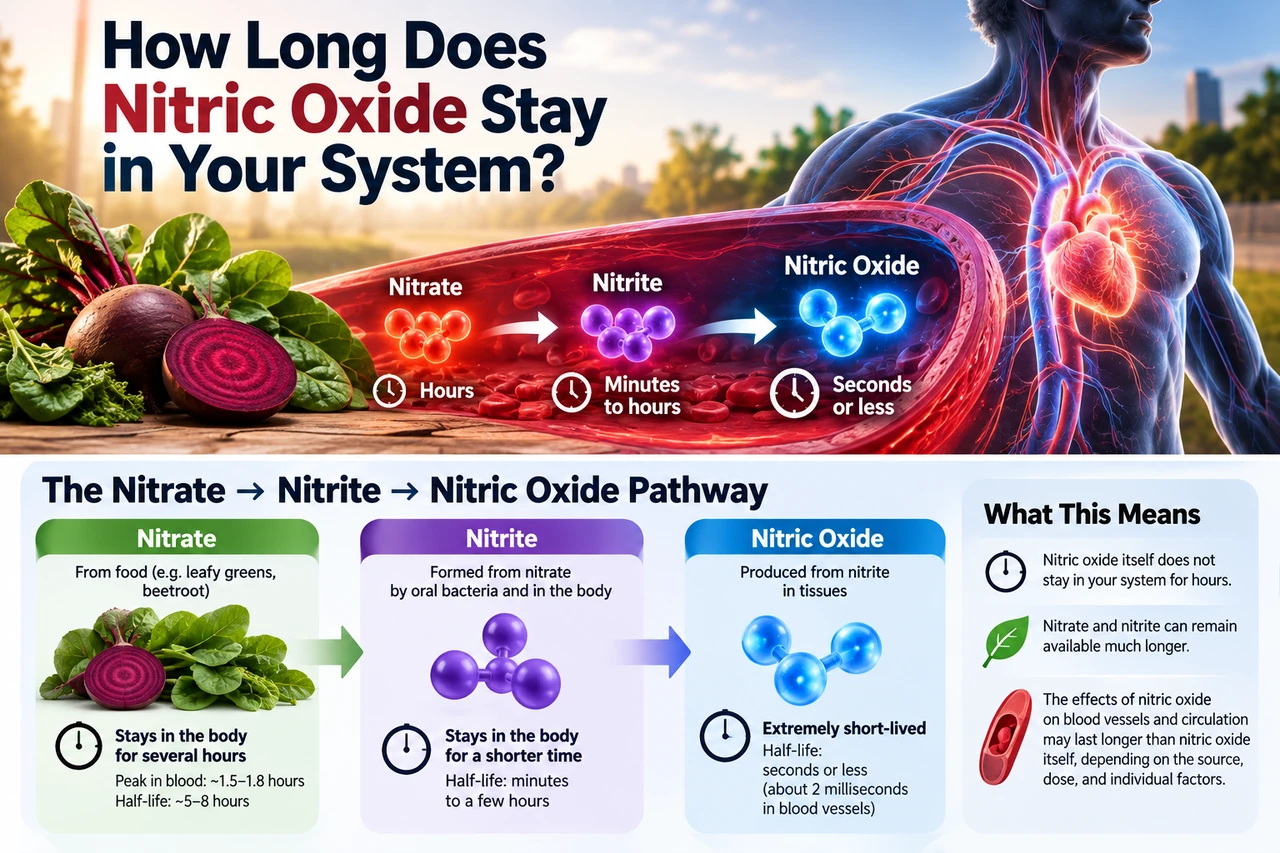
Nitric oxide itself lasts only seconds or less, but nitrate and nitrite can remain available much longer and support continued nitric oxide production.
By Planet Wellness Report · Sep 24, 2026 · 12 min read
Editorial review and publication: Felipe Lopes, Publisher & Editor. This is an editorial review, not a medical review.
How Long Does Nitric Oxide Stay in Your System? The Short Answer
Nitric oxide itself does not stay in the body for hours. It is an extremely short-lived signaling molecule that is produced, used, and broken down very quickly.
In biological tissues, nitric oxide may persist for fractions of a second to a few seconds depending on its location and surrounding conditions. In the bloodstream, it can be consumed even faster because red blood cells rapidly remove nitric oxide.
What lasts much longer are compounds involved in the same pathway, especially nitrate and nitrite. These can remain available for minutes to hours and contribute to continued nitric oxide production even though each individual nitric oxide molecule disappears rapidly.
Nitric Oxide Has an Extremely Short Half-Life
Nitric oxide, often abbreviated as NO, is a gas and signaling molecule produced throughout the body. One of its best-known functions is helping regulate blood vessel tone by signaling vascular smooth muscle to relax.
A foundational study examining the biological lifetime of nitric oxide estimated an intravascular half-life of roughly 2 milliseconds because of rapid consumption by red blood cells. Outside the bloodstream, estimated half-life varied from about 0.09 seconds to more than 2 seconds depending on oxygen concentration and tissue conditions.
That means it is misleading to say that a single dose of food or a supplement causes the same nitric oxide molecules to circulate for several hours. Nitric oxide is continually being produced and consumed.
Nitric Oxide vs. Nitrite vs. Nitrate
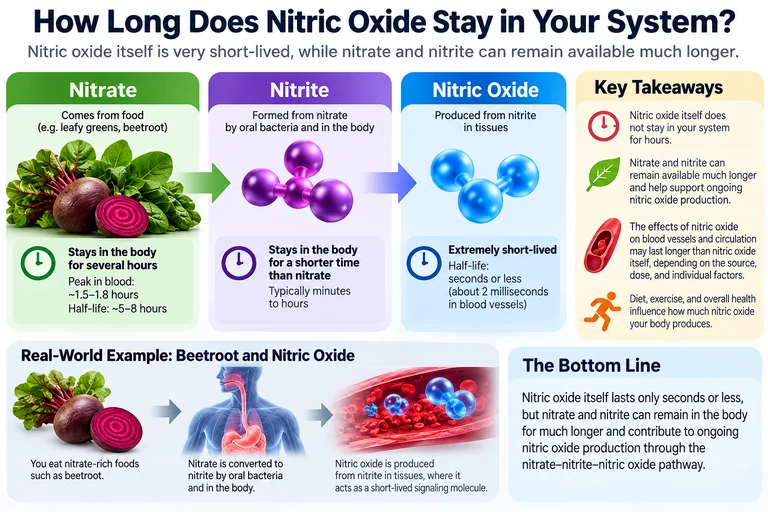
Part of the confusion around how long nitric oxide stays in the body comes from treating nitric oxide, nitrite, and nitrate as though they were interchangeable. They are related, but their behavior in the body is very different.
Nitrate
Nitrate is found naturally in foods such as beetroot and leafy green vegetables. After ingestion, nitrate enters the circulation and can remain available for several hours.
Research reviewing the dietary nitrate pathway reports that plasma nitrate typically peaks roughly 1.5 to 1.8 hours after ingestion and has a plasma half-life of about 5 to 8 hours.
Nitrite
Some circulating nitrate is taken up by the salivary glands and returned to the mouth, where oral bacteria convert part of it into nitrite.
Nitrite is shorter-lived than nitrate, but it can still remain available considerably longer than nitric oxide itself. Under appropriate physiological conditions, nitrite can be reduced further to nitric oxide.
Nitric oxide
Nitric oxide is produced locally and acts quickly. Instead of serving as a long-lasting circulating store, it behaves more like a short-range signal that is generated when and where it is needed.
Why Does Nitric Oxide Disappear So Quickly?
Nitric oxide is highly reactive. Once produced, it can interact rapidly with hemoglobin, oxygen-derived molecules, proteins, and other biological targets.
In blood vessels, red blood cells are especially important because hemoglobin reacts rapidly with nitric oxide. This helps explain why nitric oxide does not simply accumulate in the bloodstream for long periods.
Its short lifetime is not a flaw. It is part of how nitric oxide works as a tightly controlled signaling molecule.
If Nitric Oxide Lasts Seconds, Why Can Its Effects Last Longer?
The lifetime of a signaling molecule is not necessarily the same as the duration of the biological response it triggers.
Nitric oxide can activate signaling pathways inside vascular smooth muscle that influence vessel relaxation. The nitric oxide molecule itself may disappear quickly while downstream signaling and changes in vascular function continue for longer.
At the same time, the body can continue generating new nitric oxide from endogenous pathways or from nitrate and nitrite that remain available.
What Happens After Eating Nitrate-Rich Foods?
Foods such as beetroot and leafy greens contain nitrate. After these foods are consumed, nitrate is absorbed into the bloodstream and some is concentrated in saliva.
Bacteria in the mouth convert part of the nitrate to nitrite. After swallowing, nitrite can participate in reactions that generate nitric oxide in the body.
This nitrate–nitrite–nitric oxide pathway helps explain why physiological effects related to a nitrate-rich meal can extend well beyond the lifetime of any single nitric oxide molecule.
How Long Does Dietary Nitrate Stay in the Body?
Dietary nitrate persists much longer than nitric oxide. Available pharmacokinetic research suggests that plasma nitrate generally reaches its highest concentration around 1.5 to 1.8 hours after ingestion.
Its plasma half-life is approximately 5 to 8 hours. A half-life does not mean that all nitrate disappears after that period; it means that the circulating amount has fallen by approximately half under the conditions studied.
Individual responses can vary based on diet, physiology, oral bacteria, kidney handling, exercise, and other factors.
How Long Does Nitrite Stay in the Body?
Nitrite is generally shorter-lived than nitrate but substantially longer-lived than nitric oxide. Its concentration can also change as nitrate is continuously converted to nitrite and nitrite is subsequently metabolized or reduced to nitric oxide.
For that reason, it is more accurate to think of nitrate and nitrite as components of a dynamic reservoir rather than as a simple timer that starts and stops after one dose.
Does Exercise Increase Nitric Oxide?
Physical activity can influence nitric oxide biology through multiple mechanisms. Increased blood flow places greater shear stress on the lining of blood vessels, which can stimulate endothelial nitric oxide production.
Exercise also interacts with nitrate and nitrite metabolism. Research on dietary nitrate has examined how these pathways may affect skeletal muscle, oxygen use, vascular function, and exercise performance.
This does not mean that exercise creates a fixed amount of nitric oxide that remains in circulation afterward. The body continuously regulates its production and removal.
How Long Does a Nitric Oxide Boost Last?
There is no single scientifically meaningful duration for a generic nitric oxide "boost." The answer depends on what caused the change in nitric oxide availability.
Dietary nitrate, exercise, endogenous endothelial nitric oxide production, and supplements marketed for nitric oxide support do not have identical pharmacokinetics.
If an intervention increases nitrate or nitrite availability for several hours, the body may be able to generate nitric oxide repeatedly during that period even though each nitric oxide molecule lasts only seconds or less.
What About Nitric Oxide Supplements?
Most products marketed as nitric oxide supplements do not contain nitric oxide gas itself. Instead, they typically contain ingredients intended to support pathways involved in nitric oxide production.
Examples may include dietary nitrate sources such as beetroot or amino acids involved in endogenous nitric oxide metabolism. The timing and duration of their effects depend on the ingredient, dose, formulation, individual physiology, and the outcome being measured.
Claims that nitric oxide itself stays elevated for a specific number of hours should therefore be interpreted carefully unless the claim clearly identifies what was measured.
Can You Measure How Much Nitric Oxide Is in Your Body?
Measuring nitric oxide directly in the body is difficult because it is produced locally and disappears quickly.
Researchers often use related biomarkers such as nitrate and nitrite concentrations rather than attempting to measure a single stable pool of nitric oxide circulating throughout the body.
That distinction is important when interpreting studies, supplement claims, or laboratory results. A change in nitrate or nitrite does not mean that the same amount of nitric oxide is continuously present.
Factors That Influence Nitric Oxide Availability
Nitric oxide biology is influenced by more than one factor. Diet, physical activity, vascular health, age, oral bacteria, oxidative stress, oxygen availability, and underlying health conditions can all affect different parts of nitric oxide production and metabolism.
This is another reason that a single number cannot accurately describe how long nitric oxide-related effects will last for every person.
The Bottom Line
Nitric oxide itself is extremely short-lived. Depending on where it is produced and the surrounding biological conditions, its lifetime may range from milliseconds to only a few seconds.
Nitrate and nitrite behave very differently. Dietary nitrate can remain in circulation for several hours, with a reported plasma half-life of roughly 5 to 8 hours, while nitrite provides another intermediate step in the pathway toward nitric oxide production.
So when an intervention appears to support nitric oxide-related effects for hours, it does not mean that one batch of nitric oxide is circulating that entire time. It usually reflects continued production, longer-lasting precursor availability, downstream signaling, or a combination of these mechanisms.
Was this article helpful?
Your anonymous response helps improve our editorial coverage.
Loading feedback options…
Share
Share this article
Selected references
Recommended products
More from Planet Wellness Report
Continue Reading
Energy
CircO2 Review: What the 420 mg Blend Reveals—and Hides
CircO2’s lozenge discloses vitamin C 100 mg, B12 1,000 mcg and a 420 mg total blend. It does not disclose individual beetroot, hawthorn, citrulline or sodium-nitrite amounts, nitrate content, or a separate elemental-magnesium dose. That prevents the dose comparisons central to its nitric-oxide positioning.
9 min read

Energy
What Is Nitric Oxide? How It Supports Circulation, Energy, and Exercise
Nitric oxide helps regulate blood vessel tone and circulation, but it is not a stimulant or a direct source of energy. Learn how the body produces it, what exercise research shows, and where beetroot and L-citrulline fit.
10 min read
Energy
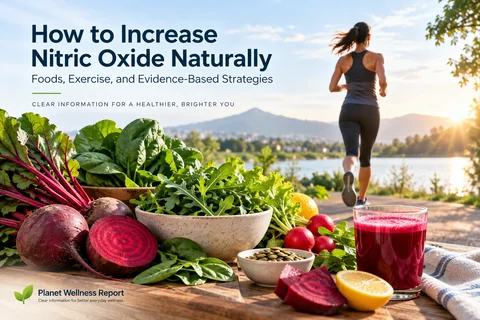
How to Increase Nitric Oxide Naturally: Foods, Exercise, and Evidence-Based Strategies
Food and exercise come first when supporting the body's nitric oxide pathways, and oral bacteria also play an important role. Beetroot and L-citrulline may be useful in specific contexts, but claims about boosting nitric oxide deserve cautious interpretation.
13 min read
Evidence
Sources
- D. D. Thomas, X. Liu, S. P. Kantrow, J. R. Lancaster Jr.. The biological lifetime of nitric oxide: implications for the perivascular dynamics of NO and O2 — Proceedings of the National Academy of Sciences of the United States of America (Jan 2, 2001) · DOI
- Satnam Lidder, Andrew J. Webb. Vascular effects of dietary nitrate (as found in green leafy vegetables and beetroot) via the nitrate-nitrite-nitric oxide pathway — British Journal of Clinical Pharmacology (Mar 1, 2013) · DOI
- Andrew M. Jones, Anni Vanhatalo, Douglas R. Seals, Matthew J. Rossman, Barbora Piknova, Kristin L. Jonvik. Dietary Nitrate and Nitric Oxide Metabolism: Mouth, Circulation, Skeletal Muscle, and Exercise Performance — Medicine & Science in Sports & Exercise (Feb 1, 2021) · DOI