
ARTICLE
Melatonin Side Effects: What to Know Before Taking It
Melatonin is often viewed as a simple sleep aid, but side effects, timing, medication interactions, and individual health factors can influence how it affects you.
By Planet Wellness Report · Sep 24, 2026 · 13 min read
Editorial review and publication: Felipe Lopes, Publisher & Editor. This is an editorial review, not a medical review.
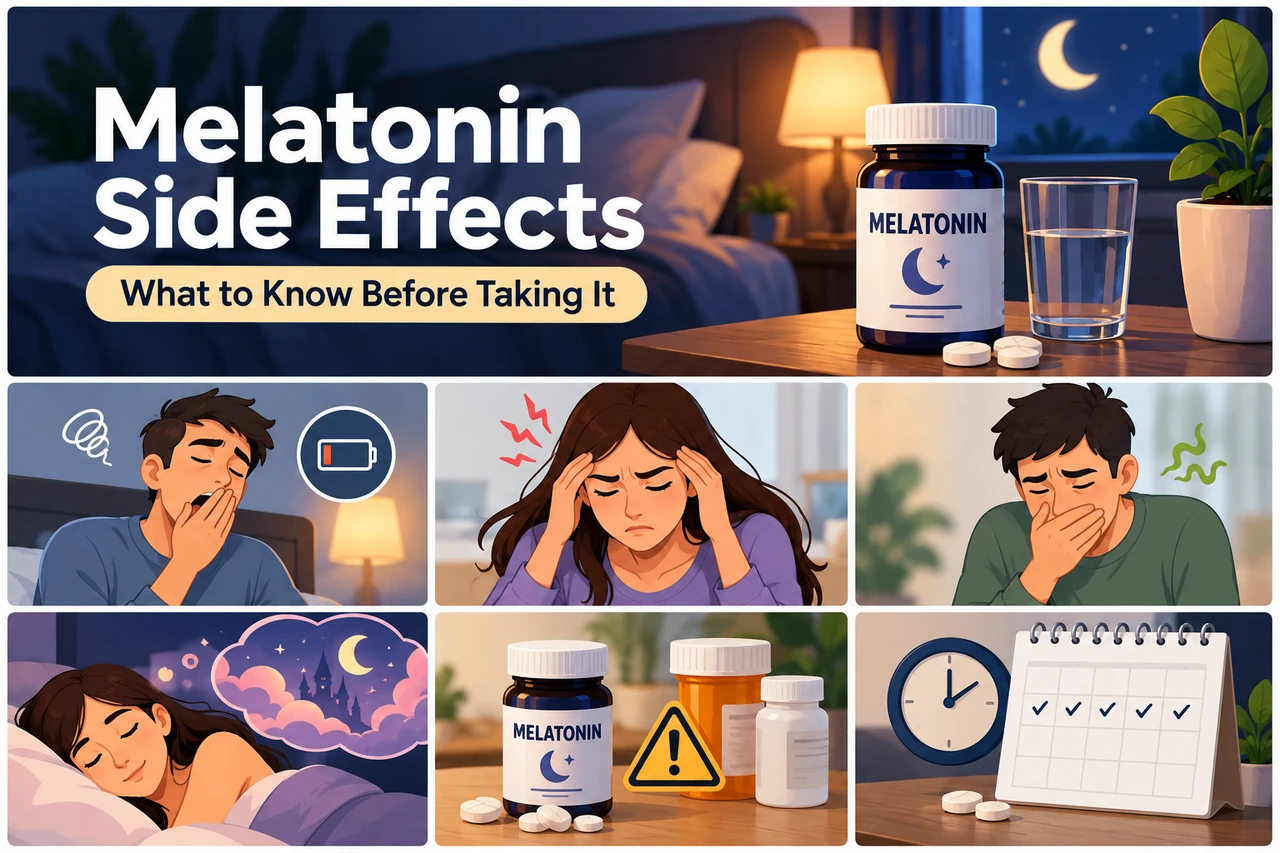
Melatonin Side Effects: The Short Answer
Melatonin appears to have a generally favorable short-term safety profile for many adults, but that does not mean it is side-effect free. Headache, dizziness, nausea, and sleepiness are among the mild effects reported in clinical research and summarized by the National Center for Complementary and Integrative Health.
Most reported adverse effects in controlled studies have been relatively minor and short-lived. However, responses can vary, and factors such as dose, timing, age, medications, health conditions, and the actual amount of melatonin contained in a supplement may influence the experience.
There is also an important distinction between short-term tolerability and long-term safety. Melatonin has been studied extensively, but high-quality evidence from long-duration randomized trials remains limited, so questions about regular use over many months or years are not fully resolved.
What Melatonin Actually Does
Melatonin is a hormone naturally produced by the body, with secretion increasing in response to darkness. One of its major roles is helping coordinate circadian rhythms, including the timing of the sleep-wake cycle.
That makes melatonin different from a conventional sedative. It can influence biological timing as well as sleep-related processes, which is one reason when it is taken can matter as much as the simple fact that it is taken.
A 2024 systematic review and dose-response meta-analysis found that both dose and administration timing can influence measured sleep outcomes. That does not establish one ideal schedule for every person, but it reinforces that melatonin should not be thought of as a supplement whose effects are independent of timing.

Common Melatonin Side Effects
Clinical research and government health guidance most consistently identify a relatively small group of short-term side effects. These do not occur in everyone, and their frequency and intensity can differ substantially between individuals.
Daytime sleepiness
Sleepiness or reduced alertness can carry into the following day in some people. This matters most when alertness is important for driving, operating equipment, working, or other safety-sensitive activities.
Older adults may be particularly susceptible to prolonged effects because melatonin can remain active longer in older people, according to NCCIH guidance.
Headache
Headache is among the mild adverse effects reported in short-term studies. A headache after taking melatonin does not necessarily prove that melatonin caused it, but a repeated pattern after supplementation deserves attention.
Dizziness
Dizziness has also been reported. Someone who feels lightheaded or unsteady after taking melatonin should be cautious with activities where impaired balance or reaction time could create a safety risk.
Nausea
Nausea is another commonly listed mild side effect. Gastrointestinal symptoms have multiple possible causes, so persistent or severe symptoms should not automatically be attributed to a supplement without considering other explanations.
Can Melatonin Make You Groggy the Next Day?
Yes. Next-day sleepiness or grogginess is a plausible and recognized effect of melatonin. The likelihood may depend on factors including the amount taken, the timing of the dose, individual metabolism, age, sleep duration, and other medications or substances.
Taking more melatonin does not automatically produce better sleep. Because melatonin interacts with circadian timing, simply increasing the amount can be a poor substitute for understanding why sleep is difficult in the first place.
If morning grogginess repeatedly follows melatonin use, it is worth reconsidering the supplement rather than treating the effect as something that must simply be tolerated.
Can Melatonin Cause Vivid Dreams or Nightmares?
Changes in dreams are frequently discussed by people who use melatonin, but they are not as consistently characterized in controlled safety research as effects such as sleepiness, headache, dizziness, and nausea.
Dream recall can also be influenced by sleep timing, awakenings during the night, stress, medications, and changes in sleep architecture. For that reason, a vivid dream after taking melatonin does not by itself establish that the supplement was the cause.
Why Timing Matters
Melatonin functions partly as a biological timing signal. Taking it at different points relative to the body's internal clock can produce different circadian effects.
This is particularly clear in jet lag. CDC guidance emphasizes timed melatonin because taking it at the wrong biological time can move circadian timing in an unintended direction rather than simply making someone sleepy.
The same principle helps explain why advice based only on taking melatonin a fixed number of minutes before bed can be overly simplistic. The reason for using melatonin and the person's circadian timing both matter.
Does the Dose Affect Side Effects?
Dose can influence how the body responds, but the relationship is not as simple as assuming that more is better or that one dose is appropriate for everyone.
Research examining melatonin for sleep has found dose- and timing-dependent differences in sleep outcomes, while safety reviews have also identified dose and timing as factors that may influence adverse effects.
Clinical study averages should not be treated as personalized dosing instructions. Someone considering melatonin should follow product directions and discuss appropriate use with a healthcare professional when medical conditions, medications, persistent sleep problems, or other risk factors are involved.
Melatonin and Medication Interactions
Melatonin is biologically active and can interact with medications. Being sold as a dietary supplement in the United States does not mean that it is automatically compatible with every prescription or over-the-counter drug.
NCCIH specifically advises people taking medications to consult a healthcare provider before using melatonin and highlights the need for medical supervision in people with epilepsy and those taking blood-thinning medications.
A systematic review of melatonin safety also identified potential interactions as an area requiring additional research, including possible effects involving cardiovascular medications and physiological systems influenced by melatonin.
Rather than relying on a short online list of interactions, anyone who regularly takes medication should check melatonin against their complete medication and health history with a qualified healthcare professional or pharmacist.
Who Should Be More Cautious With Melatonin?
Some groups warrant additional caution because safety information is limited or because individual factors can change the way melatonin is handled.
Pregnant or breastfeeding people should discuss melatonin with a healthcare professional because research on safety during pregnancy and breastfeeding is limited.
Older adults should also be cautious because melatonin may remain active longer and increase the possibility of daytime drowsiness. NCCIH additionally notes guidance recommending against melatonin use in people with dementia.
People with epilepsy, those using blood thinners, and anyone taking regular medications should seek individualized guidance rather than assuming that melatonin is free of meaningful interactions.
Is It Safe to Take Melatonin Every Night?
Short-term use appears to be safe for many people, but that answer cannot simply be extended to indefinite nightly use.
A review focused on prospective studies lasting at least six months found that reported possible adverse events were generally uncommon and few clinically significant events were described. However, the researchers also emphasized the shortage of high-quality, long-term, double-blind randomized placebo-controlled trials.
In practical terms, the absence of a strong long-term harm signal is not the same as proof that nightly use for years is risk-free.
What Do We Know About Long-Term Melatonin Side Effects?
Long-term safety is one of the areas where uncertainty remains most important. Existing studies provide some reassurance, but the evidence base is substantially thinner than the amount of melatonin use in the general population might suggest.
Potential concerns involving hormonal, metabolic, cardiovascular, neurological, or medication-related effects have been examined, but current evidence does not justify assuming that every theoretical concern represents an established long-term risk.
The most accurate conclusion is that long-term melatonin use has not produced a large, consistent signal of serious adverse events in the available prospective literature, while the quality and quantity of long-term evidence remain insufficient for strong reassurance about years of continuous use.
Melatonin Is Not Always Exactly What the Label Says
Another safety consideration in the United States is product quality. Melatonin is regulated as a dietary supplement rather than as a prescription or over-the-counter drug, and supplement contents may not always match the amount shown on the label.
NCCIH cites research finding substantial differences between labeled and measured amounts in some melatonin products. This matters because an unexpectedly high amount could change both the intended effect and the likelihood of next-day symptoms.
This variability also makes it harder to compare one person's experience with another's based only on the number printed on a supplement label.
Is Melatonin a Good Treatment for Chronic Insomnia?
Melatonin should not automatically be treated as a general solution for chronic insomnia.
The American Academy of Sleep Medicine's pharmacologic guideline issued a weak recommendation that clinicians not use melatonin for sleep-onset or sleep-maintenance insomnia in adults, based on the evidence available for chronic insomnia.
That recommendation does not mean melatonin has no legitimate uses. Its role can be different in circadian timing problems and jet lag. It does mean that persistent insomnia deserves a broader evaluation rather than escalating supplement use indefinitely.
When to Stop and Get Medical Advice
Mild symptoms that repeatedly appear after taking melatonin are a reason to reconsider its use. More significant or persistent symptoms deserve medical attention rather than repeated self-experimentation.
Professional guidance is especially appropriate when sleep problems persist, when daytime sleepiness affects safety or daily functioning, when other medications are involved, during pregnancy or breastfeeding, or when an existing medical condition could change the risk-benefit balance.
Urgent or severe symptoms should be evaluated promptly rather than assumed to be a routine supplement side effect.
How to Think About Melatonin More Safely
A useful starting point is to identify the problem being addressed. Difficulty falling asleep because of an inconsistent schedule, jet lag, a circadian timing problem, chronic insomnia, and insufficient sleep are not interchangeable conditions.
Melatonin may make more sense in some timing-related situations than in others. At the same time, basic sleep habits such as maintaining a consistent schedule, managing evening light exposure, and allowing adequate time for sleep remain important whether or not a supplement is used.
Using the smallest amount of intervention necessary, avoiding automatic dose escalation, checking for medication interactions, and paying attention to next-day functioning are more responsible strategies than assuming that an over-the-counter supplement is inherently harmless.
The Bottom Line
Melatonin has a generally favorable short-term safety profile for many adults, but it can cause side effects. Sleepiness, headache, dizziness, and nausea are among the better-documented short-term effects.
Timing, dose, age, health conditions, medications, and supplement quality can all affect how melatonin is experienced. Long-term studies have not identified a large pattern of serious adverse events, but the limited amount of high-quality long-duration research means long-term safety should not be considered completely settled.
Most importantly, melatonin is not simply a stronger-or-weaker sleeping pill. It is a hormone involved in circadian timing. Understanding why sleep is difficult is often more useful than simply taking more of it.
Was this article helpful?
Your anonymous response helps improve our editorial coverage.
Loading feedback options…
Share
Share this article
Selected references
Recommended products
 The Sleep Reset
A 14-night downloadable audio program combining guided relaxation, music, self-hypnosis techniques, and binaural beats to support a calmer bedtime routine.
View product details Yu Sleep
Liquid formula with owner-confirmed 0.9 mg melatonin per 2 mL serving and a 637 mg proprietary blend. The individual amounts of its seven blend ingredients are undisclosed.
View product details
More from Planet Wellness Report
Continue Reading

Sleep
How to Improve Sleep Quality Naturally: What to Change First
Trouble settling, repeated awakenings, unrefreshing sleep, or weekend shifts? Identify the pattern and choose what to address first.
6 min read
Sleep
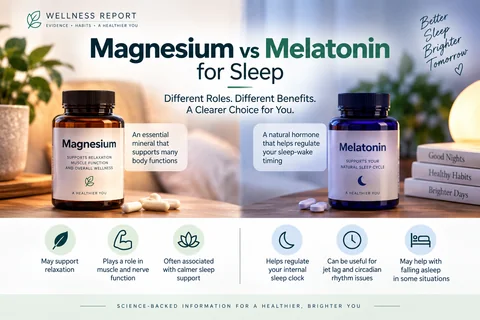
Magnesium vs Melatonin for Sleep: Which One Makes More Sense?
Magnesium and melatonin are often treated as interchangeable sleep supplements, but they play very different biological roles. Compare their evidence, potential uses, limitations, and safety.
13 min read

Sleep
Yu Sleep Review: A Known Melatonin Dose Inside an Undisclosed Blend
Yu Sleep’s owner-confirmed formula provides 0.9 mg melatonin in a 2 mL serving, plus a 637 mg blend whose seven ingredient amounts are hidden. Its liquid format is a preference feature; the disclosure cannot establish how much magnesium, theanine, apigenin, GABA or other blend constituents a serving supplies.
10 min read
Evidence
Sources
- Hope M. Foley, Amie E. Steel. Adverse events associated with oral administration of melatonin: A critical systematic review of clinical evidence — Complementary Therapies in Medicine (Feb 1, 2019) · DOI
- Melatonin: What You Need To Know — National Center for Complementary and Integrative Health (NCCIH), National Institutes of Health
- Frank M. C. Besag, Michael J. Vasey. Adverse events in long-term studies of exogenous melatonin — Expert Opinion on Drug Safety (Feb 1, 2023) · DOI
- Francy Cruz-Sanabria, Simone Bruno, Alessio Crippa, Paolo Frumento, Marco Scarselli, Debra J. Skene, Ugo Faraguna. Optimizing the Time and Dose of Melatonin as a Sleep-Promoting Drug: A Systematic Review of Randomized Controlled Trials and Dose-Response Meta-Analysis — Journal of Pineal Research (Aug 1, 2024) · DOI
- Michael J. Sateia, Daniel J. Buysse, Andrew D. Krystal, David N. Neubauer, Jonathan L. Heald. Clinical Practice Guideline for the Pharmacologic Treatment of Chronic Insomnia in Adults: An American Academy of Sleep Medicine Clinical Practice Guideline — Journal of Clinical Sleep Medicine / American Academy of Sleep Medicine (Feb 15, 2017) · DOI
- Jet Lag Disorder — Centers for Disease Control and Prevention (CDC) Yellow Book