
ARTICLE
Iron and Fatigue: When Low Iron Matters and Why Symptoms Are Not Enough
Understanding iron deficiency with and without anemia, the evidence on fatigue, and the limits of symptom-based guesses.
By Planet Wellness Report · Oct 7, 2026 · 6 min read
Editorial review and publication: Felipe Lopes, Publisher & Editor. This is an editorial review, not a medical review.

Low iron can contribute to fatigue, and iron deficiency does not always mean that anemia is already present. But feeling tired cannot tell you whether your iron stores are low, whether you have anemia, or whether iron is responsible at all. The useful distinction is between evidence of deficiency and a symptom that has many possible explanations.
Why iron matters for oxygen transport and energy
Iron is part of hemoglobin, the protein in red blood cells that carries oxygen from the lungs to tissues. It also contributes to myoglobin in muscle and to normal cellular function. Iron-dependent processes in mitochondria help cells produce usable energy. These roles explain why a shortage can matter; they do not mean that extra iron boosts energy when iron status is adequate.
Low iron stores, iron deficiency, and anemia are different concepts
Low iron stores refers to depletion of the body's reserve iron. This can be an early stage of iron deficiency. Iron deficiency is the broader problem of insufficient available iron for the body's needs; it can exist while hemoglobin remains within the normal range. Inflammation can also interfere with how stored iron becomes available.
Iron-deficiency anemia means that iron deficiency has resulted in a low hemoglobin concentration. It can impair oxygen delivery and contribute to fatigue. However, not all anemia is caused by iron deficiency, and a normal hemoglobin result does not automatically mean that iron stores are adequate. These distinctions require clinical interpretation rather than a checklist of symptoms.
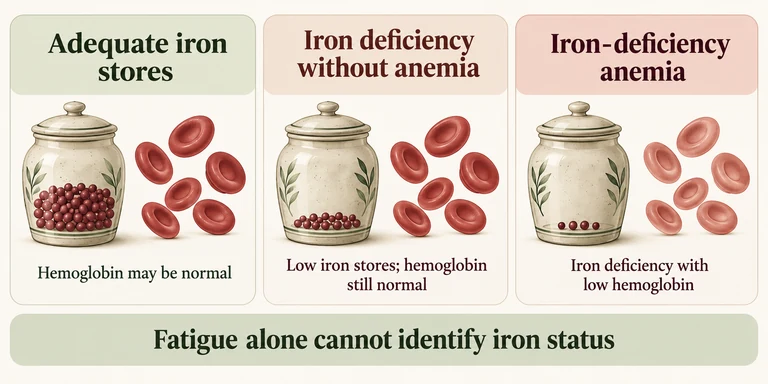
Can iron deficiency cause fatigue without anemia?
Research suggests that it can contribute in some people. Trials have tested whether treating documented iron deficiency improves fatigue even when hemoglobin is not low. That is a different question from whether everyone who feels tired should take iron.
What a systematic review found
A 2018 systematic review by Houston and colleagues included 18 randomized trials in iron-deficient adults without anemia. The fatigue analysis drew on four trials involving 714 participants and found less self-reported fatigue with iron than with control treatment. The pooled difference was modest. Objective physical-capacity measures, including maximal oxygen consumption and timed exercise tests, did not show a clear improvement.
All trials contributing to that fatigue analysis enrolled women and had an unclear overall risk of bias. The review therefore supports a possible symptom benefit in the populations studied, without establishing that all adults will respond or that feeling less fatigued means better exercise performance. It also does not establish an energy benefit in people with normal iron status.
A trial in menstruating women with low ferritin
In a 2012 trial, Vaucher and colleagues randomly assigned 198 menstruating women with unexplained fatigue, low ferritin by the study's entry criteria, and normal hemoglobin to oral iron or placebo for 12 weeks. Fatigue scores improved in both groups, with a greater average reduction in the iron group. There was no significant improvement in overall quality of life, depression, or anxiety.
The study was sponsored by an iron-product manufacturer. Its specific participants, eligibility criteria, and duration matter: it is not a dosing guide or proof that iron treats unexplained fatigue in men, older adults, pregnant people, or everyone with a borderline laboratory result.
What more recent reviews add
A 2025 systematic review and meta-analysis by Fiani and colleagues examined nonanemic children, adolescents, and menstruating adults. Randomized studies reported an improvement in fatigue; supplementation effects were absent when iron-deficient participants were excluded. The adult evidence was concentrated in menstruating adults, and the review also included studies without a placebo comparison. Its findings reinforce the importance of iron status without supporting a universal energy claim.
A 2022 update of a Cochrane review assessed intravenous iron in nonanemic iron-deficient adults. Five trials with 814 participants contributed fatigue data, with a benefit judged to have moderate certainty. The broader review included varied groups, such as people with heart failure, blood donors, and athletes; physical-function evidence was much less certain. Mild adverse events were more frequent with intravenous iron. These findings concern supervised treatment and cannot be transferred directly to an over-the-counter oral supplement.
Why fatigue alone cannot identify an iron problem
Fatigue can accompany insufficient sleep, stress, medication effects, infections, thyroid conditions, depression, and other health problems. Several contributors may overlap. Iron deficiency may be one part of the explanation, or it may not be present. For the broader differential, see our guide to feeling tired even after sleeping.
Likewise, fatigue blamed on nutrition does not identify which nutrient, if any, is lacking. Our article on possible signs of inadequate protein intake explains that same limitation in a different nutritional context. A symptom shared by several conditions cannot distinguish them.
The trials above studied selected populations, often with evidence of low iron. They do not justify assuming that iron supplementation will increase energy when iron status is normal. Improvement after starting a supplement is not a reliable diagnostic test: expectations, other changes, and ordinary symptom variation can affect how someone feels.
Ferritin and hemoglobin need clinical context
Ferritin is commonly used to assess iron stores, while hemoglobin helps assess anemia. A clinician may consider them together with a complete blood count, transferrin saturation, medical history, and evidence of inflammation. Ferritin can rise during inflammation, so a result within the laboratory range does not always rule out deficiency. Conversely, a low hemoglobin result alone cannot establish iron deficiency as its cause.
The British Society of Gastroenterology guideline emphasizes confirming deficiency and investigating its cause when managing iron-deficiency anemia. Study entry thresholds and online descriptions of an 'ideal ferritin' are not interchangeable with an individual diagnosis. The appropriate interpretation depends on the person and the clinical setting; this article does not provide a number for readers to use as a self-treatment trigger.
Why finding the cause matters
Low intake, menstrual or gastrointestinal blood loss, and impaired absorption are among the possible reasons for iron deficiency. Frequent blood donation can also deplete stores. These are reasons to discuss the possibility with a healthcare professional, not evidence that a particular person has deficiency. Replacing iron without understanding an ongoing loss or absorption problem can leave the underlying issue unaddressed.
Do not use iron supplements as an energy experiment
Do not start iron supplements on your own simply because you feel fatigued. Excess iron can be harmful, particularly in people prone to iron overload. Supplements can cause nausea, constipation, and other gastrointestinal effects, and can interact with medications. Accidental ingestion can be dangerous for children; keep iron-containing products securely out of their reach.
If deficiency is confirmed, a clinician can decide whether replacement is appropriate, choose a formulation and route, and arrange follow-up. Intravenous iron and oral products have different uses and risks. Evidence for an iron preparation used under clinical supervision does not establish that every commercial 'energy' blend will improve fatigue.
What to discuss when fatigue persists
Seek assessment when fatigue is persistent, worsening, or interfering with daily life. Describe when it started, its effect on activity, your sleep pattern, diet, medications, menstrual bleeding if relevant, and any blood donations or digestive symptoms. These details help determine whether iron testing or another evaluation makes sense.
Iron-containing foods can be part of a balanced diet, but diet changes alone may not address a confirmed deficiency or its cause. For general habits outside this article's iron-specific focus, see evidence-based ways to support steadier daily energy. Those habits complement an assessment; they do not establish why fatigue is occurring.
The practical takeaway on iron and fatigue
Iron deficiency can contribute to fatigue with or without anemia, and selected trials support a benefit from treating deficiency. Fatigue alone cannot reveal iron status or predict a response. Keep the decision anchored in appropriate assessment, the cause of any deficiency, and follow-up rather than assuming that more iron means more energy.
Was this article helpful?
Your anonymous response helps improve our editorial coverage.
Loading feedback options…
Share
Share this article
More from Planet Wellness Report
Continue Reading

Energy
Why You Feel Tired Even After Sleeping: 9 Everyday Causes of Low Energy
Getting enough hours of sleep does not always mean waking refreshed. Learn nine possible contributors to low energy, what the evidence supports, and when persistent fatigue deserves medical evaluation.
11 min read

Energy
Why You Feel Tired After Eating—and What Actually Matters
Post-meal tiredness can reflect meal size, composition, afternoon timing, or poor sleep. Learn what to compare first and when a recurring pattern needs assessment.
10 min read

Energy
Vitamin D and Fatigue: When Low Levels Matter and What Supplementation Can Actually Do
Low vitamin D and fatigue can coexist. See what randomized trials show, why baseline status matters, and how guideline definitions and safety affect interpretation.
8 min read
Evidence
Sources
- NIH Office of Dietary Supplements. Iron — Health Professional Fact Sheet — NIH Office of Dietary Supplements (Sep 4, 2025)
- U.S. National Library of Medicine. Fatigue — MedlinePlus / U.S. National Library of Medicine
- Brett L Houston et al.. Efficacy of iron supplementation on fatigue and physical capacity in non-anaemic iron-deficient adults: a systematic review of randomised controlled trials — BMJ Open (Apr 5, 2018) · DOI
- Paul Vaucher; Pierre-Louis Druais; Sophie Waldvogel; Bernard Favrat. Effect of iron supplementation on fatigue in nonanemic menstruating women with low ferritin: a randomized controlled trial — CMAJ (Jul 9, 2012) · DOI
- Dimitri Fiani; Sana Chahine; Mira Zaboube; Marco Solmi; Jacquelyn M Powers; Chadi Calarge. Psychiatric and cognitive outcomes of iron supplementation in non-anemic children, adolescents, and menstruating adults: A meta-analysis and systematic review — Neuroscience & Biobehavioral Reviews (Sep 11, 2025) · DOI
- Cory Dugan; Katerina Cabolis; Lachlan F Miles; Toby Richards. Systematic review and meta-analysis of intravenous iron therapy for adults with non-anaemic iron deficiency: An abridged Cochrane review — Journal of Cachexia, Sarcopenia and Muscle (Nov 2, 2022) · DOI
- Jonathon Snook et al.. British Society of Gastroenterology guidelines for the management of iron deficiency anaemia in adults — Gut / British Society of Gastroenterology (Sep 8, 2021) · DOI